

You book the appointments, you run the showings, you send the follow-ups — and still, the closings don’t come at the rate they should. That gap between effort and results is one of the most frustrating places in real estate. The good news is that inconsistent closing rates are almost never about luck. They’re about process leaks you haven’t found yet. This guide breaks down exactly how to diagnose those leaks, build the right tool stack, sharpen your negotiation skills, and track measurable improvement so you can close more property deals with confidence and consistency.
Table of Contents
- Diagnosing your current sales process
- Essential tools and resources for consistent closings
- Mastering negotiation and client interaction
- Troubleshooting common closing mistakes
- Tracking progress and verifying results
- Why most agents struggle with closing — and what actually creates lasting improvement
- Ready to close more deals? See the top tools and solutions
- Frequently asked questions
Key Takeaways
| Point | Details |
|---|---|
| Diagnose sales funnel leaks | Pinpoint which stage from lead to close needs the most improvement to boost overall deal volume. |
| Leverage the right tools | Using effective CRMs and automation platforms ensures consistent follow-up and fewer lost deals. |
| Practice negotiation often | Sharpen skills through repeated role-play and real conversation debriefs, not just seminars. |
| Troubleshoot and adjust | Use checklists and quick reviews to spot and fix avoidable errors before they cost you a closing. |
| Track and celebrate wins | Regularly measure results to reinforce good habits and keep improving your closing rates over time. |
Diagnosing your current sales process
Now that you know what this guide aims to deliver, let’s start by pinpointing exactly where your closings are slipping.
Most agents who plateau aren’t losing deals at the negotiation table. They’re losing them two or three stages earlier. This is the core idea behind conversion math: tracking what percentage of contacts move from one stage to the next. When you optimize the sales funnel, you stop guessing and start fixing the right problems.
Here’s a simple breakdown of what a typical real estate sales funnel looks like, with sample conversion rates:
| Funnel Stage | Sample Conversion Rate | Healthy Benchmark |
|---|---|---|
| Leads generated | 100% (baseline) | N/A |
| Leads to appointments | 20% | 25%+ |
| Appointments to signed agreements | 40% | 50%+ |
| Signed agreements to closed deals | 65% | 75%+ |
| Overall lead-to-close rate | ~5% | 10%+ |
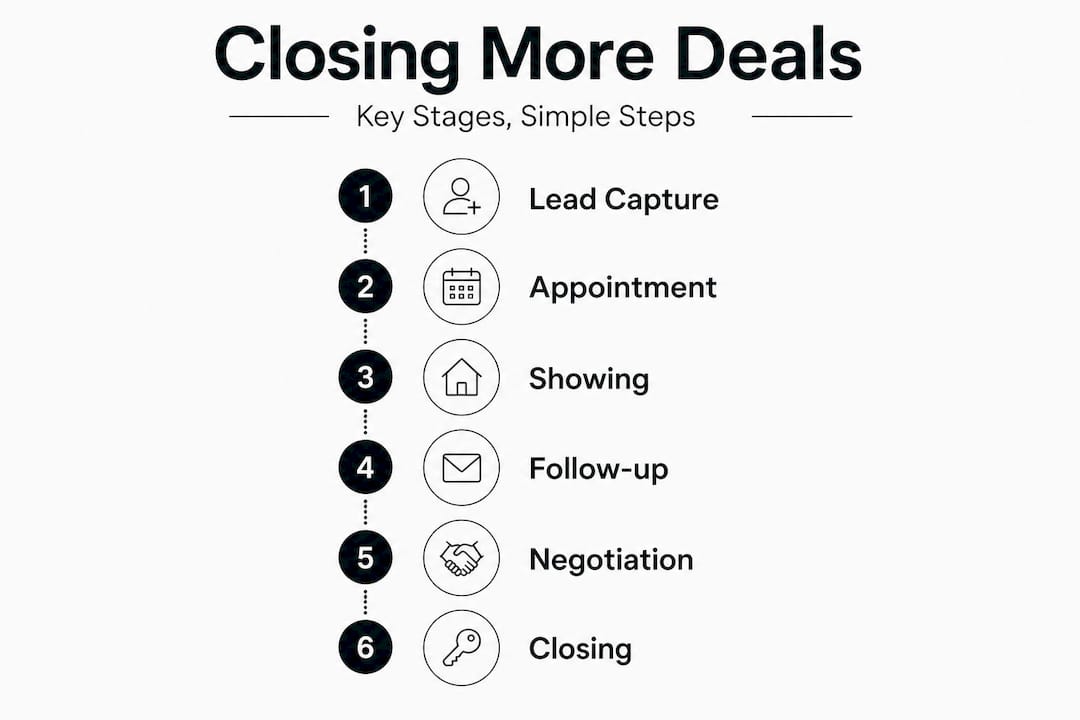
Understanding the real estate sales cycle as a sequence of conversion events — not one single moment of persuasion — changes everything about how you troubleshoot. As HousingWire notes, agents can increase deal volume by fixing conversion math upstream of the close, focusing on leads, appointments, signed agreements, and then the final close in that order.
Warning signs of weak links at each stage:
- Leads stage: You’re generating volume but appointments are rare. Your messaging or targeting is off.
- Appointment stage: You get meetings but few signed agreements. Your value proposition or qualifying process needs work.
- Agreement stage: Contracts are signed but deals fall apart before close. Documentation and communication gaps are the culprit.
- Close stage: Last-minute objections or financing issues derail deals. You need a stronger pre-close review process.
Pro Tip: Track your appointment-to-close ratio every single week. If that number drops even slightly over two to three consecutive weeks, something in your mid-funnel communication has shifted, and catching it early saves you months of lost revenue.
Essential tools and resources for consistent closings
Once you’ve assessed your process, equip yourself with the right tools and routines to support every stage.

The difference between an agent who closes 8 deals a month and one who closes 14 isn’t always skill. Often it’s infrastructure. The right tool stack removes friction, prevents follow-up failures, and keeps every prospect moving forward on schedule. Strong lead generation strategies only deliver results when the backend system can support proper follow-through.
Here’s a comparison of the essential tools top-performing agents use:
| Tool Category | Purpose | Example Features |
|---|---|---|
| CRM platform | Track every contact and deal stage | Pipeline view, task reminders, activity logs |
| Lead tracking software | Monitor lead source and behavior | Source attribution, engagement scoring |
| Calendar automation | Eliminate scheduling friction | Auto-booking links, buffer time settings |
| Email/SMS automation | Maintain follow-up at scale | Drip sequences, triggered reminders |
| Document management | Streamline agreements and signatures | E-signature, template storage |
How to set up your tool stack for maximum close rate:
- Start with your CRM. Every lead, contact, and deal must live here. No exceptions, no spreadsheets on the side.
- Connect your lead sources. Website forms, portal inquiries, and referrals should feed directly into your CRM automatically.
- Set up pipeline stages that mirror your actual sales funnel, so movement is tracked in real time.
- Build your follow-up sequences. Create automated reminders for 24-hour, 72-hour, and one-week touchpoints after appointments.
- Integrate your calendar tool. Reduce the back-and-forth of scheduling by sharing a booking link with prospects.
- Activate your document system. Make sure agreements go out within hours, not days, of a verbal commitment.
Learning how to properly nurture real estate leads through automated but personalized sequences is the single biggest time-to-close advantage you can build into your practice. The agents who lose deals at the agreement stage are usually the ones sending follow-ups three days late.
Pro Tip: Set automated reminders for every key follow-up within 48 hours of an appointment. Deals most often go cold not because the client lost interest, but because the next step wasn’t clear or timely.
Weekly reviews and morning pipeline check-ins are also non-negotiable habits. A 10-minute morning scan of your active pipeline tells you exactly who needs attention that day. A Friday review tells you what stalled during the week so you can re-engage on Monday with purpose.
Mastering negotiation and client interaction
With your workflows optimized, it’s time to boost the skills that drive deals over the finish line, especially negotiation.
Here’s what separates agents who consistently close from those who don’t: it’s not their scripts. It’s their reps. Repeated role-play with an accountability partner, where you practice uncomfortable scenarios until they feel natural, builds the reflexes you need when a real deal is on the line. One-off seminars give you ideas. Repeated practice builds skill.
Five exercises to sharpen your negotiation skills every week:
- Role-play one objection scenario daily. Pick a real objection you’ve heard recently, like a buyer pushing back on price or a seller overestimating property value, and practice your response out loud.
- Debrief every client call within five minutes. Write down what worked, what felt clunky, and what question you wish you’d asked differently.
- Review one successful closing from your past. Identify the two or three moments that made the difference and look for patterns across multiple deals.
- Practice silence. Many agents fill quiet moments with unnecessary talking. In negotiation, silence is a tool. Practice holding it for five seconds after making a point.
- Study the other side’s perspective. Before any negotiation, spend ten minutes listing every concern and priority the other party likely has. It changes your entire approach.
“Agents who role-play uncomfortable scenarios regularly and write a post-call debrief to capture what worked outperform peers who rely solely on formal training.” — Inman, 2026
Objection handling is where most deals are won or lost before the client ever signs. When you use data to respond — recent comps, days on market, neighborhood trends — you shift the conversation from opinion to evidence. Explore negotiation tips that go beyond surface-level scripts and build the kind of client trust that survives even a difficult market.
Pro Tip: Schedule a five-minute post-call reflection immediately after each client interaction. Not tomorrow, not after lunch. Do it while the details are fresh. This single habit compresses months of learning into weeks.
Revisiting your sales pitch strategies regularly ensures your approach stays relevant as market conditions and buyer psychology shift. What landed in 2024 may need updating today.
Troubleshooting common closing mistakes
Even experienced agents can lose deals due to simple, fixable missteps. Here’s how to troubleshoot those moments.
Deals don’t always fall apart for dramatic reasons. Usually it’s small failures that compound. Poor follow-through, unclear timelines, and missed signals from clients are the top culprits. Recognizing these patterns quickly is what separates reactive agents from proactive ones. Understanding the types of real estate leads you’re working with also matters, because a cold lead needs different handling than a referral who’s ready to act.
Top errors that cause deals to fall apart at the final stages:
- Weak or delayed documentation: If paperwork is slow or disorganized, clients start to doubt your competence.
- Inconsistent follow-up: Missing even one scheduled touchpoint can allow competing agents or cold feet to derail momentum.
- Unclear timelines: Clients who don’t know what happens next feel anxious and start second-guessing decisions.
- Missing pre-close red flags: Financing issues, title complications, or emotional hesitation that weren’t addressed early become deal-killers later.
- Overconfidence before signing: Treating a verbal agreement as a done deal before signatures leads to preventable surprises.
- Poor communication during the inspection phase: This stage generates the most anxiety for buyers, and silence from you at this point is damaging.
As HousingWire emphasizes, fixing conversion math means addressing failures at every stage, not just the obvious ones right before closing.
Pro Tip: Build a pre-closing checklist for every single transaction. Include documentation status, financing confirmation, inspection outcomes, client communication log, and next steps. Run through it three to five days before the scheduled close date, not the morning of.
If a deal starts to derail, act immediately. Call the client directly rather than emailing. Identify the core concern in the first two minutes of the conversation. Present two concrete options for moving forward, because choice reduces anxiety. Then document the conversation and set a follow-up within 24 hours.
Tracking progress and verifying results
With new strategies running, the final step is to ensure your results continually improve and make gains visible.
Tracking your conversion rates at each funnel stage gives you the data to make confident decisions. Without it, you’re improving by feel, which is slow and unreliable. A simple spreadsheet or your CRM dashboard is enough to start.
Steps for monthly and quarterly review:
- Pull your raw numbers for each funnel stage: leads generated, appointments booked, agreements signed, deals closed.
- Calculate conversion rates between each stage and compare to your benchmarks.
- Identify the one stage with the biggest gap from your target and focus your improvement efforts there for the next 30 days.
- Review your tool stack performance. Is your automation actually firing? Are reminders going out on time?
- Set one specific, numeric goal for the next period. Not “close more deals,” but “increase appointment-to-agreement rate from 40% to 50% in 60 days.”
- Celebrate improvements publicly, whether with your team, your accountability partner, or even just in your weekly journal. Momentum is motivating.
Here’s what progress can look like with consistent application of these strategies, based on a lead generation tool comparison across active agents:
| Metric | Before (Month 1) | After (Month 4) |
|---|---|---|
| Lead-to-appointment rate | 18% | 27% |
| Appointment-to-agreement rate | 38% | 52% |
| Agreement-to-close rate | 62% | 78% |
| Overall lead-to-close rate | 4.2% | 11% |
| Average days to close | 74 days | 51 days |
These numbers are achievable. The agents who hit them didn’t find a magic script. They fixed conversion math at every stage, built consistent routines, and measured their way to better performance.
Why most agents struggle with closing — and what actually creates lasting improvement
Let’s address a deeper truth about mastering closings in real estate, one that most training programs won’t tell you directly.
The industry sells tactics. New scripts, new objection handlers, new drip sequences. And agents buy them, try them for two weeks, and then return to the same patterns that were holding them back before. The real problem isn’t a lack of tactics. It’s a lack of process ownership.
The agents who close at the highest rates aren’t necessarily the most charismatic or the best talkers. They’re the ones who treat their business like a system, not a hustle. They run diagnostics. They review their numbers. They role-play uncomfortable scenarios until the responses are automatic. And they do it week after week, not just when they have a bad month.
Here’s the uncomfortable reality: most agents only analyze their process when things go wrong. The top performers do it regardless. That proactive stance is what creates a compounding advantage over time. Every debrief is a data point. Every review session is an investment in the next deal.
“Process over hacks. Accountability over inspiration. Repeated reps over one-time seminars. That’s the framework for agents who close at elite rates.”
The overlooked sales methods that drive the biggest improvements aren’t glamorous. They’re consistent. They’re boring, even. But they work precisely because most agents skip them. If you’re willing to embrace the diagnostic framework, the post-call debrief habit, and the weekly funnel review, you’re already ahead of the majority of agents in your market.
Ready to close more deals? See the top tools and solutions
Now that you have the frameworks, explore top-rated resources perfectly suited for closing your next wave of deals.
At ex.plo.re, we’ve built a platform specifically designed to amplify what you’re already doing. Whether you need smarter real estate prospecting tools to fill your pipeline or refined prospecting strategies to qualify leads faster, our technology and expert team are ready to support every stage of your sales cycle.

Our platform integrates the lead generation tools you need, the automation to keep follow-ups on track, and the expert guidance to help you close at a higher rate starting now. Stop leaving deals on the table and let us amplify your impact. Book a consult or explore our solutions today to see what a fully optimized sales process looks like in practice.
Frequently asked questions
What is the fastest way to increase property deal closings?
The fastest way is to identify leaks in your sales process and target the stage with the lowest conversion rate for improvement. As HousingWire advises, fixing conversion math upstream of the close delivers faster results than any closing script alone.
How often should I review my sales funnel metrics?
Review your sales funnel metrics weekly for quick adjustments and conduct a deeper analysis monthly or quarterly to spot trends. Consistent tracking is what separates agents who improve steadily from those who plateau.
What negotiation skills matter most in property deals?
Active listening, repeated scenario practice, and clear objection handling are the most critical skills for closing property deals. Inman research confirms that regular role-play and post-call debriefs build these skills faster than formal seminars.
What’s the best follow-up routine to prevent deals from falling through?
The best routine combines scheduled reminder check-ins, quick post-call notes, and automation for crucial deadlines so nothing slips. Using your CRM to automate key touchpoints ensures consistent follow-through even during your busiest weeks.
Recommended
- How to Close Luxury Yacht Sales: Proven Steps for Brokers
- Real Estate Sales Pitch Tips: Boost Closing Rates 37%
- How to Attract Local Real Estate Clients Effectively
- 6 Essential Negotiation Tips for Brokers to Close Big Deals
- Real Estate Low Budget Game | Beginner Real Estate Training From $0
- How to Buy Commercial Property in Singapore: A Step-by-Step Guide | Aesthetic Havens