

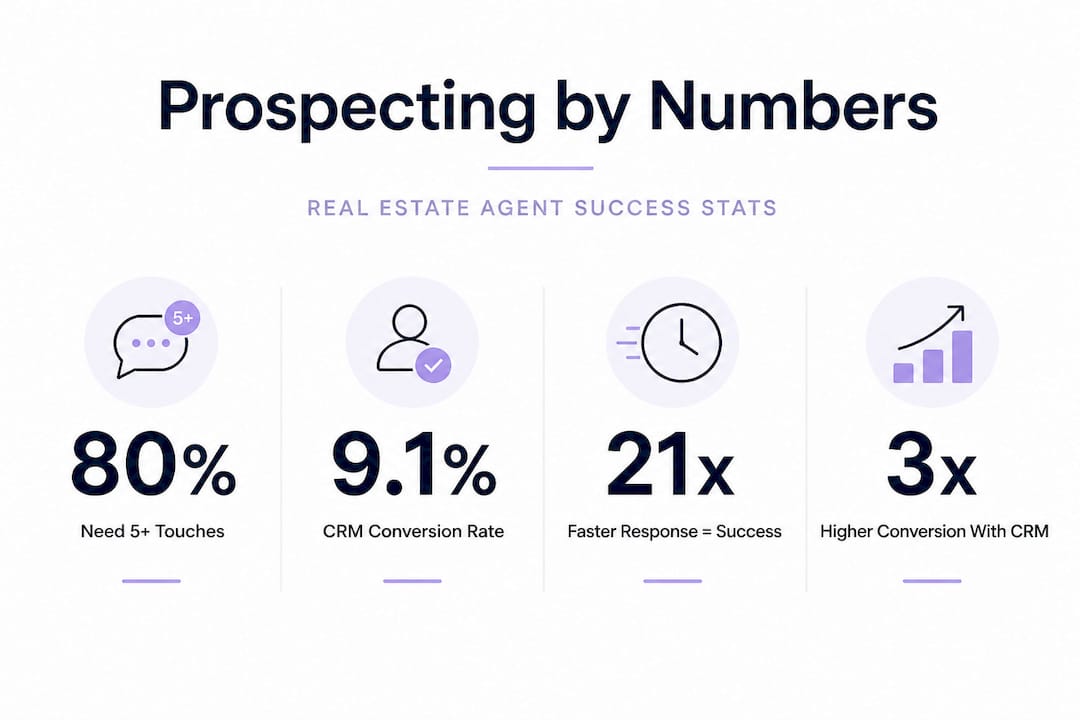
Most agents are leaving serious money on the table without realizing it. 80% of real estate deals require five or more touches before a prospect converts, yet the average agent gives up after just one or two attempts. That gap is not a market problem. It is a prospecting problem. If you are serious about becoming a top performer in your market, mastering prospecting is the single highest-leverage skill you can develop. This guide breaks down exactly what prospecting means, which strategies actually work, why follow-up is everything, and how the right tools turn effort into results.
Table of Contents
- Understanding prospecting in real estate
- Core prospecting strategies for real estate agents
- The critical role of follow-up in prospecting
- Tools and technology that amplify prospecting results
- Our take: What most agents miss about prospecting
- Find your next prospecting breakthrough
- Frequently asked questions
Key Takeaways
| Point | Details |
|---|---|
| Persistence wins deals | Most real estate deals close after several follow-ups—not after just one attempt. |
| Speed boosts conversion | Responding to leads within five minutes makes you far more likely to qualify and convert. |
| CRM grows your business | Agents using CRM tools enjoy dramatically higher conversion rates and more efficient prospecting. |
| Follow-up is crucial | Consistent and strategic follow-up separates top-performing agents from average ones. |
| Adopt new technology | Automation and smart tools can amplify your prospecting efforts and client acquisition results. |
Understanding prospecting in real estate
Prospecting in real estate is the systematic process of identifying, contacting, and building relationships with potential clients before they are ready to buy or sell. It is not cold calling strangers from a phone book. It is a disciplined, repeatable approach to filling your pipeline with qualified people who will eventually need your help.
Prospecting in real estate covers a wide range of activities, including:
- Door knocking in targeted neighborhoods to introduce yourself and gather market intelligence
- Phone outreach to expired listings, for-sale-by-owner sellers, and past clients
- Email and SMS campaigns to warm leads who have shown interest but not yet committed
- Social media engagement to build visibility and attract inbound inquiries
- Networking events and community involvement to generate referrals organically
- Open houses used strategically as lead capture opportunities, not just listing services
What separates top performers from average agents is not talent. It is consistency and system. Top agents follow top lead generation strategies that are repeatable and trackable. They prospect every single day, regardless of how busy their current pipeline looks.
“The agents who dominate their market are not necessarily the most charming or the most experienced. They are the most persistent. Prospecting is not a task you complete. It is a habit you build.”
The data backs this up. As mentioned, 80% of sales require five or more meaningful touches to close, yet most agents stop after one or two. That means the majority of your competition is abandoning leads that are still convertible. Your opportunity is right there.
Core prospecting strategies for real estate agents
With a clear understanding of prospecting, let’s explore the proven strategies top agents deploy to win more clients.
There are two broad categories of prospecting: outbound and inbound. Outbound means you initiate the contact. Inbound means prospects find you through content, reputation, or referrals. The most effective agents work both channels simultaneously.
Here is a step-by-step framework for building your prospecting system:
- Define your target market. Know exactly who you want to work with. Luxury buyers? First-time homeowners? Investors? Your messaging and channels depend on this clarity.
- Build a contact database. Start with your sphere of influence, past clients, and neighborhood farm lists. Every name is a potential deal or referral.
- Choose your primary outreach channels. Pick two or three channels you will work consistently rather than spreading yourself thin across ten.
- Create a follow-up cadence. Decide in advance how many touches you will make, at what intervals, and through which channels.
- Personalize every communication. Generic messages get ignored. Use the prospect’s name, reference their specific situation, and lead with their interests.
- Track every interaction. If it is not in your CRM, it did not happen. Tracking allows you to identify what is working and refine relentlessly.
One of the most powerful shifts you can make is investing in nurturing real estate leads with a long-term mindset. Most leads are not ready to act today. They are six, twelve, or even eighteen months away from a decision. The agents who stay top of mind during that window win the business.

Pro Tip: Use a simple “value touch” approach. Every other contact should deliver something genuinely useful: a neighborhood market update, a relevant article, or a referral to a trusted vendor. This builds trust faster than pitching on every call.
Personalization is a competitive edge most agents underuse. Reference something specific, whether it is the neighborhood they asked about, the timeline they mentioned, or the concern they raised. When you make prospects feel seen and understood, you stand apart from every agent who sends generic drip emails.
| Strategy | Outbound or Inbound | Best for | Effort level |
|---|---|---|---|
| Cold calling expired listings | Outbound | Motivated sellers | High |
| Social media content | Inbound | Brand building, younger buyers | Medium |
| Email nurture campaigns | Both | Warm leads, long-term pipeline | Low to medium |
| Door knocking | Outbound | Geographic farming | High |
| Referral network | Inbound | Quality, high-intent clients | Low (once built) |
| Open house lead capture | Both | Active buyers in market | Medium |
Understanding which prospecting methods for brokers deliver the best return for your specific niche is how you build a focused, efficient business. The agents who try to do everything usually master nothing.
To generate high-value leads, focus your energy on the channels where your ideal clients actually spend their time. If you specialize in luxury properties, LinkedIn and curated email newsletters will outperform door knocking in most cases.
The critical role of follow-up in prospecting
Successful prospecting depends on what you do after the first touch, making follow-up a non-negotiable skill.
Here is a hard truth: most agents fail at prospecting not because they lack leads but because they fail to follow up effectively. Speed is a major factor. Responding to a new inquiry in under five minutes makes you 21 times more likely to qualify that lead than if you wait 30 minutes or more. The window of maximum intent is narrow, and the agents who respond first win most of the time.
Follow-up timing benchmarks every agent should know:
| Response time | Impact on lead qualification |
|---|---|
| Under 5 minutes | 21x more likely to qualify |
| 5 to 30 minutes | Significantly reduced but still viable |
| 1 to 24 hours | Lead engagement drops sharply |
| Over 24 hours | Most leads have moved on or contacted a competitor |
The common mistakes agents make with follow-up include:
- Stopping too early. Giving up after one or two contacts when the data shows five or more are needed
- Being too salesy. Every follow-up feels like a pitch instead of a check-in or value add
- Lack of variety. Sending the same type of email every time instead of mixing calls, texts, and personalized messages
- No clear system. Relying on memory rather than a CRM to track who needs contact and when
- Failing to log interactions. Without records, follow-ups become repetitive and impersonal
The importance of follow-up cannot be overstated in a competitive market. Why follow-up matters is a topic every broker needs to internalize at a strategic level, not just a tactical one.
Consider improving follow-ups after every client interaction, including property walkthroughs, discovery calls, and open house conversations. A timely, thoughtful follow-up after a walkthrough can be the moment a prospect decides you are the agent they trust.
Building a structured approach means you master follow-up workflow as a system, not a series of ad hoc actions. Map out exactly what happens after a new lead comes in, after a showing, after a proposal, and after a quiet period. When you have that clarity, nothing falls through the cracks.
Statistic to remember: Agents who respond to leads within five minutes are 21 times more likely to qualify those leads. Every minute of delay is a percentage point of conversion you are giving away.
Tools and technology that amplify prospecting results
Having mastered follow-up, it is time to look at how technology can help elevate your prospecting game.
The right tools do not replace your effort. They multiply it. Agents who use CRM systems achieve conversion rates of 9.1%, which is roughly three times higher than agents who manage their pipeline manually or not at all. That gap is significant and reflects the compounding benefit of consistent, organized outreach.
A strong CRM built for real estate should offer:
- Automated follow-up sequences triggered by lead behavior or timeline milestones
- Contact segmentation so you can message buyers, sellers, past clients, and referral sources differently
- Activity tracking that shows every email opened, call made, and note logged
- Task reminders that ensure no lead goes untouched past your defined interval
- Pipeline visibility so you always know where each prospect stands and what action is needed next
- Integration with communication tools like email, SMS, and social media platforms
Understanding the role of CRM in real estate goes beyond contact management. The best CRM systems help you identify which leads are warming up based on engagement signals, so you can prioritize your time on prospects most likely to convert this week rather than treating every contact the same.
Automation is where things get powerful. You can set up email sequences that deliver value touches on a set schedule, text message alerts that trigger when a lead revisits your website, and calendar reminders for anniversary calls to past clients. All of this happens without you manually managing every step.
Pro Tip: Do not wait until your pipeline is overflowing to implement a CRM. Build the habit when your volume is manageable so the system becomes second nature before the busy season hits.
When choosing a technology stack, prioritize tools that reduce friction, not add complexity. If the platform takes three hours to learn every time you want to run a campaign, you will avoid using it. The best tool is the one you will actually use every day, consistently.
Our take: What most agents miss about prospecting
Most training programs focus on scripts. Get the opener right, nail the objection, close the appointment. And while having a clear, confident way to introduce yourself matters, the agents who consistently outperform their market are not winning because of their script. They are winning because of their system.
The biggest blind spot we see in real estate prospecting is agents underestimating the compounding effect of persistence. A lead you contact five times over three months is not just five times more likely to convert than a lead you contacted once. The compounding impact of repeated, relevant contact builds trust exponentially over time. Each touch that delivers value stacks on the previous one, creating a relationship where you become the automatic choice when the prospect is ready to move.
Here is the practical wisdom most guides leave out: the agents who build the strongest pipelines are not necessarily working harder. They are adapting faster. They test a message, track the response rate, adjust the timing, and iterate. They treat prospecting like a performance system, not a personality contest.
We also believe the speed obsession around follow-up is somewhat misunderstood. Yes, responding fast is critical for inbound leads. But for ongoing nurture, it is not about being fastest. It is about being most relevant. A message that arrives at the right time in a prospect’s decision process, even if it is the fourth or fifth touch, is worth infinitely more than three fast but generic messages sent in the first 24 hours.
When you focus on attracting local real estate clients, the agents who win long-term are those who match their approach to where the client actually is in their journey, not where the agent wants them to be. That takes patience, strategic thinking, and a system that supports both.
Find your next prospecting breakthrough
Ready to apply what you have learned? The difference between agents who understand prospecting and agents who dominate their market is execution, and execution is powered by the right tools working behind the scenes.

Explore prospecting client acquisition tools designed to help you build a pipeline that performs consistently, not just when the market is hot. If you want to evaluate your options side by side, our prospecting tool comparisons give you a clear picture of what each platform delivers and where each one excels. And if you need help deciding where to focus your lead generation budget, the lead generation tool comparison will cut through the noise and show you exactly what works for agents at your level. At ex.plo.re, we amplify the work you are already doing so your effort translates into results, not just activity.
Frequently asked questions
How many touches does it typically take to convert a real estate prospect?
80% of real estate deals require five or more touches before a prospect converts, which means agents who give up early are walking away from viable opportunities consistently.
How fast should agents respond to new leads?
Responding within five minutes makes you 21 times more likely to qualify the lead, so speed of response is one of the highest-impact habits you can build into your daily workflow.
What is the main benefit of using a CRM for prospecting?
Agents using a CRM system achieve conversion rates around 9.1%, which is roughly three times higher than those who do not use one, reflecting the power of organized, consistent follow-up.
What are the most common mistakes in prospecting?
Stopping after one or two contacts and failing to respond quickly to new inquiries are the two most frequent mistakes, and both directly cost agents deals that were still within reach according to conversion research.
Can automation help with real estate prospecting?
Yes. Automation tools, especially within a CRM, ensure consistent follow-up sequences and timely outreach, which is a key driver of the higher conversion rates that CRM users consistently achieve compared to agents managing leads manually.
Recommended
- Prospecting in Real Estate: Boosting Client Acquisition
- How to Generate Real Estate Leads for High-Value Clients
- Top Prospecting Methods for Brokers to Win Clients
- 6 Advanced Prospecting Tips for Agents to Win Luxury Clients
- Buyers Guide
- Elite Guide to Off-Market Real Estate: Secure Riviera Gems – Living on the Côte d’Azur