

Every real estate agent knows that sinking feeling when a promising client suddenly pulls back and says, “I need to think about it.” You’ve done the work, built the relationship, and shown the property, yet the deal stalls. Client objections are one of the most common reasons agents lose business they should have closed. The good news is that objections are not dead ends. They are signals. Once you understand what they mean and how to respond, you shift from feeling stuck to confidently guiding every conversation toward a close. This guide covers exactly that.
Table of Contents
- Understanding sales objections in real estate
- Types of client objections and what they reveal
- How to respond: Techniques for overcoming objections
- Comparing approaches: Scripting vs. adaptive objection handling
- Top tips for minimizing objections before they arise
- Why mastering objections is every agent’s competitive edge
- Take your client conversations and conversions further
- Frequently asked questions
Key Takeaways
| Point | Details |
|---|---|
| Objections are feedback | Sales objections reveal client concerns you can address to move the deal forward. |
| Know objection types | Recognizing categories like price, timing, and trust helps you tailor your responses. |
| Adapt your approach | Listening and adapting to objections is more effective than memorizing scripts. |
| Prevention is powerful | Proactively addressing common objections leads to smoother client experiences. |
| Growth opportunity | Mastering objections sets high-performing agents apart in the competitive real estate market. |
Understanding sales objections in real estate
A sales objection is any hesitation, concern, or pushback from a client that slows or stops the deal from moving forward. In real estate, these moments feel especially charged because the stakes are high on both sides. Buyers are committing to one of the largest financial decisions of their lives. Sellers are letting go of a property tied to memory and identity. Timing, emotion, and money all collide at once, which is why objections in real estate carry more weight than in almost any other industry.
Here is the mindset shift that changes everything: objections are feedback, not rejection. When a client says, “The price feels too high,” they are not walking away. They are telling you exactly what barrier stands between them and a signed contract. As HubSpot’s research on handling objections notes, “Objections are better understood as barriers to be removed than reasons to push harder.” That single reframe transforms how you show up in every client conversation.
Common real estate objections fall into four broad areas:
- Pricing: “This is over our budget” or “We can get something similar for less.”
- Timing: “We’re not ready to move yet” or “We want to wait and see what the market does.”
- Trust: “We’re still interviewing other agents” or “We’re not sure you know this neighborhood well enough.”
- Property features: “The layout doesn’t work for us” or “We need a bigger yard.”
Each one of these is a door, not a wall. Recognize them early, and you have the opportunity to open that door rather than watch it close.
Types of client objections and what they reveal
Knowing that objections exist is one thing. Knowing what they actually mean is where your competitive edge begins. Different objections require understanding, not just rebuttal. Each type signals a specific mindset, and reading that signal correctly determines your next move.
Here is a structured breakdown of the four main objection categories, what clients are really communicating, and how to interpret each one:
| Objection type | Common signal | What it reveals |
|---|---|---|
| Price | “It’s too expensive” | Client needs to see value, not just cost |
| Timing | “We’re not ready yet” | Fear of commitment or external pressure |
| Trust | “We’re still looking around” | Relationship has not been fully established |
| Property/Product | “It doesn’t feel right” | Needs have not been fully understood |
When you see pricing objections, your client is not saying no to the property. They are saying yes, but I need to justify this to myself. That is a value conversation, not a price negotiation. Timing objections often mask a fear of making the wrong decision, especially in a volatile market. Trust objections signal that your credibility and rapport have not yet reached the tipping point. Property objections mean you need to go back to discovery and ask better questions.
The cost of missing these signals is significant. Agents who treat objections as rejection stop following up, stop asking questions, and ultimately lose business that was genuinely within reach. The agents who are attracting local buyers consistently are the ones who see every objection as a clue and act on it immediately.
- Price objections are the most common and the most mishandled. Agents often respond defensively rather than with data.
- Timing objections require patience and a long-term nurture strategy, not pressure.
- Trust objections need to be resolved through social proof, testimonials, and demonstrated local expertise.
- Property objections are solved by better discovery questions before the showing, not after.
How to respond: Techniques for overcoming objections
Now that you recognize the main objection types, here is how to handle them with professional tact. The goal is not to “win” the argument. The goal is to remove the barrier that stands between your client and their decision. Treating objections as information leads to better outcomes than scripting aggressive rebuttals.
Use this five-step framework for every objection you encounter:
- Listen fully. Do not interrupt. Let the client complete their thought. Most agents jump in too fast and miss the real concern buried in the objection.
- Acknowledge their concern. Say something like, “That’s a completely valid concern, and I hear you.” This disarms defensiveness and builds trust instantly.
- Clarify the objection. Ask a follow-up question: “When you say the price feels high, are you comparing it to a specific property, or is it more about your overall budget?” Clarification prevents you from solving the wrong problem.
- Address the concern directly. Now bring in your data, your expertise, or your alternative solution. This is where improving your sales pitch pays off. Use market comparables, neighborhood trends, or financing options to reframe the conversation.
- Confirm resolution. Ask, “Does that address your concern, or is there something else you’d like to explore?” This closes the loop and signals that you are listening, not just talking.
Here is a quick example dialogue for a pricing objection:
Client: “I think the asking price is too high for this area.”
Agent: “I appreciate you sharing that. Can I ask, are you comparing it to a recent sale nearby, or does it feel high relative to your budget overall?”
Client: “We saw something similar two streets over for $40,000 less.”
Agent: “Great point. Let me pull up that listing so we can compare the specs side by side. In most cases, the difference comes down to condition, lot size, or recent upgrades. Let’s look at the numbers together.”

That exchange moves the conversation forward without pressure. It positions you as an advisor, not a salesperson. And it keeps the real estate sales funnel moving.
Pro Tip: Resist the urge to argue. Every time you argue with an objection, you create resistance. Instead, ask a question that invites your client to think through their concern out loud. Questions guide; arguments push back.
Comparing approaches: Scripting vs. adaptive objection handling
With multiple tools available, it is important to choose the best approach for you and your market. The two dominant methods agents use are the rebuttal script and the barrier-removal approach. Each has strengths, and each has real risks.
| Factor | Rebuttal script | Barrier-removal approach |
|---|---|---|
| Core method | Pre-written responses to counter objections | Asking questions to understand and remove barriers |
| Strength | Consistent, fast, easy to train | Builds trust, tailored to each client |
| Risk | Can feel robotic, may backfire with savvy buyers | Requires more skill and active listening |
| Best for | New agents building confidence | Experienced agents in complex markets |
| Client experience | Transactional | Consultative |
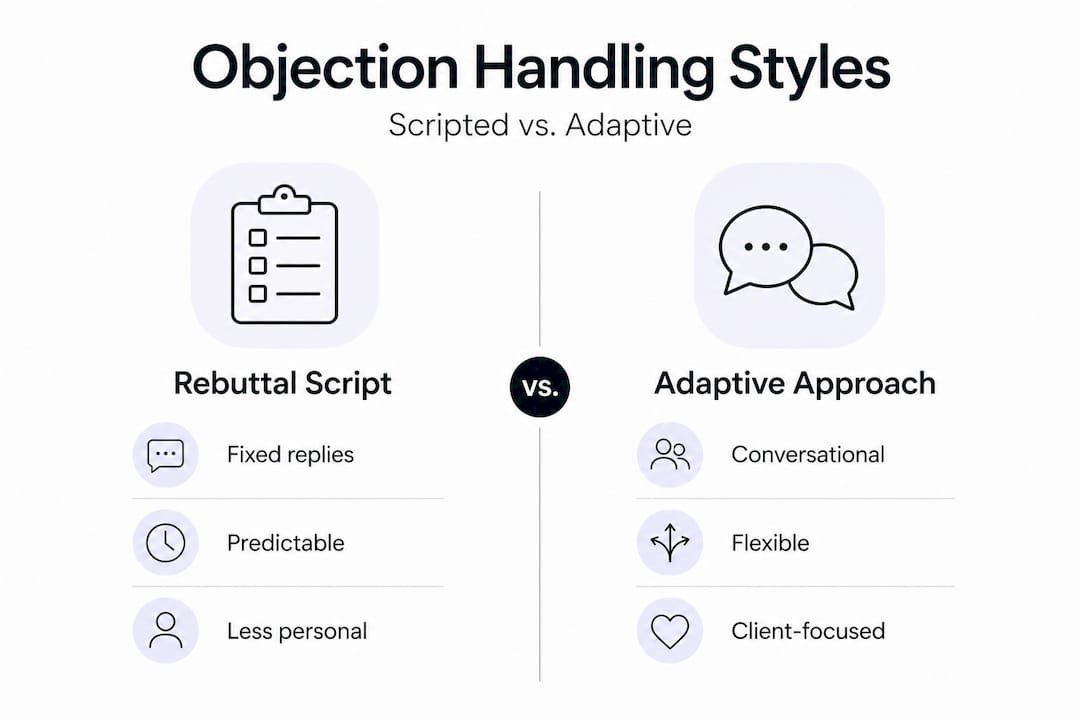
The industry trend is clear. Modern buyers, especially in the luxury and high-value segments, prefer conversational advisors over scripted salespeople. They have done their research. They know the market. A canned rebuttal feels dismissive to a well-informed client. As objection handling research confirms, “Not all methods are equally effective. Understanding the objection removes the barrier; pure scripts can backfire.”
This is especially relevant when you consider how cold calling fits into your outreach. Scripts have a place in cold prospecting, but the moment a client engages and raises a real concern, you need to shift into adaptive mode.
Pro Tip: Blend both methods. Use a script as a starting point to build confidence, then adapt in real time based on what your client actually says. The best agents are fluent in both modes and know exactly when to switch.
Top tips for minimizing objections before they arise
Beyond responding to objections, you can design your outreach to avoid many roadblocks in the first place. Objections are less frequent or intense when client barriers are anticipated and addressed early. This is a proactive strategy, and it separates top producers from average agents.
Here is what you can implement this week:
- Pre-qualify with purpose. Ask discovery questions early that surface concerns before they become objections. “What’s your biggest hesitation about moving right now?” is a powerful opener that hands you the objection map before the pitch even begins.
- Build rapport before you pitch. Clients who trust you are far less likely to object. Invest in the relationship during the first two touchpoints before you introduce any property or pricing conversation.
- Tailor your marketing to local barriers. If your market has a lot of first-time buyers nervous about interest rates, create content that directly addresses that fear. Localized, relevant content builds credibility before the first call.
- Follow up with high-value content. Send a neighborhood market report, a property comparison guide, or a local stats update after your first meeting. This positions you as an expert and preemptively answers the questions that become objections later. This approach is central to generating real estate leads that actually convert.
- Refine your prospecting methods. The quality of your lead source affects the quality of your conversations. Better-qualified prospects raise fewer objections because they are already further along in their decision-making.
The agents who minimize objections are not lucky. They are strategic. They build systems that surface concerns early, address them proactively, and enter every client conversation with a clear picture of what barriers they need to remove.
Why mastering objections is every agent’s competitive edge
Here is the uncomfortable truth most sales training skips: the majority of agents fear objections because they interpret them as personal rejection. That fear causes them to avoid the very conversations that would make them better. They rush past objections, offer discounts too quickly, or simply stop following up. And in doing so, they leave deals and relationships on the table.
The top agents we see building dominant local practices have a completely different relationship with objections. They seek them out. Not because they enjoy conflict, but because they understand that an objection is the clearest signal of genuine engagement you will ever receive. Silence is far more dangerous. A client who says nothing is a client who is already mentally gone. A client who objects is still in the room, still considering, still open.
There is a deeper strategic insight here too. Every objection you hear is market intelligence. When the same concern comes up repeatedly, it tells you something about your pitch, your positioning, or your target audience. Track your objections. Categorize them. Look for patterns. If pricing objections spike, maybe your marketing is attracting the wrong segment. If trust objections dominate, your credibility-building process needs work. This feedback loop, when used intentionally, becomes a powerful tool for refining your marketing strategies and your entire client experience.
The agents who treat objections as a feedback system rather than a threat are the ones who evolve fastest. They close more deals, build stronger reputations, and create the kind of client loyalty that generates referrals without asking. Mastering objections is not just a sales skill. It is a business-building discipline.
Take your client conversations and conversions further
You now have a clear framework for understanding, categorizing, and responding to client objections. But knowledge without the right tools only gets you so far.

At ex.plo.re, we give real estate agents the technology and expert support to turn every client conversation into a conversion opportunity. Whether you want to boost your closing rates with a sharper sales pitch, access the best lead generation tools for Realtors, or build a prospecting strategy that surfaces better-qualified clients from the start, our platform is built for exactly that. Stop leaving deals on the table. Let our team and technology amplify what you are already doing and help you close with confidence.
Frequently asked questions
What is a sales objection in real estate?
A sales objection is any concern or hesitation from a client that interrupts or slows down the real estate sales process. It signals a barrier that needs to be understood and removed, not argued against.
How should I respond when a client objects to pricing?
Listen fully, clarify their concern, and offer solutions or market data to address their specific objection. Avoid defending the price immediately; instead, ask what they are comparing it to so you can respond with relevant information.
Can I prevent objections before they come up?
Yes, you can minimize objections by addressing common concerns early and building rapport during your first interactions. Pre-qualifying questions and high-value follow-up content are your strongest preventive tools.
What’s the difference between a rebuttal script and a consultative approach?
A rebuttal script tries to counter objections automatically, while a consultative approach treats objections as clues to solve with custom solutions. Consultative handling builds more trust and works better with informed, high-value clients.
Are objections a bad sign in a client conversation?
Objections mean your client is paying attention and considering your offer, making them a valuable opportunity to engage. Objections signal real engagement and are far more promising than silence or disengagement.