

Most agents believe a strong first impression wins the client. It doesn’t. 80% of successful sales take five or more follow-ups, yet the majority of real estate professionals abandon the pursuit after a single attempt. That gap between effort and expectation is where deals go to die. If you’re investing in lead generation but not seeing the conversions to match, the problem almost certainly isn’t your leads. It’s your follow-up. This article lays out proven, practical strategies to turn your pipeline into a conversion engine, with real frameworks you can deploy starting today.
Table of Contents
- Why follow-up is the real engine of real estate sales
- How frequency and persistence shape conversion rates
- Multi-channel follow-up: what actually works
- Customizing follow-up for each lead’s stage in the pipeline
- Why most agents undervalue disciplined follow-up and how you can stand out
- Take your real estate follow-up and results further
- Frequently asked questions
Key Takeaways
| Point | Details |
|---|---|
| Follow-up drives conversions | Most real estate deals require multiple follow-ups to move prospects forward. |
| Persistence pays off | Only a small percentage of agents stick with follow-up long enough to win more sales. |
| Mix your message channels | Combining calls, texts, and emails increases your chances of connecting with leads. |
| Personalize your timing | Tailoring frequency and message to each client’s stage closes more deals. |
Why follow-up is the real engine of real estate sales
With that in mind, let’s see why ongoing follow-up is so valuable in this industry.
A fast response to a new inquiry is essential. Studies consistently show that responding within the first five minutes dramatically increases your odds of making contact. But speed alone only gets you to the starting line. The real race is what happens next.
“The agents who win aren’t always the fastest. They’re the most consistent. A structured follow-up cadence keeps you relevant long after the first conversation.”
Real estate operates on a longer decision cycle than most industries. A buyer might browse listings for three to six months before making a move. A seller might be “thinking about it” for a year. When you reach out once and then go silent, you’re essentially handing that client to whoever contacts them next. Your brand disappears. And in a referral-driven business like real estate, being forgotten is expensive.
This is why why follow-up matters at every stage of the pipeline. According to NAR guidance on converting online leads, effective follow-up is a core conversion mechanism. It starts with a quick initial response and then relies on a structured cadence to stay top-of-mind and convert leads into appointments and clients.
Here’s what operating without a follow-up plan actually costs you:
- Lost lead spend. Every dollar you put into Zillow, social ads, or SEO is wasted if you don’t convert the inquiry.
- Invisible brand. Clients work with agents they remember. No follow-up means no memory.
- Competitor advantage. If you don’t follow up, your competitor will.
- Lower referral volume. Poor engagement early means fewer satisfied clients later, which shrinks your referral pipeline.
Pro Tip: Map out every stage of your typical client journey, from first inquiry to closing. Note where communication typically drops off. That gap is your biggest opportunity.
How frequency and persistence shape conversion rates
Having seen the strategic importance of follow-up, it’s crucial to recognize how frequency and persistence impact your success.

Let’s talk about the numbers, because they’re striking. 80% of successful sales require five or more follow-ups, yet 44% of salespeople give up after a single attempt. In real estate, that pattern is painfully common. An agent sends one email after an open house, hears nothing back, and moves on. Meanwhile, the lead signs with someone else three weeks later.
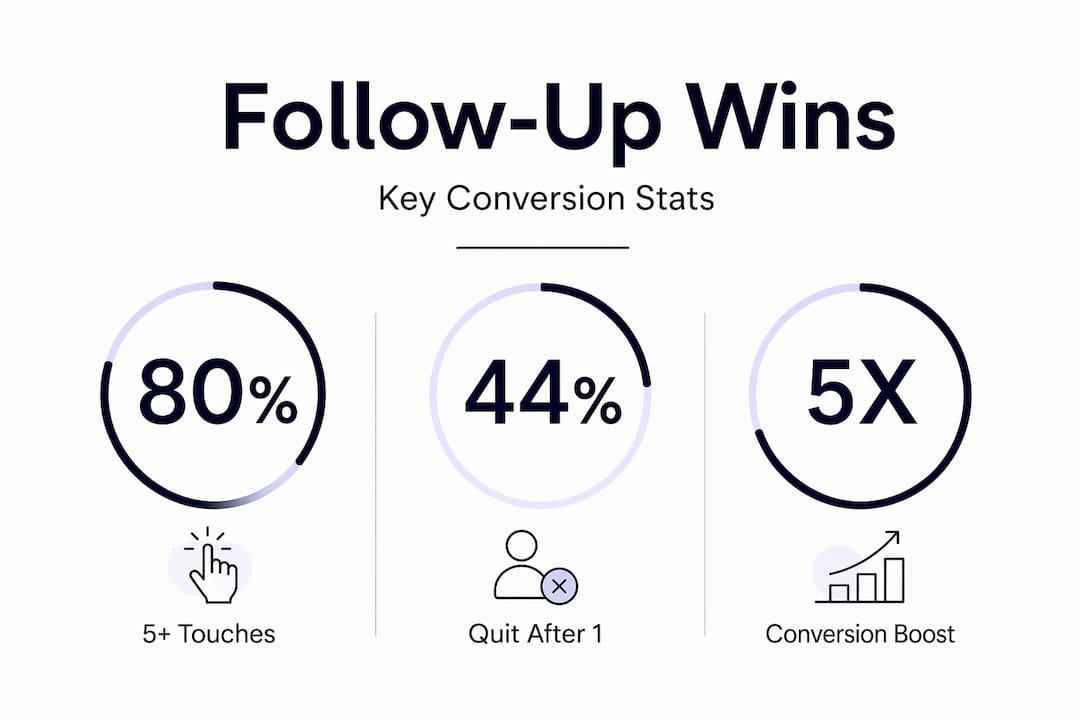
The persistence gap is your competitive advantage. Most agents won’t do what it takes. If you will, you win.
Here’s how the math plays out across a typical sales funnel:
| Follow-up attempt | % of deals still in play | % of agents still following up |
|---|---|---|
| 1st contact | 100% | 100% |
| 2nd follow-up | 72% | 56% |
| 3rd follow-up | 58% | 37% |
| 4th follow-up | 44% | 20% |
| 5th+ follow-up | 80% of all closed deals | Less than 10% |
The data tells a clear story: most of your deals are sitting in that fifth-contact zone, and almost no one is reaching them. That’s not discouraging. That’s an open field.
To build a follow-up workflow that generates consistent results, structure your touches across a deliberate timeline:
- Day 1: Immediate response within 5 minutes of inquiry, via phone call.
- Day 2: Text message checking in and offering to answer questions.
- Day 4: Email with a relevant listing, market insight, or neighborhood guide.
- Day 7: Second phone call, focused on their timeline and needs.
- Day 14: Value-add email with a market update or a recent comparable sale.
- Day 21: Personal text or voicemail. Keep it warm and low-pressure.
- Day 30+: Monthly market reports and check-ins until they’re ready to move.
This sequence isn’t exhausting. It’s systematic. And when you automate portions of it, the effort drops dramatically while your conversion rate climbs.
Multi-channel follow-up: what actually works
Now that you see the value in persistence, let’s zero in on how the best agents diversify their approach.
Not every client wants to talk on the phone. Some prefer a quick text. Others respond best to a well-crafted email with a clear next step. The agents who crack the code on follow-up aren’t just persistent. They’re adaptable. They match the medium to the message and to the person.
NAR guidance on converting online leads confirms that the mechanics which work in practice combine speed on inbound leads, a planned cadence across channels including calls, texts, and email, and stage-aware messaging that speaks to where the client is right now.
Here’s how to map your channels to your intent:
| Channel | Best use case | Tone | Frequency |
|---|---|---|---|
| Phone call | First contact, major updates, relationship building | Warm, conversational | 1 to 2x per week max |
| Text message | Quick reminders, scheduling, informal check-ins | Casual, brief | 2 to 3x per week max |
| Market data, listings, long-form value content | Professional, informative | 1 to 2x per week | |
| Video DM | Personal touch, property tours, re-engagement | Authentic, visual | Once per key stage |
The key insight here is that each channel carries a different emotional weight. A phone call signals importance and personal investment. A text feels casual and respectful of time. An email gives the client something to refer back to. When you layer these together intentionally, you create a communication experience that feels attentive without feeling overwhelming.
Pro Tip: When improving follow-ups after a property walkthrough, send a brief text within an hour asking for their honest reaction. Then follow up the next morning with a more detailed email summarizing the home’s highlights and any competing listings worth considering. This two-step approach feels natural and keeps momentum alive.
Avoiding channel fatigue is just as important as using multiple channels. Here’s what to watch out for:
- Never send the same message twice across different channels. It signals a lack of thought.
- Don’t follow up on all channels the same day. Space them out to avoid feeling aggressive.
- Watch for cues. If a client only ever responds to texts, lean into that.
- Give them an out. Occasionally ask if your outreach frequency is working for them. Most clients appreciate being asked.
Customizing follow-up for each lead’s stage in the pipeline
While variety in channels matters, effectiveness hinges on how well you match your message to the client’s mindset.
A cold lead and a hot lead require completely different conversations. Sending a “ready to make an offer?” email to someone who just signed up to browse listings is jarring and counterproductive. Sending a neighborhood guide to someone who already toured three homes and is ready to move is equally tone-deaf. Personalization isn’t a luxury. It’s the difference between a response and silence.
Cold leads are in research mode. They’re gathering information, not making decisions. Your follow-up for this group should be educational and low-pressure:
- Share market reports or neighborhood guides.
- Ask open-ended questions about their ideal timeline and priorities.
- Offer free resources like a first-time buyer checklist or a seller’s net sheet.
- Avoid hard CTAs like “schedule a showing” until you’ve built some rapport.
Warm leads are engaged but not committed. They’ve responded, asked questions, or toured properties. This is where you start introducing light urgency:
- Reference specific conversations or properties they showed interest in.
- Share relevant updates: a price drop on a listing they liked, a new property matching their criteria.
- Propose a low-commitment next step like a 15-minute call or a quick market review.
- Help them understand why use a real estate agent at this stage of their journey, especially if they’re hesitating.
Hot leads are ready to act. Your messaging here should be clear, fast, and decisive:
- Be specific about next steps and timelines.
- Remove friction: offer to handle scheduling, paperwork questions, or lender referrals.
- Create appropriate urgency based on real market conditions.
For lead nurturing strategies that move leads through the pipeline efficiently, focus on meeting clients where they are mentally, not where you need them to be commercially.
And then there’s ghosting. Every agent deals with it. A lead goes dark after a promising start. The instinct is often to either bombard them with messages or give up entirely. Neither works.
As NAR guidance on converting online leads notes, non-responsive leads need nudges with accurate market context and clear CTAs. Send a short, direct message that acknowledges their silence without making it awkward. Try something like: “Hey, just checking in. The market in [neighborhood] has shifted recently. Worth a quick conversation when you have a moment.” That’s a nudge, not pressure.
Why most agents undervalue disciplined follow-up and how you can stand out
Here’s the hard-won truth from inside the industry: follow-up is boring. It doesn’t feel like “winning.” There’s no adrenaline in sending a seventh email or leaving a third voicemail. But that unglamorous consistency is exactly what separates good agents from exceptional ones.
Most agents pour energy into lead generation because it feels productive. A new lead is exciting. A conversation that didn’t convert is something to move past. This psychology creates a blind spot that costs millions in potential commissions every year across the industry.
We’ve seen agents transform their business not by doubling their lead budget, but by simply committing to follow up on the leads they already had. One broker working in a competitive urban market increased her conversion rate by 34% over six months without adding a single new lead source. Her only change? She implemented a structured seven-touch follow-up sequence and held herself accountable to it. The deals were always there. She just hadn’t stayed in the game long enough to win them.
Quality over quantity is the principle that truly elevates top performers. A disciplined follow-up system applied to 50 quality leads outperforms a chaotic approach applied to 200. Buyers and sellers remember agents who show up at the right moment with the right information. They forget the agent who sent one generic email three months ago.
There’s also an emotional intelligence component that gets overlooked. Great follow-up isn’t just about the message. It’s about timing, tone, and genuine interest in the client’s situation. When your follow-up feels like a form letter, it gets deleted. When it feels like you actually remembered who this person is and what they care about, it gets a response.
Build nurturing leads for faster sales into your daily workflow, not as a task you dread, but as the highest-leverage activity in your business. Because that’s exactly what it is.
Take your real estate follow-up and results further
Ready to put this into practice and scale up your results?
Understanding the strategy is one thing. Executing it consistently, across dozens of active leads, while running showings and negotiations and client calls, is another challenge entirely. That’s where smart tools and streamlined systems make the difference.
At ex.plo.re, we build the infrastructure that lets you follow up with precision and confidence, without the manual overhead that burns agents out. From boosting client acquisition with sharper prospecting tools to comparing the right lead generation tool comparison for your market, and putting your outreach on autopilot with real estate automation, we give you the leverage to turn your follow-up discipline into a genuine growth engine. Let our technology and expert team amplify what you’re already doing well.
Frequently asked questions
How fast should I follow up with a real estate lead?
Aim to respond within minutes of receiving an inquiry. Quick initial response is one of the most critical factors in converting online leads, since your competitors are reaching out at the same time.
How many follow-up attempts should I make before giving up?
Plan for at least five touchpoints before considering a lead inactive. Five or more follow-ups account for 80% of successful sales, so persistence well beyond the first attempt is where most conversions actually happen.
What follow-up channel works best for real estate sales?
No single channel dominates. A planned cadence across channels combining calls, texts, and emails consistently outperforms any single-channel approach and gives you more ways to connect with different communication preferences.
How do I get non-responsive real estate leads to engage?
Send a short, specific message tied to a real market development and include a direct question. Nudges with clear CTAs are significantly more effective for re-engaging silent leads than general check-in messages that don’t give them a reason to respond.