

Yes, Advantage+ Catalog ads work for real estate, and they work hard, but only when your listing catalog syncs automatically and your tracking actually captures buyer behavior. These ads turn browsing signals into ready-made retargeting creative without you touching a design tool. Skip the catalog or the tracking setup, and you’re just burning budget on empty automation. Get both right, and speed to lead becomes your real advantage.
TL;DR:
- Successful Advantage+ Catalog ads require automatic catalog sync and tracking of buyer behavior to convert browsing signals into retargeted listings effectively.
- Proper setup includes building a detailed catalog, automating MLS/IDX feed updates, installing the Meta Pixel and Conversions API, and testing event accuracy before spending any money.
- Creative and feed hygiene are critical, with consistent high-quality images, real-time availability updates, and dynamic tokens in ad copy to maximize relevance.
- Targeting restrictions under the Housing Special Ad Category limit demographic and geographic targeting options, making behavior-based retargeting and creative self-selection essential.
- The biggest predictors of success are correct feed and tracking setup before ad spend, with campaign performance improving after 30 to 60 days of consistent operation.
Table of Contents
- How Facebook Dynamic Ads Work for Real Estate
- Setting Up Advantage+ Catalog Ads: A Step-by-Step Checklist
- Creative and Feed Best Practices That Actually Convert
- Targeting Restrictions Under Meta’s Housing Special Ad Category
- Measuring and Optimizing Dynamic Ad Performance
- How ex.plo.re Runs Advantage+ Catalog Campaigns
- What the Data Actually Tells Agents to Prioritize
- Get Advantage+ Catalog Ads Running Without the Guesswork
- Sources
- FAQ
How Facebook Dynamic Ads Work for Real Estate
Advantage+ Catalog ads (what most agents still call Facebook dynamic ads) pull listing data straight from your catalog and assemble the creative automatically, matching each ad to the person most likely to act on it. Meta’s own documentation on Advantage+ Catalog Ads for Real Estate confirms these ads are catalog-driven by design, not hand-built campaign by campaign.
Here’s the mechanism underneath the automation:
- A buyer views three condo listings on your site, then leaves without inquiring.
- Your Meta Pixel and Conversions API log that behavior as structured events (view, save, contact).
- Meta matches those events to catalog items and rebuilds an ad showing those exact three condos.
- The buyer sees your listings again on Facebook or Instagram within hours, not days.
That behavioral loop is why catalog ads sidestep a real problem in housing advertising: you can’t legally micro-target by demographic in this category, so relevance has to come from what someone actually did, not who Meta guesses they are. Used this way, catalog ads aren’t your top-of-funnel play. They’re the retargeting engine that catches warm traffic your other content already generated.
Setting Up Advantage+ Catalog Ads: A Step-by-Step Checklist
Getting this live correctly the first time saves weeks of troubleshooting later. Follow this order:
- Build your catalog in Commerce Manager. Every listing needs
listing_id,listing_name,price,url,images,availability, andproperty_typepopulated, matching the schema outlined in Google’s DynamicRealEstateAsset reference. - Automate your MLS/IDX feed sync. Sold and expired listings must drop out automatically, or you’re paying to advertise homes nobody can buy.
- Install the Meta Pixel and layer in Conversions API. CAPI recovers events that browser restrictions block, which keeps your optimization signal intact.
- Map listing IDs between your feed and remarketing tags, then test every event in Event Manager before you spend a dollar.
- Select Housing as your Special Ad Category and confirm your account policy settings before you publish.
Pro Tip: Run a 48-hour test with a $0 budget draft campaign first. If Event Manager shows events firing against the wrong listing IDs, you’ll catch a broken feed mapping before it costs you a single lead.
Creative and Feed Best Practices That Actually Convert
Automation only performs as well as the data feeding it. Feed hygiene and image discipline matter more here than in almost any other Meta ad format, because you’re not designing individual ads. You’re designing the rules Meta uses to build thousands of them.
On the creative side:
- Use a consistent hero shot as the first image in every listing (exterior, well-lit, no watermark clutter).
- Stick to a uniform aspect ratio across the catalog so ads don’t crop awkwardly between placements.
- Include at least four to six images per listing so Advantage+ has enough material to rotate.
On the feed side, price fields need proper ISO 4217 formatting, and availability status (for sale, pending, sold) has to update in near real time, a requirement the DynamicRealEstateAsset schema builds into its structure directly. Your ad copy should lean on dynamic tokens, headline patterns pulling listing_name, price, and bed/bath count straight from the feed, so every ad feels specific without you writing one line of individual copy.
One decision worth thinking through: full MLS inventory versus agent-only listings. Broader inventory gives Advantage+ more material to optimize against, but agent-only feeds keep every lead squarely yours. Practitioner data backs the retargeting logic here: dynamic retargeting of site visitors converts markedly better than static ads shown cold, because you’re re-serving property someone already showed interest in, not guessing at interest from scratch.
Targeting Restrictions Under Meta’s Housing Special Ad Category
Real estate ads fall under Meta’s Housing Special Ad Category, and that classification strips out targeting options most advertisers take for granted. Here’s what’s off the table:
- No age range targeting (you’re locked to broad delivery).
- No gender targeting (must remain set to all).
- No ZIP-code-level micro-targeting, and location radius has a required minimum.
- No lookalike audiences built from protected-class-adjacent data.
The 2026 Campaign Playbook from AdLibrary lays out these restrictions clearly. The logic behind them is straightforward: fair housing law doesn’t bend for ad delivery algorithms. This is exactly why catalog-driven, behavior-based retargeting matters so much in this category. It gets you relevance through what a person did, not who Meta thinks they are.
Compliant workarounds that still perform: message at the market level rather than the neighborhood level, layer your funnel so catalog ads only fire on warmed traffic, and let your creative do the audience self-selection (a $2 million waterfront listing doesn’t need demographic targeting to filter itself). Before you launch anything, confirm you’ve declared Housing in Ads Manager and preview delivery to check nothing silently reverted to a restricted setting. A helpful guide to the Special Ad Category checklist walks through the exact settings Meta checks during review.
Measuring and Optimizing Dynamic Ad Performance
Cost per lead is the vanity metric everyone watches. Cost per appointment and cost per closed deal are the numbers that actually tell you whether the campaign is working. Track all three, because a cheap lead that never books a showing isn’t cheap at all.
To get attribution right, you need offline events, appointments booked, showings held, deals closed, flowing back into Meta through Conversions API or a direct CRM integration. Without that loop, you’re optimizing toward form fills, not toward closings.
- Give the learning phase real time: practitioner benchmarks suggest $150–$300 per month as a realistic minimum spend floor before judging results.
- Refresh creative regularly. Stale ads fatigue fast once retargeting pools shrink.
- Run A/B tests on offer language and CTA phrasing, not just images.
- Audit feed quality weekly. A broken price field can quietly tank an entire ad set.
Pro Tip: Pair your catalog ads with pre-filled Instant Forms. It cuts friction dramatically, though you’ll want to tune the form fields so lead volume doesn’t outpace lead quality.
How ex.plo.re Runs Advantage+ Catalog Campaigns
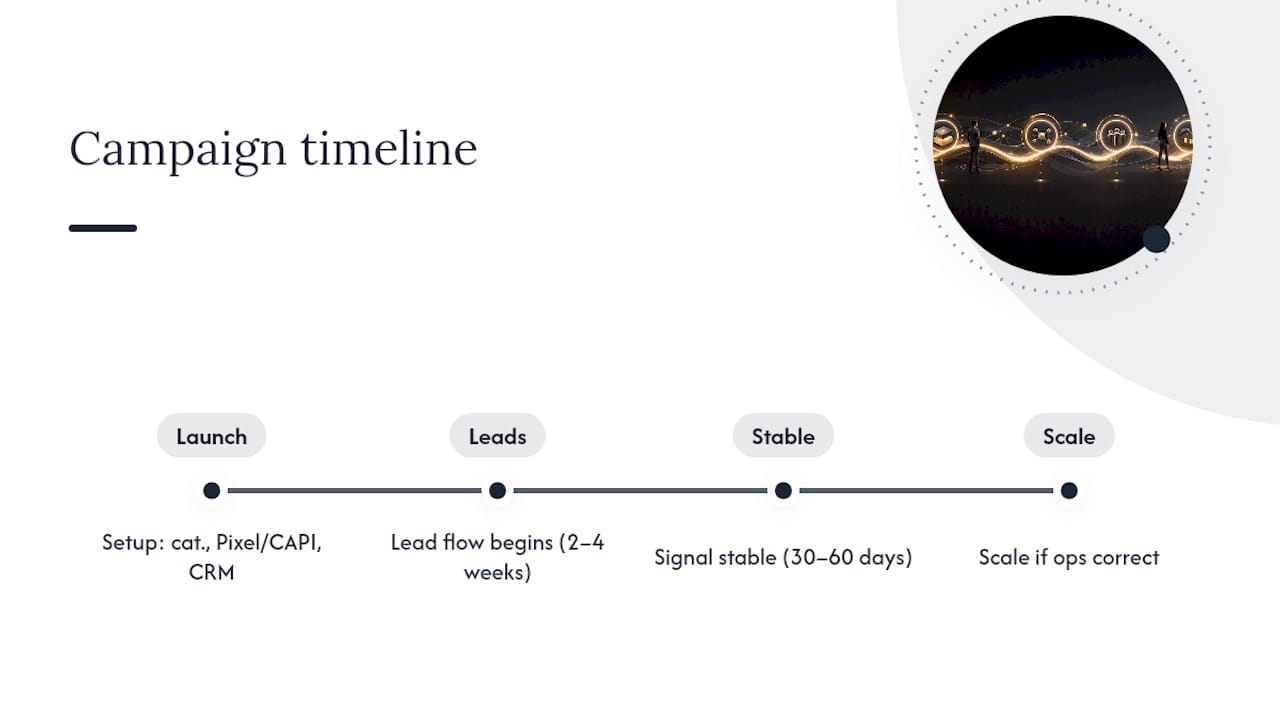
Running these campaigns well means treating the setup as infrastructure, not a one-time task. Plo’s implementation covers catalog management, Pixel and CAPI installation, ad build, and CRM mapping so leads land somewhere your team can act on them immediately.
Timelines follow a predictable pattern. Lead flow typically starts within two to four weeks of a clean launch, and signal stability, the point where Meta’s algorithm has enough data to optimize confidently, tends to arrive in 30 to 60 days given sufficient consistent spend.
The single biggest predictor of campaign performance isn’t the ad creative. It’s whether the catalog feed and tracking were built correctly before the first dollar was spent.
That operational discipline, more than any creative trick, is what separates accounts that scale from accounts that stall out at week three.
What the Data Actually Tells Agents to Prioritize
Most advice on Facebook advertising for real estate treats targeting as the lever worth obsessing over. That advice is outdated for this specific ad type. Housing Special Ad Category rules already stripped away the demographic dials agents used to fiddle with, so the actual leverage points have shifted to catalog quality, tracking completeness, and creative volume.
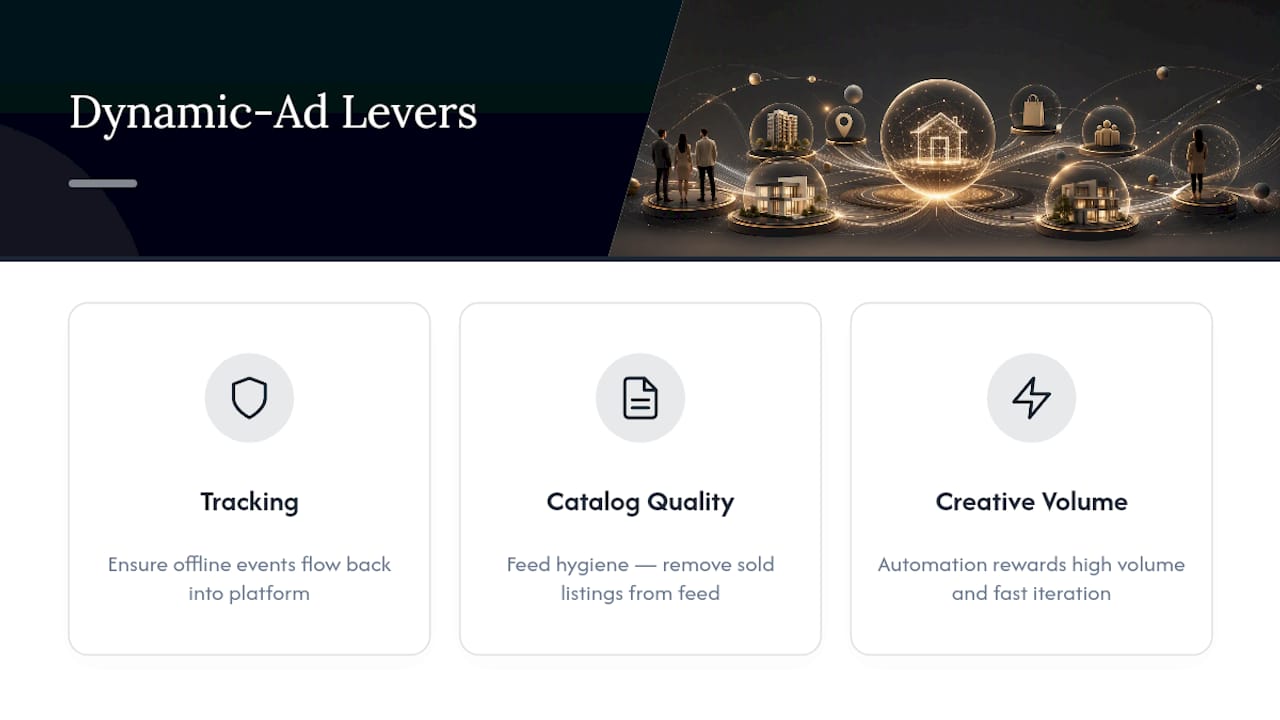
Here’s what the conventional wisdom gets wrong: agents still spend hours agonizing over audience segments when the real return sits in feed hygiene and pixel completeness. A perfectly built audience means nothing if your catalog feed is serving sold listings, or if half your conversion events are getting dropped by browser tracking restrictions that Conversions API exists specifically to fix.
If you’re prioritizing anything first, prioritize the tracking. Speed to lead determines whether that hot retargeting click turns into a booked showing or a missed opportunity, and you can’t measure speed to lead, or optimize toward it, without offline events flowing back into the platform. Creative velocity comes second. Automation rewards volume and fast iteration over any single “perfect” ad. Targeting sophistication comes last, because in this category, you don’t get to be sophisticated about it anyway. Build the foundation first. The automation genuinely works once it has something solid to work from.
— Jason
Get Advantage+ Catalog Ads Running Without the Guesswork
Advantage+ Catalog campaigns can be built and run end to end, so you aren’t stitching together a Pixel, a feed sync, and a CRM handoff on your own between showings. This approach includes handling catalog management, Pixel and CAPI installation, ad creative assembly, and CRM integration, then routing every lead straight to your pipeline for fast follow-up.

Onboarding starts with a catalog audit and tracking review, followed by campaign build and a 30-day optimization window where we tune creative and feed hygiene together. If you’d rather have a team that runs these campaigns daily handle the setup than learn Event Manager on the side, check pricing and plans or book a demo to see how fast your catalog could be generating booked appointments.
Sources
For readers validating the technical details themselves: Meta’s own Advantage+ Catalog Ads for Real Estate page covers official feature requirements. Google’s DynamicRealEstateAsset developer reference documents required feed fields. For tracking implementation depth, stape.io’s Pixel and CAPI guide is worth a read, and KnowSpan’s piece on property data tracking covers structuring property feeds for marketing systems.
- About Advantage+ Catalog Ads for Real Estate
- Meta Ads for Real Estate Agents: 2026 Campaign Playbook
- DynamicRealEstateAsset | Google Ads API | Google for Developers
- How Your MLS Listings Become Facebook Ads That Bring Buyers Back
FAQ
Do Facebook Ads Work for Real Estate Agents?
Yes, particularly for retargeting people who already viewed listings on your site or app. Catalog-driven ads convert better than cold, static ads because they show a browser the exact properties they already showed interest in, rather than a generic listing they’ve never seen.
What Is the 3-3-3 Rule in Real Estate?
Definitions vary depending on who’s using the term, and it’s typically applied to sales follow-up cadence (contacting a lead at three set intervals) rather than to Facebook ad structure specifically. It’s not a Meta advertising framework, so don’t confuse it with catalog ad setup steps.
How Much Do Facebook Real Estate Ads Typically Cost?
Practitioner benchmarks put a realistic minimum around $150 to $300 per month just to let the algorithm learn, with most agents scaling well beyond that floor once results stabilize. Plo’s managed campaign plans, including Marketing Suite at $445 per month, build ad spend and setup into a single package rather than leaving you to guess at a budget alone.
What Is the 3-2-2 Method for Facebook Ads?
This isn’t a standard Meta advertising framework, and there’s no established definition tied to catalog or dynamic ad strategy. If you’ve seen it referenced elsewhere, treat it as informal shorthand rather than platform-official guidance, and lean instead on the funnel structure (cold awareness, warm retargeting, catalog conversion) covered earlier in this guide.