

Long client lists and rapid deal cycles often leave even top brokers feeling overbooked and reactive. In luxury real estate, every minute holds the potential for meaningful client engagement or wasted opportunity. By adopting personalized time tracking systems, targeted prioritization, and automation tools, you gain accurate insight and more productive hours, making each client interaction count and driving your business forward.
Table of Contents
- Step 1: Set up Personalized Time Tracking Systems
- Step 2: Prioritize High-Impact Client Activities
- Step 3: Automate Repetitive Broker Tasks With Technology
- Step 4: Verify Improved Efficiency And Client Outcomes
Quick Summary
| Essential Insight | Detailed Explanation |
|---|---|
| 1. Implement Accurate Time Tracking | Use a personalized time tracking tool to capture detailed metrics on your daily activities, enhancing productivity insights. |
| 2. Focus on High-Impact Clients | Segment clients by value and engagement to prioritize interactions that yield the best results for your business. |
| 3. Automate Repetitive Tasks | Identify low-skill tasks and apply automation tools to save hours each week and improve efficiency. |
| 4. Measure Efficiency Changes | Track key performance indicators before and after implementing strategies to assess their effectiveness. |
| 5. Adjust Based on Feedback | Regularly gather client feedback and review operational metrics to refine strategies for better client satisfaction. |
Step 1: Set up personalized time tracking systems
You’re about to build a system that shows you exactly where your time actually goes. This foundation transforms vague productivity concerns into concrete data you can act on.
Start by choosing a time tracking tool designed for brokers that integrates with your existing workflow. Look for software that captures time spent on client communications, deal tracking, and market research—the activities that truly drive your business forward. The best systems blend seamlessly into your day rather than creating additional friction.
Set up tracking categories that match your actual work patterns, not some generic template. Your categories might look like this:
- Client calls and consultations
- Property research and market analysis
- Administrative tasks and paperwork
- Lead follow-up and negotiations
- Personal development and training
Configure your system to track across multiple devices. Whether you’re on your desktop, phone, or tablet, your time data needs to flow into one unified source. This prevents the common mistake of tracking inconsistently because “I forgot to log this on my phone.”
Connect your time tracking to your calendar and other tools you already use daily. Personalized time management agents that adapt to your preferences and changing demands give you better control without constant manual adjustments. This automation handles routine logging so you focus on billable hours and client relationships.
Test your setup with a real day of work before going all-in. Run through your normal routine and identify where logging feels awkward or where data gaps appear. Make adjustments now rather than abandoning the system later.
Accurate time tracking reveals hidden productivity patterns that transform how you allocate your energy.
Pro tip: Set a daily 5-minute review where you scan your logged hours before leaving the office, adjusting categories or adding notes while details are fresh—this habit keeps your data accurate and identifies time blocks worth protecting.
Here’s a quick comparison of time tracking and automation tools commonly used by brokers:
| Tool Type | Example Platform | Core Benefit | Typical Use Case |
|---|---|---|---|
| Time Tracking Software | ClickUp | Transparent work records | Tracking hours spent on each task |
| CRM Systems | Salesforce | Streamlined client data | Managing client interactions |
| Workflow Automation | Zapier | Reduces manual workload | Automating routine emails |
| Robotic Process Automation | UiPath | High accuracy operations | Document processing and filing |
Step 2: Prioritize high-impact client activities
Not all client interactions move the needle equally. This step teaches you to focus your energy on the activities that genuinely drive revenue and strengthen client relationships.
Begin by segmenting your client portfolio based on two factors: potential value and current engagement level. Your A-tier clients—those with the highest lifetime value or closest to major deals—deserve the bulk of your attention. B-tier clients represent solid, recurring business. C-tier clients may require less frequent contact. This isn’t about abandoning anyone; it’s about being realistic with your time.
Identify which activities within each tier create the most impact. Research shows that client segmentation combined with strategic follow-ups dramatically improves satisfaction and business outcomes. Focus on these high-impact actions:
- Nurturing active prospects close to closing
- Conducting timely follow-ups with qualified leads
- Deepening relationships with your top clients
- Building trust through consultative conversations
- Addressing client concerns before they escalate
Leverage your CRM system to automate lower-impact work and surface high-priority clients. Most luxury brokers waste time on administrative busywork when their CRM could handle it. Set up alerts for key milestones so you never miss a critical moment.
Apply predictive analytics to identify high-potential clients within your existing portfolio. Market data reveals which properties, neighborhoods, or client profiles convert fastest. Use this intelligence to concentrate your prospecting efforts where conversion rates are highest.
Review your activity log weekly. Are you spending time on clients who consistently go silent? Are you missing engagement opportunities with your strongest prospects? Adjust your calendar accordingly.
Your most valuable hour goes to your highest-impact client, not your loudest one.
Pro tip: Block your calendar’s first hour each morning for high-tier client activities before emails and calls pull you in other directions, ensuring your peak mental energy flows to activities that actually grow your business.

Step 3: Automate repetitive broker tasks with technology
Repetitive work drains your energy and pulls you away from client relationships. This step shows you how to hand off the grunt work to technology so you reclaim hours each week.
Start by identifying which tasks consume your time without requiring your expertise. Data entry, property verification, follow-up emails, and document processing are prime candidates. Many brokers spend 15-20 hours weekly on activities a system could handle in seconds. Write down three tasks that make you think, “I wish I didn’t have to do this manually.”
Explore automation tools that match your workflow. Robotic Process Automation handles rule-based tasks like data entry and document processing with remarkable accuracy. When paired with AI capabilities, these systems tackle more complex workflows while reducing errors. Platforms like Zapier and Airtable automate specific processes without requiring coding knowledge.
Prioritize these high-value automations:
- Automated follow-up email sequences to leads
- Property data pulled directly into your CRM
- Client document collection and filing
- Lead qualification scoring based on criteria you set
- Calendar scheduling and meeting reminders
Start small rather than overhauling everything at once. Pick one repetitive task, set up automation, test it thoroughly, and refine based on real-world results. Success breeds confidence to automate more tasks. When your CRM system maximizes client success, it becomes the hub connecting your automation tools together.
Measure the time you reclaim. If automating follow-up emails saves five hours weekly, that’s 260 hours annually—hours you can spend on strategy, client relationships, or actually closing deals.
Technology should free your time for what only you can do, not replace your judgment.
Pro tip: Start with your most annoying, highest-frequency task rather than the most complex one—small automation wins build momentum and show ROI faster than attempting a complicated overhaul.
Step 4: Verify improved efficiency and client outcomes
You’ve implemented time management strategies. Now measure whether they’re actually working. This step teaches you to track concrete improvements in both your operational efficiency and client satisfaction.
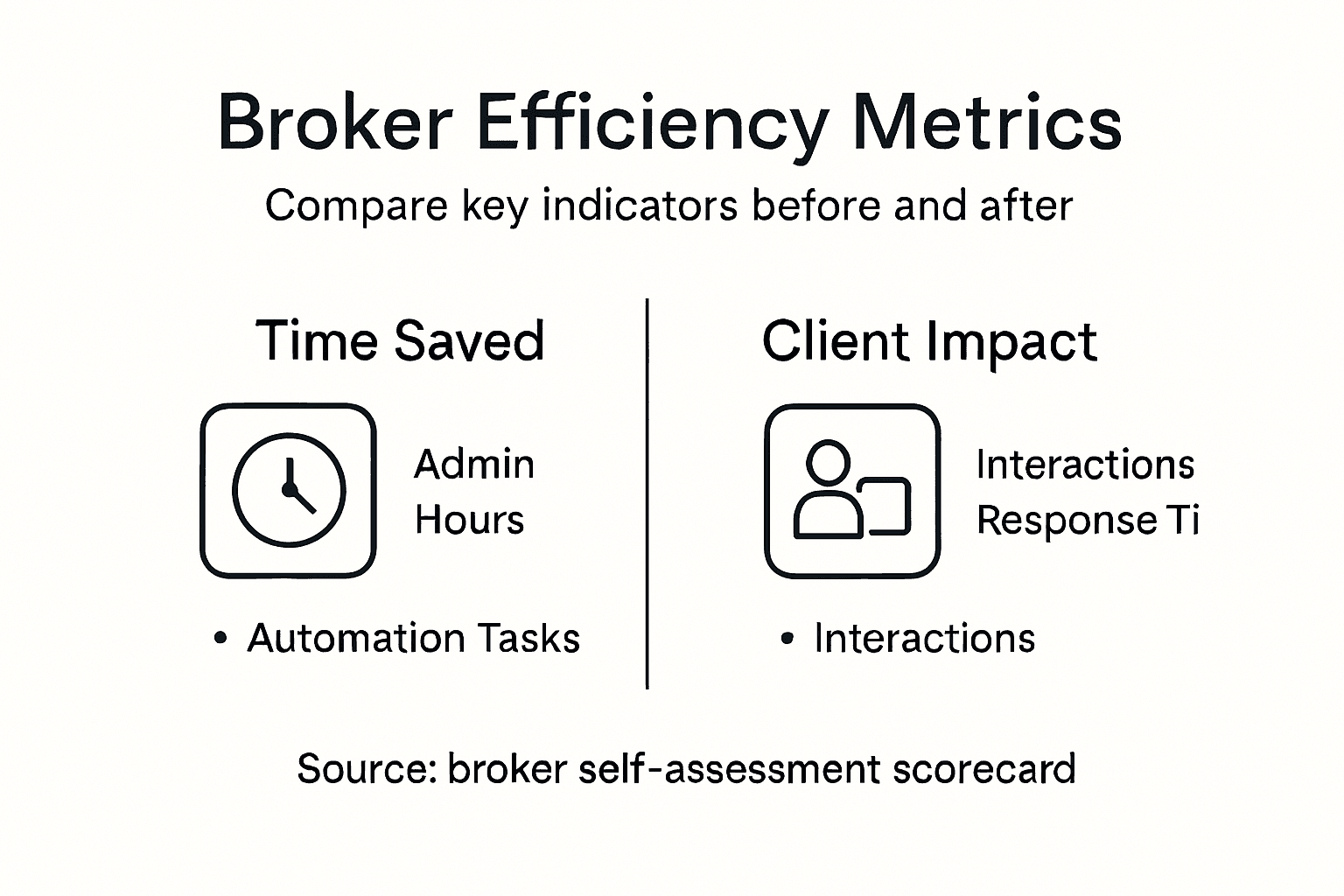
Begin by establishing baseline metrics before your changes took full effect. How many hours did you spend on administrative tasks last month? What was your average response time to client inquiries? How many deals closed monthly? These numbers become your control group for comparison.
Track efficiency gains across your daily operations. Monitor these specific metrics:
- Time spent on repetitive tasks versus client-facing work
- Number of client touchpoints per week
- Average response time to client communications
- Deals progressed through your pipeline monthly
- Client satisfaction scores or feedback ratings
Measure client outcome improvements directly. Research demonstrates that enhanced broker strategies and greater care standards lead to better client advice and market responses. Better time allocation means you provide more thoughtful guidance rather than rushed recommendations. Track whether clients report feeling more heard and understood.
Conduct quarterly reviews comparing current metrics to your baseline. Calculate time saved through automation. If you recovered 10 hours weekly, that’s 40 hours monthly you can reinvest in high-value client interactions. Document which changes delivered the biggest impact and which underperformed.
Gather client feedback intentionally. Ask directly: “Are you experiencing better communication from us?” or “Has our service quality improved?” Brokers who employ strategic advising and relationship-building achieve measurable client benefits. Your clients will tell you if your efforts are landing.
Adjust your system based on data. If automation didn’t save as much time as expected, investigate why. If certain priorities consistently deliver results, double down on those activities.
Metrics transform good intentions into undeniable proof of progress.
Pro tip: Create a simple one-page monthly scorecard tracking 5-7 key metrics—this visual record keeps you accountable and reveals trends you’d otherwise miss in the daily grind.
Review how key efficiency metrics change across broker operations:
| Metric | Before Strategies | After Strategies | Business Impact |
|---|---|---|---|
| Weekly admin hours | 20 hours | 7 hours | More time for client work |
| Client response time | 1 day | 4 hours | Faster client satisfaction |
| Deals closed per month | 5 | 8 | Increased revenue potential |
| Client satisfaction rating | 3.5/5 | 4.5/5 | Stronger repeat business |
Unlock Your Full Potential with Streamlined Time Management for Brokers
Mastering time management is essential to boosting your impact with clients. This article highlights common challenges brokers face such as balancing client priorities, automating repetitive tasks, and making every minute count. If you struggle with tracking your hours accurately, prioritizing high-value activities, or freeing time from administrative work, you are not alone. These pain points create stress and hold back potential success.
At ex.plo.re CRM, we empower brokers by providing cutting-edge tools designed specifically to streamline your prospecting and sales workflows. Imagine reclaiming hours weekly by automating routine follow-ups and gaining clear insights into where your time goes, so you can focus on what matters: cultivating top-tier client relationships and closing more deals. Our technology and expert team work together to amplify the impact of your daily efforts.
Take control of your time and elevate your brokerage with proven solutions that align perfectly with strategies outlined in the article. Learn more about how our luxury broker tools help you implement personalized time tracking, prioritize clients effectively, and automate tasks seamlessly.
Start transforming your productivity today and become the power broker you aspire to be.
Optimize your workflow and increase your earnings now.
Boost your success with ex.plo.re CRM.
Interested in getting started?
See how our specialized systems work for real estate agents, yacht, and luxury brokers.

Experience the difference expert technology and talent make. Visit https://ex.plo.re/crm and amplify your client impact with smarter time management today.
Frequently Asked Questions
How can I set up a personalized time tracking system as a broker?
To set up a personalized time tracking system, choose a time tracking tool that integrates with your existing workflow. Create categories that reflect your actual work patterns, such as client calls and property research, and ensure you’re tracking across all devices.
What types of client activities should I prioritize to increase my impact?
Focus on client activities that drive revenue and relationships, such as nurturing active prospects and conducting timely follow-ups. Segment your clients by potential value and engagement level to allocate your time effectively, ensuring you deliver exceptional service to high-tier clients.
How can I automate repetitive tasks to save time as a broker?
You can automate repetitive tasks by identifying actions that do not require your expertise, such as data entry and follow-up emails. Implement automation tools that fit your workflow to reclaim hours weekly, allowing you to concentrate on client relationships and high-impact work.
What metrics should I track to verify improved efficiency in my brokerage?
Track specific metrics like time spent on administrative tasks, number of client interactions, and average response times. Regularly review these metrics against your baseline to measure progress and determine which time management strategies yield the greatest efficiency gains.
How can I ensure my time management strategies lead to better client outcomes?
Gather client feedback regularly to evaluate the quality of your service and communication. Use surveys or direct questions to understand if clients feel heard and supported, helping you adjust your strategies for improved outcomes and stronger relationships.
What is a good practice for maintaining accurate time tracking data?
Set aside 5 minutes at the end of each day to review your logged hours. Adjust categories or add notes while details are fresh to keep your data accurate and identify time blocks that are crucial to protect.