

Overview: Social proof is the trust surrogate that shortens the sales cycle for high-value transactions. For real estate agents, yacht brokers, and luxury sellers, it reduces perceived risk and supplies the decision-ready evidence wealthy buyers need before they commit. Here are three things you can do today:
- Place a specific, outcome-focused testimonial directly beside your primary call-to-action on every listing page.
- Add a verified transaction metric (“a verified transaction metric showing a substantial total in closed luxury sales over recent years”) to your hero section.
- Request a structured case study within 48 hours of every closed deal, while the client’s enthusiasm is fresh.
One more thing: publish all proof as crawlable text on your own domain. AI-driven buyer research is now a real part of the discovery process, and proof buried in images or locked inside third-party platforms simply won’t surface.
Table of Contents
- What is social proof, and why does it work differently in luxury sales?
- Why social proof matters for real estate agents, yacht brokers, and luxury sellers
- What types of social proof work best, and where should you place each one?
- How to collect, curate, and display proof that actually converts
- What to do and what to avoid when deploying social proof
- U.S. legal and ethical rules you need to follow
- How do you measure whether social proof is actually working?
- A real-world example: how one luxury broker rebuilt trust with structured proof
- Key Takeaways
- What I’ve seen work with luxury clients
- How Plo helps you build a social proof system that runs itself
- Authoritative sources and further reading
What is social proof, and why does it work differently in luxury sales?
Robert Cialdini coined the term in his 1984 book Influence: Science and Practice, describing it as the psychological mechanism by which people look to others’ behavior to decide their own. In marketing, it functions as a conversion system: a structured body of evidence that tells a skeptical prospect, “people like you made this decision, and it worked out.”
In luxury sales, the stakes change the equation. A generic five-star rating might move a $200 hotel booking. It will not move a $4.2M waterfront listing or a $1.8M yacht transaction. What moves those buyers is outcome-focused proof from a comparable client: same wealth tier, same property type, same concern about overpaying or choosing the wrong broker.
“People trust other people more than brands. Social proof serves as a stand-in for a personal recommendation — and in high-value transactions, that surrogate carries the weight of a referral from a trusted peer.” — Sprout Social
Both human buyers and AI research agents now consume your proof. Structure it accordingly: named roles, transaction outcomes, and dates in plain text, not screenshots.
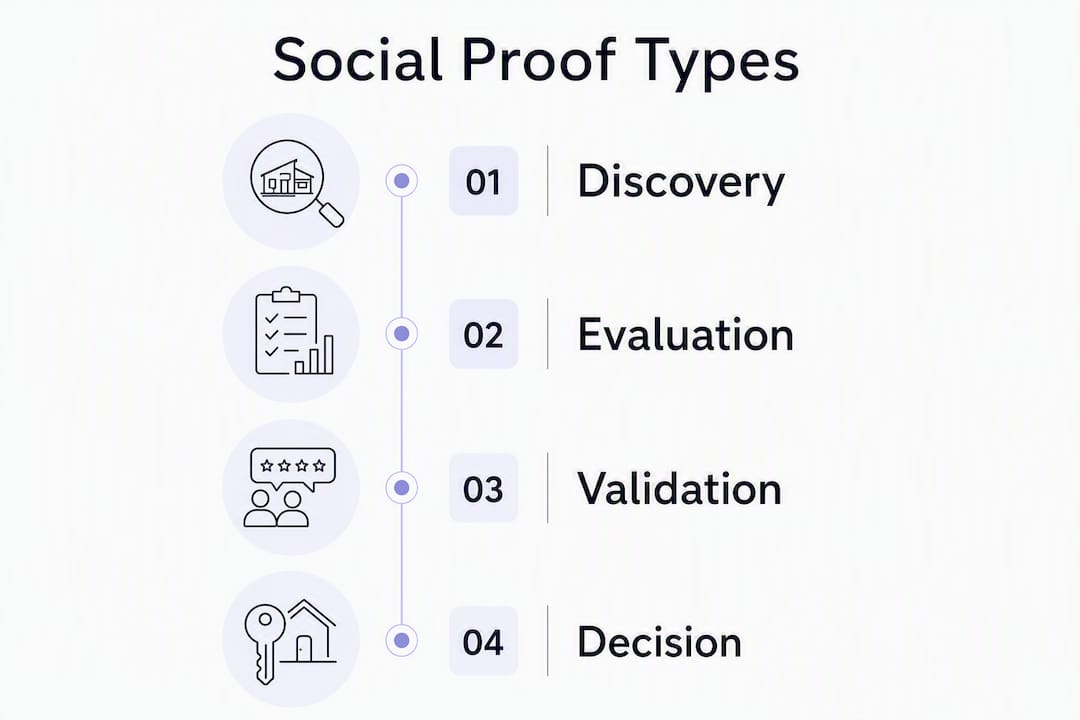
Why social proof matters for real estate agents, yacht brokers, and luxury sellers
High-net-worth buyers operate under elevated perceived risk. The financial exposure is obvious, but the reputational risk is just as real: choosing the wrong broker in a visible market is a social mistake, not just a financial one. Social proof reduces that perceived risk by acting as a peer recommendation at scale.
- Salesforce recommends a two-stage approach: lead with aggregated outcome metrics to establish authority, then present persona-specific case studies as prospects advance toward commitment.
- Marketful notes that trust in single reviews declined substantially between 2020 and 2025; volume, recency, and response rate now matter as much as star rating.
- Placement amplifies impact. Proof positioned at high-friction decision points (pricing pages, contact forms, appointment booking) produces the largest conversion lifts.
The psychological impact on real estate buyers is well-documented: when a prospect sees that someone in their situation chose you and got a measurable result, the decision to reach out becomes significantly easier.
What types of social proof work best, and where should you place each one?
Match the proof format to the buyer’s stage. Discovery calls for authority signals; evaluation calls for specificity; commitment calls for friction reduction.

| Proof Type | Best Placement | Luxury Sales Example |
|---|---|---|
| Outcome testimonial | Hero section, listing sidebar | “Sold our Malibu estate significantly over asking price in a short timeframe.” |
| Case study (challenge → result) | Proposal PDF, email nurture | Full narrative for qualified buyers in evaluation |
| Transaction metrics | Hero, bio page | “Over hundreds of luxury properties sold across the U.S.” |
| Awards / certifications | Footer, bio, listing header | NAR designations, Christie’s affiliate badge |
| Media mentions | Press page, email signature | Wall Street Journal, Robb Report features |
| Peer referrals / UGC | Social channels, listing pages | Client-shared video walkthrough with caption |
| Expert endorsements | Proposal, private collateral | Architect or interior designer co-endorsement |
For yacht brokers, a private password-protected PDF with three comparable transaction case studies is often more persuasive than any public-facing widget. High-net-worth buyers in that market value discretion; proof that respects privacy signals that you’ll handle their transaction the same way.
Pro Tip: Place a one-sentence outcome stat directly adjacent to your “Schedule a Consultation” button. That single placement, per Marketful’s guidance, reduces last-moment hesitation more reliably than a full testimonials page buried in the navigation.
Amplifying proof through social sharing workflows extends its reach without requiring new content creation every time.
How to collect, curate, and display proof that actually converts
Collecting: timing and templates
Ask within 48 hours of closing. That window captures peak satisfaction before the client moves on. A structured prompt outperforms an open-ended request every time. Salesforce recommends guiding clients toward outcome-focused responses rather than general praise.
Use this three-field prompt:
- What was your situation before we worked together?
- What result did we achieve?
- Who would you recommend me to?
Capture role, transaction value, and approximate outcome in your CRM alongside the quote. Automated email workflows can trigger this request the moment a deal closes, so nothing slips through.
Curating: specificity over volume
Edit for outcomes, not adjectives. “Jason was fantastic” is noise. “Jason negotiated a $220K price reduction on our Palm Beach condo in under three weeks” is proof. For privacy-sensitive clients, anonymize to role and market: “HNW buyer, Manhattan condo, 2025.”
Video testimonials carry more weight than text for yacht and luxury property buyers, but they require more friction to produce. Prioritize video for your top three or four flagship transactions; use structured text for the rest.
Displaying: web, PDF, and AI-readiness
- Hero section: one outcome stat + one short testimonial, above the fold
- Listing detail pages: sidebar testimonial from a comparable transaction
- Proposals: two to three case studies in challenge-approach-result format
- Private buyer PDFs: password-protected, three to five detailed narratives for qualified prospects
Format everything as crawlable HTML text. Schema markup (Review, LocalBusiness) helps both search engines and AI agents surface your proof in research queries.
Pro Tip: Refresh your proof library every 90 days. Lead Alchemists notes that testimonials older than 6–12 months actively reduce credibility in fast-moving markets like luxury real estate and yacht brokerage. Date every testimonial visibly.
What to do and what to avoid when deploying social proof
Do:
- Use specific results with dollar amounts, timelines, and named outcomes
- Include the client’s role and market (“first-time yacht buyer, Fort Lauderdale, 2025”)
- Date every testimonial and refresh on a 90-day cycle
- Pair logos or media badges with outcome metrics, not just the logo alone
- Keep proof contextually relevant to the page it appears on
Don’t:
- Stack multiple review widgets on the same page; NN/g research shows excessive badges create cognitive load and can hurt conversions
- Bury proof in images only — it becomes invisible to search engines and AI agents
- Let unverified claims stand without a name, date, or outcome
- Reuse the same testimonial across every page; match proof to the specific listing or service
“UX restraint matters: too many badges and conflicting widgets cause cognitive load and can backfire. Focused, context-aware proof performs best.” — Nielsen Norman Group
A well-staged property also contributes to offline proof. Professional presentation before showings, including property preparation, creates the kind of first impression that generates the testimonials worth publishing.
U.S. legal and ethical rules you need to follow
The FTC’s endorsement guidelines require that any material connection between you and a reviewer (gifted services, referral fees, reciprocal arrangements) be clearly disclosed. “A client said…” is fine. Paying for a review without disclosure is not.
Consent checklist:
- Obtain written permission before publishing any testimonial, including name, photo, or transaction detail
- Offer anonymization as a default option for privacy-conscious clients
- Disclose any compensated or gifted relationship adjacent to the endorsement
Recordkeeping:
- Maintain a timestamped proof file: original quote, consent form, and publication date
- Archive testimonials older than 12 months rather than deleting them
- Review your proof library quarterly for accuracy, especially after market shifts
This article is general information, not legal advice. Confirm your specific disclosure obligations with a qualified attorney or review the FTC’s current endorsement guidance directly.
How do you measure whether social proof is actually working?
Core KPIs to track:
- Conversion rate at lead capture (contact form, appointment booking)
- Qualified lead rate (prospects who match your target client profile)
- Average time from first contact to signed contract
- Proposal-to-close rate
Testing ideas:
- Testimonial vs. no testimonial on a listing page (hold all other variables constant)
- Headline metric (“$200M sold”) vs. narrative case study in the hero section
- Proof placement: hero vs. directly adjacent to the CTA button
Tracking checklist:
- UTM tags on all proof-adjacent CTAs to isolate traffic sources
- Event tracking for CTA clicks on pages with and without testimonials
- Cohort analysis comparing lead quality from proof-heavy pages vs. standard pages
NN/g recommends usability testing and attention tracking to verify that proof elements are noticed and not overwhelming. Even a simple five-person session can reveal whether your testimonials are being read or scrolled past.
A real-world example: how one luxury broker rebuilt trust with structured proof
The challenge: A boutique real estate team in South Florida had strong transaction volume but a thin digital presence. Prospects arriving from referrals converted well; cold inbound leads dropped off at the contact form.
The approach: The team added a single outcome testimonial (“Closed a multi-million dollar waterfront listing quickly, significantly over asking price.”) directly above the contact form. They built three case studies in challenge-approach-result format and placed them in a password-protected PDF sent to qualified prospects after the first call. They also began dating all testimonials and refreshing the library every quarter.
The result: Inbound contact form submissions increased, and the team reported that prospects arriving for initial consultations were arriving pre-sold on the broker’s track record rather than asking basic credibility questions.
Three takeaways you can copy:
- One specific outcome stat above the contact form is worth more than a full testimonials page elsewhere
- A private case-study PDF signals discretion and professionalism to high-net-worth buyers
- Dating testimonials visibly builds credibility; hiding the date destroys it
“The shift wasn’t about adding more proof — it was about placing the right proof at the exact moment a prospect was deciding whether to reach out.” — South Florida luxury team, 2025
Key Takeaways
Social proof works in luxury sales because it replaces perceived risk with peer-validated evidence, and placement at the decision point matters as much as the proof itself.
| Point | Details |
|---|---|
| Proof type must match buyer stage | Use metrics for authority at discovery; case studies for evaluation; outcome stats at CTAs for commitment. |
| Specificity beats volume | A single outcome-focused testimonial with a dollar figure and timeline outperforms ten generic five-star ratings. |
| Refresh every 90 days | Older testimonials can reduce credibility in fast-moving luxury markets — it is important to refresh them regularly.; date every entry. |
| Format for AI and search | Publish proof as crawlable HTML text with schema markup so AI research agents can surface it. |
| Plo automates the workflow | Plo’s CRM and automated email tools trigger testimonial requests at close and integrate proof into proposals and listing pages. |
What I’ve seen work with luxury clients
The agents and brokers who get the most out of social proof share one habit: they treat it as a system, not a task. They don’t scramble for a testimonial when a new listing goes live. They have a library, a refresh schedule, and a placement map. The proof is already in place before the prospect arrives.
What most professionals underestimate is how much the format of proof matters at the high end. A wealthy buyer who has done three luxury transactions before is not impressed by a star rating. They want to see that you’ve handled their exact situation before and that someone comparable to them trusted you with it. That specificity is what closes the gap between interest and commitment.
If you’re not yet treating your testimonial library as a core business asset, that’s the single habit worth building first. Everything else follows from having the right proof, in the right format, in the right place.
How Plo helps you build a social proof system that runs itself
Most brokers know they should be collecting testimonials. Few have a system that actually does it consistently. Plo closes that gap with automated prospecting and CRM workflows that trigger testimonial requests at close, capture structured responses, and push proof into your listing pages, proposals, and email sequences without manual effort.
The platform also generates private buyer collateral, including password-protected case-study PDFs, and formats proof for AI-readiness so your track record surfaces in the research queries your next client is already running. Expert onboarding means you’re not configuring workflows alone. For real estate agents, yacht brokers, and luxury brokerage professionals ready to turn every closed deal into a client acquisition asset, Plo is the operational layer that makes it happen. See how it fits your workflow at ex.plo.re/crm.
Authoritative sources and further reading
- Salesforce: Social Proof in Marketing — Two-stage proof strategy (metrics → case studies) and testimonial timing guidance used throughout this guide.
- Sprout Social: Social Proof in Digital Marketing — Peer trust as a surrogate for personal recommendations; foundational for the “why it matters” section.
- Nielsen Norman Group: Social Proof in UX — Cognitive load research on badge overuse; basis for UX restraint recommendations and A/B testing guidance.
- Marketful: The Complete Social Proof Guide — AI-driven buyer research, trust decay data, and CTA placement guidance.
- Lead Alchemists: Social Proof in Marketing — Testimonial decay timelines specific to real estate and yacht brokerage.
- Wharton Executive Education: Social Proof as a Trust Signal — Academic framing of trust signals and their role in consumer decision-making.