

Imagine spending three months showing a prospect waterfront estates and superyachts, only to discover they were never in a position to close. That scenario plays out more often than most luxury agents admit, and the cost is not just time. It’s opportunity cost, reputation, and momentum. Qualifying high net worth (HNW) and ultra-high net worth (UHNW) buyers requires a process that blends financial rigor with relationship intelligence. This guide walks you through exactly how to do that, so you stop chasing and start closing with confidence.
Table of Contents
- Understanding luxury buyer profiles and motivations
- Establishing credibility: Earning trust before qualification
- Smart financial vetting: Proof of funds and nuanced screening
- Behavioral cues and qualifying conversations
- Common mistakes and best practices in luxury buyer qualification
- Why real luxury buyer qualification is an art, not just a science
- Take your luxury buyer strategy to the next level
- Frequently asked questions
Key Takeaways
| Point | Details |
|---|---|
| Know luxury buyer profiles | Understanding motivations and behaviors is crucial for qualifying real estate and yacht buyers in the luxury segment. |
| Lead with trust, not paperwork | Building rapport and establishing credibility should come before requesting financial documentation from luxury clients. |
| Blend behavioral and financial screening | The best qualification process combines discreet financial vetting with close attention to buyer actions and cues. |
| Avoid mass marketing traps | Referrals and relationship-driven strategies are far more effective than generalized marketing for attracting real luxury buyers. |
Understanding luxury buyer profiles and motivations
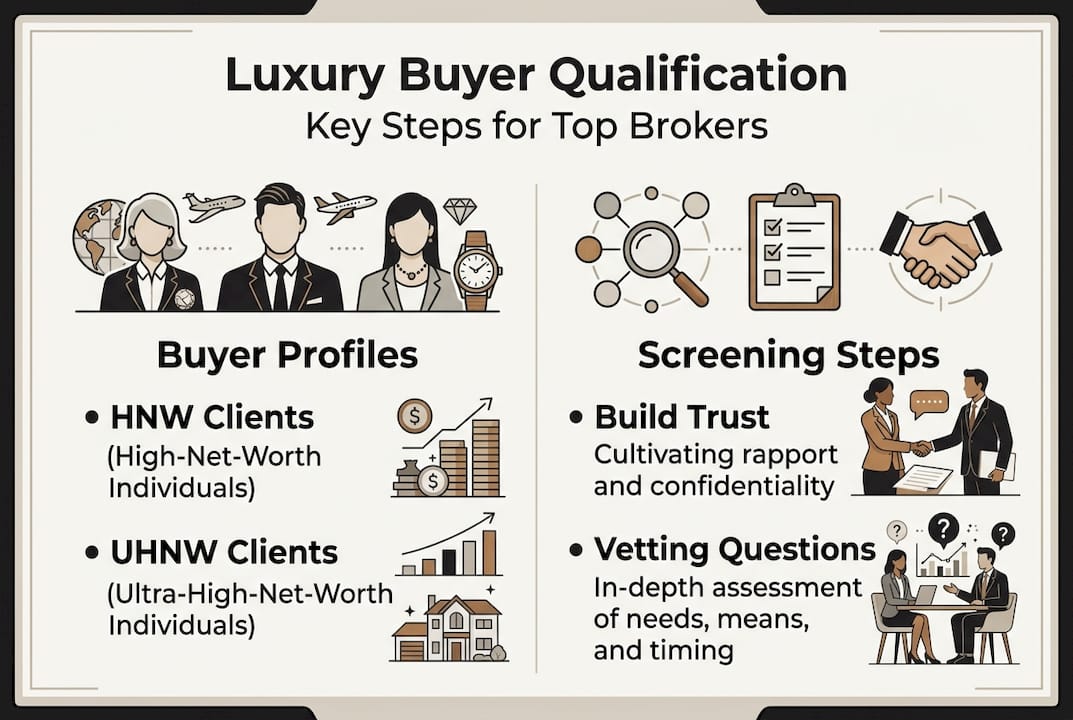
Not all wealthy buyers are the same. The gap between HNW and UHNW clients is not just about zeros in a bank account. It shapes how they communicate, what they value, and how they want to be approached.
| Buyer segment | Net worth range | Key characteristics |
|---|---|---|
| High net worth (HNW) | $1M to $30M | Investment-focused, responsive to market data |
| Ultra-high net worth (UHNW) | $30M+ | Legacy-driven, privacy-conscious, COI-reliant |
| Family office buyers | $100M+ | Multi-generational, committee-based decisions |
UHNW buyers rarely make purchases purely for financial return. Their motivations run deeper: lifestyle elevation, privacy from public life, legacy creation for future generations, and curated experiences that money alone cannot manufacture. A $25M estate or a 60-meter yacht is often a statement of identity, not just an asset.
Behavioral signals matter enormously here. Watch for pattern recognition in how they discuss past acquisitions. Do they reference specific architects, designers, or shipyards by name? Do they ask about HOA governance structures or flag registry details? Specificity signals experience and genuine intent. Vague enthusiasm, on the other hand, is a warning sign.
The most reliable source of credible UHNW buyers is your circle of influence (COI): attorneys, family office advisors, private bankers, and past clients who trust you enough to refer. Cold inquiries from digital ads rarely convert at this level. UHNW buyer qualification blends financial proof with behavioral signals, and your sourcing strategy should reflect that from the start.
Key motivations to listen for during early conversations:
- Privacy and discretion: They want off-market listings and confidential processes
- Legacy and generational wealth: Purchases tied to family continuity
- Experience and exclusivity: Access to things others cannot have
- Control and autonomy: They lead the timeline, not you
For more context on serving this segment well, explore these luxury brokerage tips that top producers rely on daily.
“The UHNW buyer is not shopping. They are selecting. Your job is to be worth selecting.”
Trust and social proof are the currency of this market. Testimonials from recognizable names, discreet event invitations, and warm introductions from mutual contacts carry far more weight than any marketing brochure.
Establishing credibility: Earning trust before qualification
Once you understand who you are dealing with, the next move is not to ask for financial documents. It is to earn the right to ask. First impressions at this level are not just about appearance. They are about authority, discretion, and alignment.
Micro-commitments are small, low-stakes actions that build trust incrementally. Inviting a prospect to an exclusive property preview, sharing a curated market report, or making a warm introduction to a relevant contact are all micro-commitments. Each one signals that you operate at their level without demanding anything in return.
Here is how COI referrals compare to cold inquiries in practice:
| Inquiry type | Trust level at first contact | Time to qualification | Conversion likelihood |
|---|---|---|---|
| COI referral | High | Shorter | Significantly higher |
| Cold digital lead | Low | Longer | Lower |
| Event-sourced contact | Medium | Moderate | Moderate |
The UHNW preference for COI referrals over mass marketing is well-documented. These buyers do not respond to broad campaigns. They respond to trusted introductions and consistent relationship signals.
Steps to build credibility before financial screening:
- Research the prospect thoroughly before any meeting
- Lead with insight, not inventory (share market intelligence, not listings)
- Offer value through your network before asking for anything
- Attend events where your ideal clients already gather
- Follow up with substance, not just a “checking in” message
One of the most common mistakes agents make is leading with financial questions too early. It signals desperation and misaligns with how UHNW buyers expect to be treated. They want to feel chosen, not screened.
Pro Tip: Build lasting luxury client relationships by treating every interaction as a long-term investment. One well-nurtured contact can generate multiple referrals over a decade. Use advanced prospecting strategies to stay top of mind without being intrusive.
Smart financial vetting: Proof of funds and nuanced screening
With trust established, you can move to financial screening, provided you do so with discretion and professionalism. Asking for proof of funds (POF) too bluntly can collapse weeks of relationship-building in seconds.

The most effective approach frames POF as a mutual protection mechanism. You are not questioning their ability to buy. You are ensuring that both parties invest time appropriately. Phrasing matters: “To protect your privacy and streamline the process, our sellers require a brief financial confirmation before we arrange private access” lands very differently than “Can you show me proof of funds?”
Common financial documents in luxury sales:
- Bank statements or brokerage summaries (often redacted for privacy)
- Letter of financial standing from a private banker or wealth manager
- Trust or entity documentation for family office buyers
- Pre-approval letters for financed luxury purchases
- LOI (letter of intent) paired with escrow deposit confirmation
UHNW buyers expect both behavioral vetting and financial proof, and financial gates must be handled with nuance. Rushing this step or making it transactional signals that you do not understand their world.
Red flags to watch for during financial vetting:
- Reluctance to involve any professional advisor
- Inconsistency between stated wealth and lifestyle indicators
- Pressure to skip standard documentation steps
- Vague answers about funding source or entity structure
Statistic: Luxury properties priced above $10M can take 12 to 24 months to sell. Qualifying buyers early protects your pipeline and your energy.
Pro Tip: Use your luxury real estate marketing strategies to attract pre-qualified prospects through exclusive content and private events, reducing the need for awkward financial conversations later.
Behavioral cues and qualifying conversations
Financial verification is only half the picture. Perceptive agents read between the lines during every client interaction. The way a buyer talks, asks questions, and responds to information tells you more than any document.
Key behavioral signals that indicate serious intent:
- Specificity: They reference exact locations, architectural styles, or vessel specifications
- Urgency with purpose: They have a timeline tied to a life event, not vague interest
- Decision authority: They speak in first person about choices, not “we need to check with someone”
- Risk awareness: They ask about downside scenarios, not just upside potential
- Follow-through: They respond promptly and honor scheduled calls and meetings
UHNW qualifying blends behavioral signals like risk tolerance and pattern recognition with hard financial criteria. Your discovery conversations should be designed to surface both.
Effective discovery questions to reveal true intent:
- “What does the ideal outcome of this acquisition look like for your family?”
- “Have you purchased at this level before, and what worked or did not work about that process?”
- “What is your preferred timeline, and what is driving it?”
Warning signs of non-serious buyers:
- Requests for extensive tours before any financial conversation
- Inability to name a decision-making timeline
- Excessive focus on price reduction before seeing the property
- Inconsistent communication patterns
Intuition sharpens with experience, but it is not a replacement for structured questions. Combine your instinct with a consistent discovery framework. Build your networking tips for brokers practice so you are consistently meeting the right people, and use local networking for brokers to deepen your referral base where serious buyers already exist.
Common mistakes and best practices in luxury buyer qualification
Even experienced brokers fall into traps that slow or derail the qualification process. Recognizing these patterns early gives you a real edge.
Top mistakes luxury agents make:
- Over-relying on mass marketing: Mass marketing is ineffective for UHNW buyers who prefer relationships and COI introductions
- Ignoring soft signals: Focusing only on financials and missing behavioral red flags
- Failing to follow up with substance: Generic check-ins do not build relationships
- Moving too fast to financial gating: Skipping trust-building steps kills deals before they start
- Not documenting qualification criteria: Without a system, you repeat the same mistakes
| Best practice | What it looks like in action | Why it works |
|---|---|---|
| Blend behavioral and financial vetting | Use discovery questions alongside POF requests | Protects relationships while ensuring seriousness |
| Nurture through consistent communication | Monthly value-add touchpoints | Keeps you top of mind without pressure |
| Leverage COI networks | Regular engagement with advisors and attorneys | Delivers pre-qualified, high-trust referrals |
| Troubleshoot qualification breakdowns | Review where deals stalled and identify the gap | Continuous improvement of your process |
Pro Tip: Explore luxury broker marketing ideas that attract serious buyers organically, reducing time spent on unqualified leads.
When a qualification process breaks down, trace it back to its root. Was trust not established early enough? Was the financial conversation premature? Did you miss a behavioral signal? Each breakdown is data. Use it to sharpen your approach.
Why real luxury buyer qualification is an art, not just a science
Every framework in this guide matters. But here is what most qualification guides will not tell you: the brokers who consistently close at the highest levels are not just following a process. They are reading rooms, sensing hesitation, and knowing when to slow down even when a deal looks ready to move.
Rigid screening frameworks can actually repel the buyers you most want. UHNW clients are perceptive. They can tell when they are being processed rather than understood. The agents who win long-term are the ones who treat qualification as an ongoing conversation, not a checklist.
Veteran luxury brokers balance instinct with methodology. They use structured discovery questions but know when to set the script aside. They request POF but frame it as a shared interest. They invest in lead generation for luxury brokers that prioritizes relationship depth over volume.
The most overlooked element is long-term rapport. A buyer who does not close today may refer three clients next year. Qualification is not a gate. It is the beginning of a relationship that, if handled well, compounds over time.
Take your luxury buyer strategy to the next level
You now have a clear picture of what separates agents who consistently qualify and convert luxury buyers from those who waste time on the wrong prospects. The next step is putting these strategies into a system that works without burning you out.

ex.plo.re gives luxury real estate agents and yacht brokers the tools to streamline every stage of the prospecting and qualification cycle. From smarter outreach to relationship tracking, we amplify the work you are already doing. Explore luxury brokerage explained to see how top brokers operate, review the top prospecting tools built for this market, and compare the best yacht broker platforms available today. Your next high-value client is closer than you think.
Frequently asked questions
What is the best way to verify a luxury buyer’s financial status?
Tactful financial vetting is most effective when framed as a mutual protection step, not a screening process. Request documentation through their advisor or banker after rapport is established.
How do you spot a serious luxury buyer versus a tire kicker?
Behavioral cues like urgency tied to a real timeline, specificity about needs, and willingness to engage financial proof are the clearest indicators of genuine buyer readiness.
Are mass marketing tactics effective for qualifying high-net-worth buyers?
Mass marketing is ineffective for UHNW buyers. This segment responds to personal referrals, COI introductions, and relationship-driven engagement, not broad campaigns.
When should you ask for proof of funds during the luxury sales process?
Financial gating should follow relationship building, not precede it. Request proof of funds only after you have established credibility and mutual trust with the prospect.