

Overview: Local networking is the highest-converting lead source available to real estate agents, yacht brokers, and luxury sales teams. Referrals from local relationships close faster, cost less to acquire, and produce clients with higher lifetime value than any paid channel. Expect your first meaningful results after several months of consistent activity, with a predictable referral pipeline forming over the longer term.
The core benefits, fast:
- Referrals that convert at 3–4x the rate of cold leads
- Off-market access through vendor, lender, and business-owner relationships
- Trust and credibility that shortens luxury negotiations
- Co-marketing partnerships with local concierges, marinas, and lenders
- Hyperlocal content that makes you the recognized expert in your zip code
Key Takeaways
| Point | Details |
|---|---|
| Referrals dominate luxury sales | 66% of sellers found their agent via referral; referred leads convert at 3–4x the rate of cold prospects. |
| Top producers earn more | Agents generating 40%+ of business from referrals earn an average of $40,000 more per year than those who don’t. |
| Consistency beats reach | Expect 3–9 months to a first referral closing; 12+ months for a predictable monthly pipeline. |
| Track from day one | Tag every referral source in your CRM immediately; without attribution data, you can’t measure or reward what works. |
| Plo automates the system | Plo’s CRM and managed services handle follow-up, attribution, and content so your human outreach compounds faster. |
Table of Contents
- Why local networking matters more in luxury and high-value sales
- The concrete business benefits, one by one
- Your 30/60/90 plan to build a referral network
- How to measure the ROI of your local networking
- Mistakes that kill referral momentum
- What real brokers say about local networking outcomes
- When to scale local networking with technology
- The one habit that separates local authority from local presence
- Plo helps you turn local relationships into measurable leads
- Sources
Why local networking matters more in luxury and high-value sales
High-net-worth clients don’t respond to cold outreach the way a first-time buyer might. They vet their advisors through their own networks first. A referral from a trusted attorney, a yacht club commodore, or a private banker carries more weight than any ad spend you can deploy. That’s the core dynamic: in luxury markets, trust is the product, and local relationships are how you manufacture it at scale.
Concierge expectations compound this. HNW clients expect seamless handoffs — from agent to estate attorney, from yacht broker to marine surveyor, from luxury listing to interior designer. Brokers who are embedded locally can make those introductions instantly. Brokers who aren’t lose the deal to someone who can.
RISMedia’s practitioner reporting captures this precisely:
Being embedded locally also reduces objection handling. When a client already knows your name from a charity gala or a neighborhood association meeting, the first conversation starts three steps ahead.
The concrete business benefits, one by one
Referrals convert faster and cost less. Industry data summarized by Jamil Academy shows that A majority of sellers found their agent through a referral or past relationship, and referred leads convert at significantly higher rates than cold prospects. For a luxury broker closing five deals a year, shifting even two of those to referral-sourced leads changes the unit economics of your entire business.
Top producers earn materially more. AgentsGather’s analysis of NAR data finds that agents who generate more than 40% of their business from referrals earn an average of $40,000 more per year than those who don’t network actively. That gap widens at the luxury price point, where a single additional referral-sourced closing can represent six figures in commission.
Off-market access. Local relationships with estate attorneys, family office advisors, and private bankers surface listings before they hit the MLS. For yacht brokers, marina managers and boat club officers are the equivalent channel. These relationships don’t appear on any portal.

Co-marketing partnerships. Pairing with local businesses — a luxury hotel concierge, a private lending officer, a high-end moving company — creates a mutual referral loop. You send them clients; they send you introductions. Neighborhood-level content amplifies this by giving partners something to share with their own audiences.
Lifetime value and repeat business. A client who found you through a trusted local contact is far more likely to return for their next transaction and refer their peers. Local relationships raise LTV by reducing the re-acquisition cost between deals.
Content advantages. Hyperlocal content — neighborhood market reports, school district updates, marina condition notes — positions you as the authority and drives organic discoverability. AgentsGather notes that agents producing neighborhood-level content increase trust with relocating buyers and out-of-state referral partners simultaneously.
Your 30/60/90 plan to build a referral network
Start in week one with the single highest-return activity: identify five local professionals who serve your target client (an estate attorney, a private banker, a luxury hotel concierge, a marina manager, a high-end contractor) and request a 20-minute coffee meeting. No pitch. Just curiosity about their business and what a good referral looks like for them.
Days 1–30: Plant seeds
- Book five professional coffee meetings with non-competing local service providers
- Attend one local networking event (chamber, yacht club, arts board, or BNI chapter)
- Publish one hyperlocal content piece — a neighborhood market snapshot or marina conditions update — and share it with your new contacts
- Set up CRM tags:
referral_source,referral_partner,event_metfor every new contact
Days 31–60: Deepen and systematize
- Follow up with every coffee contact; send one piece of relevant local content to each
- Join one board, charity committee, or neighborhood association where your target clients are active
- Co-host or sponsor a small local event — a wine tasting, a dock party, a neighborhood market update breakfast — and capture RSVPs as a lead list
- Add a referral-source field to every new lead in your CRM; track referral attribution from day one
Days 61–90: Convert and measure
- Ask your strongest new contacts for one warm introduction
- Launch a structured referral group cadence (BNI-style chapters convert faster but require weekly attendance — worth it for disciplined agents)
- Review your CRM: how many leads carry a
referral_sourcetag? What’s the pipeline value? - Adjust your event calendar based on which venues produced the most qualified contacts
Pro Tip: Write a 200-word neighborhood note — one local market insight, one community event mention, one personal observation — and hand-deliver it to five local businesses near your target listings. It costs nothing and positions you as the embedded local expert before you’ve spent a dollar on ads.
Jamil Academy’s synthesis is clear: most networking channels take 3–9 months before a first closing, and 12+ months for predictable monthly volume. Consistency matters more than reach.
How to measure the ROI of your local networking
The three metrics that matter most are referral rate (what percentage of new leads cite a personal referral as their source), pipeline sourced from networking (total deal value in your CRM tagged to a networking contact), and close rate on referred leads (almost always higher than your blended average).
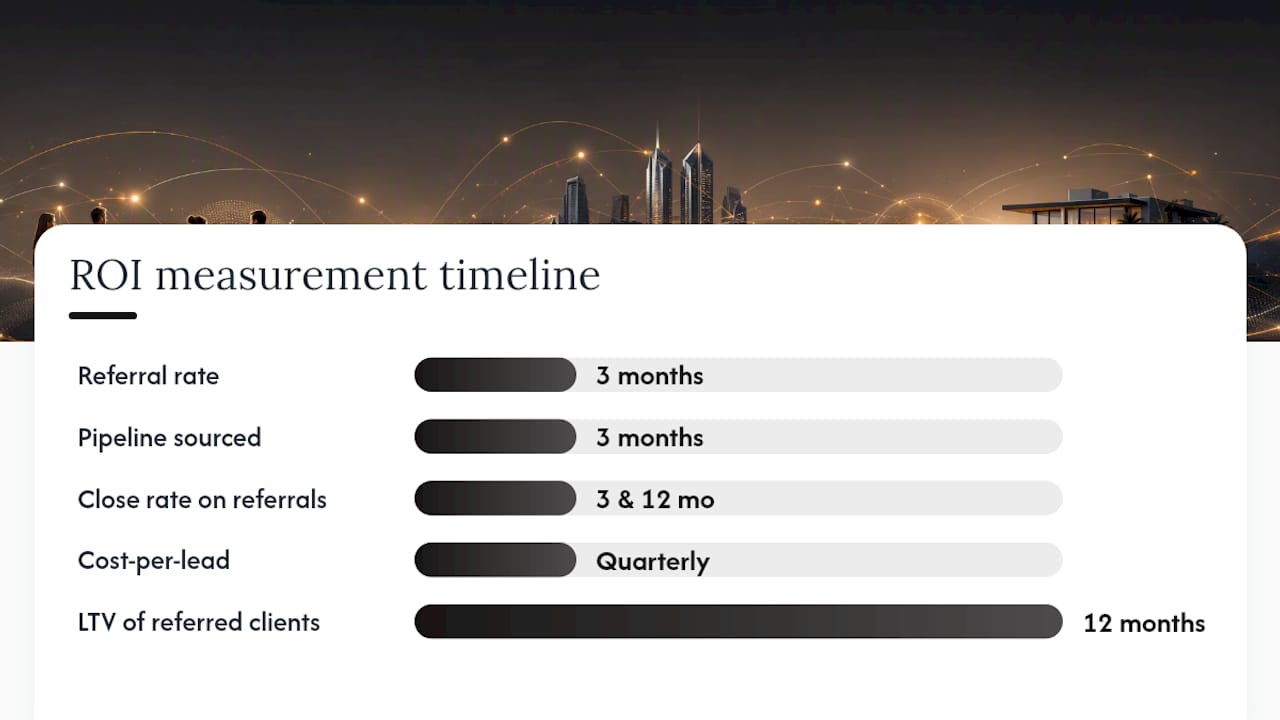
| Metric | How to measure | Expected timeline | Sample goal |
|---|---|---|---|
| Referral rate | CRM referral-source field as % of total new leads | 3 months to establish baseline | 30% of new leads from referrals by month 9 |
| Pipeline sourced | Sum of deal value tagged referral_source in CRM |
Visible by month 3 | One referral-sourced deal in pipeline by month 3 |
| Close rate on referrals | Referral closes ÷ referral leads | Compare at 3 and 12 months | Target 3–4x your cold-lead close rate |
| Cost-per-lead | Event + time costs ÷ leads generated | Quarterly review | Below your paid-channel CPL by month 12 |
| LTV of referred clients | Total commission per client over 3 years | Annual review | 20%+ higher than non-referred clients |
Tracking checklist:
- Add a
referral_sourcefield to every contact record on first entry - Tag every event-met contact with the event name and date
- Run a monthly CRM report: leads by source, pipeline by source, closes by source
- Use local client acquisition workflows to automate follow-up sequences without losing the personal touch
Inman’s reporting on community events confirms that events with on-site data capture — RSVPs, raffle sign-ups, mailing list opt-ins — convert attendees into a measurable lead pool and produce long-term loyalty. Pair every event with a capture mechanism.
Mistakes that kill referral momentum
Most brokers don’t fail at local networking because they lack charm. They fail because they treat it as a one-time activity rather than a system.
- One-off event attendance. Showing up once and expecting referrals is the most common mistake. Relationships require repeated exposure — the same faces, the same venues, over months.
- Superficial outreach. Handing out cards without genuine curiosity about the other person’s business produces nothing. Ask what a good referral looks like for them before you mention yourself.
- Over-reliance on a single channel. One BNI chapter, one charity board, one event series — if that channel dries up, your pipeline does too. Diversify across at least three venue types.
- Failing to track referrals. If you don’t tag referral sources in your CRM from day one, you can’t measure what’s working or reward the partners who send you business.
- Transactional volunteerism. Joining a charity board purely to prospect is obvious and off-putting. Show up to contribute first; the referrals follow naturally.
- Connector fatigue. If you ask a partner for introductions before you’ve given them value, you burn the relationship. Give two referrals before you ask for one.
What real brokers say about local networking outcomes
The practitioner evidence is consistent: local networking compounds when it’s systematic.
The mechanics behind that observation are straightforward. A contact met at a yacht club event in January refers a client in April. That client refers a colleague in September. By December, one handshake has produced two closings and a third in the pipeline — none of which appear in your ad attribution reports.
- Agents embedded in local schools, neighborhood groups, and business associations report being called first when a listing comes available, often before the seller contacts anyone else.
- Brokers who co-sponsor local events with national brand tie-ins — localizing a national campaign to a neighborhood moment — report both brand lift and direct lead capture when paired with RSVP data collection.
When to scale local networking with technology
Keep the relationship-building human. Automate everything else.
The handshake, the coffee meeting, the board seat — those stay personal. What you can and should automate: follow-up sequences after events, neighborhood content distribution, referral attribution tagging, and lead nurturing for contacts who aren’t ready to transact yet.
| Approach | Best for | Trade-off |
|---|---|---|
| Manual outreach | Early-stage relationship building, high-value contacts | Time-intensive; doesn’t scale past ~50 active contacts |
| CRM automation | Follow-up sequences, referral tagging, lead nurturing | Requires setup; loses personal feel if over-automated |
| Managed services | Content production, ad campaigns, attribution reporting | Higher cost; the best ROI when paired with active human outreach |
Inman’s pull-through examples show that localizing national sponsorships with community events and local partners produces stronger brand identity than either tactic alone — but it requires operational support to execute consistently.
Pro Tip: Use CRM automation to send a personalized neighborhood market update to every contact 30 days after you meet them. It keeps you top of mind without requiring a manual follow-up call for every contact in your database.
Plo’s platform automates follow-up, measures referral attribution, and scales neighborhood content — so your human outreach gets amplified rather than replaced. For brokers ready to move from manual to managed, local marketing support from Plo combines CRM tagging, content, and managed outreach into a single workflow.
The one habit that separates local authority from local presence
Local networking produces results when you stop thinking about it as lead generation and start treating it as reputation management. The brokers who dominate their markets aren’t the ones who attend the most events. They’re the ones who show up consistently, give value first, and make it easy for their network to refer them.
The single habit worth adopting today: write one hyperlocal insight — a market observation, a zoning update, a neighborhood event note — and share it with five contacts every week. Not a newsletter blast. A personal message. Over 12 months, that habit builds a reputation that no ad campaign can manufacture.
Plo helps you turn local relationships into measurable leads
Local networking produces your highest-quality leads. The gap between brokers who know that and brokers who profit from it is a system. Plo gives you that system: CRM automation that tags every referral source, tracks pipeline by contact, and fires follow-up sequences the moment a new contact enters your database — so no relationship falls through the cracks.
Getting started takes four steps: connect your existing contact list, set up referral-source tags, activate your neighborhood content calendar, and let Plo’s managed team handle attribution reporting while you focus on the handshakes. For brokers ready to scale, explore Plo’s prospecting tools and workflows built specifically for real estate agents, yacht brokers, and luxury sales teams. Start your local client acquisition workflow today and see your referral pipeline take shape within 90 days.
Sources
- Real Estate Agent Networking: Building a Referral-Driven Business – AgentsGather
- Real Estate Networking Events 2026 | Generate More Leads
- Community Roadmap: Becoming the Go-To Local Expert by Building Relationships — RISMedia
- How Local Outreach And Community Events Build Trust And Client Loyalty | Inman Real Estate News