
Overview: The fastest path to more replies is a short, signal-grounded follow-up sequence built on five core message elements and a Fibonacci-style cadence. Write your first follow-up within 48–72 hours of initial contact, keep it under 125 words, and include: a context hook, a reason to reply now, one specific detail, a single low-friction CTA, and an exit path. That structure, repeated across five to eight touches spaced progressively, consistently outperforms both the “one-and-done” email and the daily-ping approach.
Quick-start checklist:
- Five elements every message needs: context (remind them who you are and why), reason/value now (why this matters today), specificity (one concrete detail tied to their situation), a single CTA (pick a time, answer yes/no), and an exit path (“if the timing’s off, just say so”)
- First follow-up: send within 48–72 hours of the trigger event; keep it to 3–5 sentences
- Immediate next step: pick one scenario below (cold outreach, demo no-show, or post-meeting), copy the matching cadence, and schedule touch one before you close this tab
Pro Tip: Don’t write your follow-up from scratch. Start with the five-element skeleton, drop in one signal-grounded detail from the prospect’s LinkedIn or recent news, and you’re done in four minutes.
Table of Contents
- What triggers a follow-up, and who deserves one?
- Proven follow-up strategies and ready-to-use templates
- How to structure every follow-up message
- What cadence should your follow-up sequence use?
- When should you add a second or third channel?
- What mistakes kill your follow-up results?
- How do you measure whether your follow-ups are working?
- Three copy-paste cadences you can deploy today
- How Plo implements this follow-up workflow
- Key Takeaways
- The follow-up habit that actually changes your numbers
- Plo makes your follow-up sequences run themselves
- Useful sources and further reading
What triggers a follow-up, and who deserves one?
Not every contact in your CRM earns a seven-touch sequence. Follow up when a clear trigger exists and the prospect meets at least one qualification signal. That combination is what separates productive outreach from inbox noise.
Common triggers worth acting on:
- Lead capture or demo request: someone raised their hand. Follow up within two to three business days; timing your first follow-up within that window keeps your message relevant while the prospect’s interest is still warm.
- Proposal sent, no reply: wait three to five business days, then follow up with a single specific question about the proposal scope, not a generic “just checking in.”
- Content engagement: a prospect opened your deck three times or clicked a pricing link. That behavioral signal justifies an immediate, personalized reach-out.
- Missed meeting or demo no-show: follow up the same day with a reschedule offer and two time options.
- Post-meeting silence: send a recap within 24 hours, then a decision-nudge follow-up at day five.
Prioritization: the Hot / Warm / Cold triage rule
Hot: replied, clicked, or booked in the last 72 hours. Follow up within one business day, by phone or email. Warm: engaged in the last 14 days but gone quiet. Use a three-to-five touch email sequence with one LinkedIn touchpoint. Cold: no engagement in 30+ days. Run a short re-engagement sequence (three touches max), then break-up email.
Role match and buying window matter too. A VP of Sales who downloaded your pricing sheet and has a Q3 budget cycle is worth a full eight-touch sequence. A junior analyst who clicked one blog post is not.

Proven follow-up strategies and ready-to-use templates
Effective follow-up techniques treat every message as a second chance to solve a problem the prospect hasn’t fully articulated yet. If your follow-up adds no new value, it almost certainly won’t move the deal. That principle shapes every template below.
Email templates
Template 1: First follow-up (post-initial outreach)
Subject: Re: [original subject]
Hi [Name], wanted to make sure my note from [day] didn’t get buried. The short version: [one-sentence value prop tied to their specific situation]. Is [specific outcome] something you’re actively working on this quarter? Happy to send over [resource] or jump on a 15-minute call. If the timing’s off, just say so.
Template 2: Value-add follow-up
Subject: One thing that might help
Hi [Name], saw that [company] recently [relevant news or trigger]. Thought this [case study / stat / insight] might be relevant given what we discussed. Still happy to walk you through how we’ve solved [specific problem] for teams like yours. Worth a quick call this week?
Template 3: Calendar CTA
Subject: 15 minutes — [Tuesday or Wednesday]?
Hi [Name], I’ll keep this short. Does [Tuesday at 10 AM] or [Wednesday at 2 PM] work for a 15-minute call? I want to show you one specific thing that’s been working for [similar company type]. If neither works, here’s my calendar: [link].
Template 4: Break-up email
Subject: Should I close your file?
Hi [Name], I’ve reached out a few times and haven’t heard back, so I’m guessing the timing isn’t right. I’ll stop following up after this. If anything changes, you know where to find me. Wishing you a strong quarter.
Pro Tip: Break-up emails often generate the highest reply rates in a sequence because they trigger loss-aversion. Write them with genuine finality, not fake urgency.
Call and voicemail scripts
Live call opener:
“Hi [Name], this is [Your Name] from [Company]. I sent you a note about [specific topic] last week. I have one quick question: is [problem/outcome] still on your radar for this quarter? If yes, I’d love 15 minutes. If not, I’ll get out of your way.”
Voicemail (under 30 seconds):
“Hi [Name], [Your Name] at [Company]. Leaving a quick message about [specific topic]. I’ll send a follow-up email right after this call with two time options for a quick chat. No pressure — just wanted to make sure you had what you need. Talk soon.”
LinkedIn message templates
- Connection request: “Hi [Name], I work with [role type] on [specific challenge]. Noticed [specific detail from their profile or post]. Would love to connect.”
- DM follow-up: “Hey [Name], sent you an email last week about [topic]. Figured LinkedIn might be easier. Is [specific outcome] something your team is focused on right now?”
- Pattern-interrupt: “Completely understand if my emails have been easy to ignore. One honest question: is [problem] actually a priority, or should I come back in Q4?”
Personalization tip for every template: open with a signal-grounded hook. “I saw your team just expanded to [city]” outperforms “Hope you’re doing well” by a wide margin. Signal-grounded openers drive reply rates up to 5x higher than generic subject-line variations.
How to structure every follow-up message
Every follow-up you send should contain five elements. Not four, not six. Five. This structure, recommended by follow-up email practitioners, keeps messages to 3–5 sentences while covering everything a prospect needs to reply.
The five elements:
- Context: one sentence reminding them who you are and what you last discussed
- Reason to reply now: why this matters today, not next month
- Specificity: one concrete detail tied to their company, role, or situation
- Single CTA: one ask, closed-loop (yes/no or pick-a-time)
- Exit path: a graceful out that reduces pressure and, counterintuitively, increases replies
Annotated example (82 words):
Five-element pre-send checklist:
- Does the opener reference a real signal (not “Hope you’re well”)?
- Is there a clear reason the prospect should care right now?
- Is there one specific detail that proves you did your homework?
- Is there exactly one ask, and is it easy to answer in one click or one word?
- Does the message give them a graceful way to say no?
Pro Tip: Prioritize the opener over the subject line. Signal-grounded personalization in the first sentence is frequently 3–5x more predictive of a reply than subject-line experimentation. Write the body first, then the subject.

What cadence should your follow-up sequence use?
Aim for five to eight touches over roughly 28 days, shaped by a Fibonacci-style cadence. The progressive spacing, days 0, 2, 5, 9, 14, 21, and 28, avoids the “desperate daily ping” pattern while keeping you present through a typical B2B buying window. This cadence preserves momentum without burning goodwill.
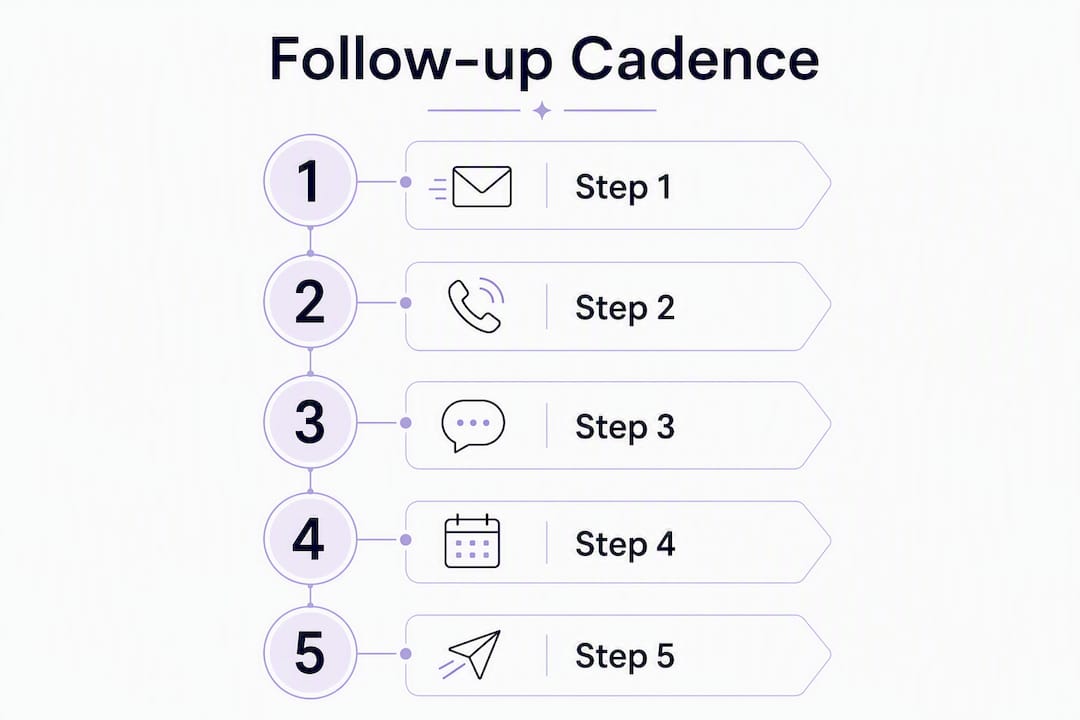
Why Fibonacci spacing works: early touches are close together when interest is highest. Later touches spread out, giving the prospect breathing room while keeping the sequence alive. The result feels deliberate, not aggressive.
| Day | Channel | Purpose | Typical reply-rate range |
|---|---|---|---|
| 0 | Initial outreach | 5% | |
| 2 | First follow-up (context + value) | 5% | |
| 5 | Social touchpoint or DM | 3% | |
| 9 | Value-add (case study or insight) | 4–7% | |
| 14 | Phone/VM | Live call or voicemail | 3–5% |
| 21 | Calendar CTA | 3–5% | |
| 28 | Break-up email | — |
When to stop and re-queue:
- Stop the sequence immediately when the prospect replies (any reply), books a meeting, or unsubscribes.
- After the break-up email, move the contact to a long-term nurture queue and re-engage in 60–90 days with fresh context.
- For sales pipeline optimization, flag re-queued contacts with a “future opportunity” tag so they surface automatically when the next trigger fires.
Break-up subject line examples:
- “Should I close your file?”
- “Okay to let this go?”
- “Last note from me”
When should you add a second or third channel?
Email is the backbone of any follow-up sequence. Add phone and LinkedIn at specific inflection points, not from the start, and not on every touch. The goal is presence without pressure.
Channel-choice rules:
- Add phone at day 14 if the prospect opened your emails but never replied. A live call or voicemail breaks the pattern and often surfaces the real objection.
- Use LinkedIn at day 5 for prospects where you share a connection, they’re active on the platform, or their company recently posted something you can reference.
- Pause automation immediately when a prospect replies, even if the reply is negative. Continuing a sequence after a “not interested” response is one of the fastest ways to damage your sender reputation.
- Direct mail (a handwritten note or a relevant physical piece) works well at day 14–21 for high-value enterprise prospects where the deal size justifies the effort.
Example multi-channel sequences:
High-intent prospect (demo requested, no-show):
- Day 0: Email (reschedule + two time options)
- Day 1: LinkedIn DM (brief, friendly)
- Day 3: Phone call or voicemail
- Day 7: Email (value-add + final reschedule offer)
Cold outreach (no prior contact):
- Day 0: Email (initial outreach)
- Day 2: Email (first follow-up)
- Day 5: LinkedIn connection request
- Day 9: Email (value-add)
- Day 14: Voicemail
- Day 21: Email (calendar CTA)
- Day 28: Break-up email
Channel etiquette notes:
- Send emails Tuesday through Thursday, 9–11 AM local time. Avoid Friday afternoons and Monday mornings.
- Keep LinkedIn messages under 75 words. Longer messages on social read as copy-paste blasts.
- Set suppression rules in your CRM so a prospect who replies to email is automatically removed from the phone and LinkedIn queue.
What mistakes kill your follow-up results?
The fastest wins in outreach often come from removing bad habits rather than adding new tactics. These six mistakes account for most stalled sequences.
The six most common follow-up mistakes:
- “Just checking in” with no new value. A follow-up that adds nothing new is an inbox reminder, not a conversation starter. Every touch needs a fresh angle, a new resource, or a specific question.
- Weak, open-ended CTAs. “Let me know your thoughts” hands the cognitive load to the prospect. A closed-loop CTA (“Does Thursday at 10 AM work?”) is far easier to answer and consistently outperforms open-ended asks.
- Too-frequent touches. Daily follow-ups signal desperation and train prospects to ignore you. The Fibonacci cadence exists precisely to prevent this.
- Fake “Re:” subject lines. Prefixing a cold email with “Re:” when there was no prior thread triggers spam filters and destroys trust the moment the prospect notices.
- Ignoring engagement signals. Sending the same generic sequence to a prospect who opened your email four times and clicked your pricing link is a missed opportunity. Hot signals deserve a personalized, immediate response.
- No suppression rules. Continuing a sequence after a reply, a purchase, or an unsubscribe is both a deliverability risk and a relationship killer. Automated sequences must include suppression logic that pauses on reply, on purchase, and on unsubscribe.
Deliverability and compliance red flags:
- Authenticate your sending domain with SPF, DKIM, and DMARC before launching any sequence.
- Honor unsubscribe requests within 10 business days (CAN-SPAM requirement for U.S. senders).
- Monitor your spam complaint rate. If it climbs above 0.1%, pause and audit your sequence before continuing.
Quick dos and don’ts:
| Do | Don’t |
|---|---|
| Add one new value per touch | “Just checking in” |
| Use closed-loop CTAs | “Let me know your thoughts” |
| Suppress on reply/unsubscribe | Continue sequences after a reply |
| Reference a real signal in the opener | Use fake “Re:” prefixes |
| Space touches progressively | Send daily follow-ups |
How do you measure whether your follow-ups are working?
Measure outcomes, not activity. Opens tell you almost nothing about whether your sequence is moving deals forward. Track replies, meetings booked, and pipeline velocity instead, and connect those numbers to business results.
Primary metrics to track:
- Reply rate per sequence step: which touch generates the most replies? This tells you where your sequence is strong and where it stalls.
- Meeting booking rate: what percentage of sequences convert to a booked call? This is the real output metric for most BDR teams.
- Replies per sequence step: break this down by day and channel to identify your highest-performing touchpoints.
- Conversion to opportunity: of the meetings booked, how many become qualified pipeline? This connects follow-up quality to revenue.
- Unsubscribe and complaint rate: a rising unsubscribe rate usually means your sequence is too frequent or too generic.
A/B tests worth running:
- Hook type: signal-grounded opener (“I saw your team just hired three BDRs”) vs. benefit-led opener (“Most teams in your space cut ramp time by 30% with this one change”). Run each on 50+ contacts before drawing conclusions.
- CTA language: “Does Thursday at 10 AM work?” vs. “Here’s my calendar — grab 15 minutes.” Small wording changes can shift booking rates meaningfully.
- Cadence spacing: test a five-touch sequence vs. a seven-touch sequence on similar prospect segments. Measure reply rate and unsubscribe rate together.
Use your CRM’s automation dashboard to spot stalled sequences: any contact who has received three or more touches with zero engagement is a signal to either change the hook or move them to a cold re-queue. Automation that routes on real-time engagement signals rather than fixed delays catches these stalls before they become dead leads.
Three copy-paste cadences you can deploy today
Here are three complete sequences you can copy, customize, and schedule before your next prospecting block.
Cold outreach cadence (28 days, 7 touches)
- Day 0 (Email): Initial outreach. Signal-grounded opener + one-sentence value prop + calendar CTA.
- Day 2 (Email): First follow-up. “Wanted to make sure this didn’t get buried” + one specific detail + yes/no question.
- Day 5 (LinkedIn): Connection request or DM. Under 60 words. Reference the email thread.
- Day 9 (Email): Value-add. Share a relevant case study, stat, or insight. One question at the end.
- Day 14 (Phone/VM): Live call or voicemail. Under 30 seconds. Mention you’ll send a follow-up email immediately after.
- Day 21 (Email): Calendar CTA. Two specific time options. Keep it to three sentences.
- Day 28 (Email): Break-up. “Should I close your file?” Move to long-term nurture on no reply.
For real estate follow-up sequences, this cadence maps directly to the post-listing-inquiry workflow.
Demo no-show cadence (7 days, 4 touches)
- Day 0, within 2 hours (Email): “Missed you today. Here are two times to reschedule: [Tuesday 10 AM] or [Wednesday 2 PM]. Here’s my calendar if neither works: [link].”
- Day 1 (LinkedIn DM): Brief, friendly. “Hey [Name], sent you a reschedule note yesterday. LinkedIn might be easier — does [time] still work?”
- Day 3 (Phone/VM): Call to confirm interest. If voicemail: “Wanted to make sure the demo is still useful for you. Happy to adjust the agenda if priorities shifted.”
- Day 7 (Email): Final reschedule offer. “Last note on this — if the demo no longer makes sense, just say so and I’ll stop reaching out.”
Calendar CTA copy snippets:
- “Does [Tuesday at 10 AM] or [Thursday at 2 PM] work? [Book directly here: link]”
- “Grab 15 minutes on my calendar: [link]. I’ll send an agenda in advance.”
Post-meeting cadence (14 days, 4 touches)
- Day 0, within 24 hours (Email): Meeting recap. Bullet the key points discussed, confirm next steps, and name a decision deadline if one was mentioned.
- Day 3 (Email): Value-add follow-up. One resource tied to a specific concern they raised in the meeting.
- Day 7 (Email): Decision nudge. “Wanted to check in on [specific next step]. Is there anything on your end holding things up?”
- Day 14 (Email or Phone): Next-step nudge. If still no movement, offer to loop in another stakeholder or adjust the proposal scope.
For practical follow-up playbooks tailored to luxury and real estate sales cycles, these cadences translate directly to high-value client workflows.
How Plo implements this follow-up workflow
Plo maps the five-element message structure and Fibonacci cadence into a CRM-triggered workflow that runs without manual oversight for warm and cold contacts, while routing hot leads to a rep within minutes.
The workflow in brief:
- Lead capture fires a CRM trigger (form fill, demo request, content click, or missed meeting).
- Immediate task is created for the rep: personalize and send touch one within two hours for hot leads, or queue touch one for the next business morning for warm leads.
- Sequence branch on engagement: if the prospect opens or clicks, the CRM routes them to a high-intent branch with a shorter cadence and a rep notification. If no engagement, the standard Fibonacci sequence continues.
- Break-up + re-queue: at day 28, the break-up email fires automatically. Non-responders move to a 90-day nurture queue with a re-engagement trigger.
Implementation details:
- Triggers: form fills, email opens (3+ times), link clicks, missed meetings, and proposal views all fire distinct sequence branches.
- Suppression rules: sequences pause automatically on reply, on meeting booked, on purchase, and on unsubscribe. Suppression logic is non-negotiable for deliverability and compliance.
- Personalization layer: AI-assisted openers pull from the prospect’s LinkedIn activity, company news, and CRM history to generate signal-grounded hooks at scale.
- Rep handoff: hot leads (3+ opens or a link click) trigger an immediate rep notification with the prospect’s engagement history attached.
- Privacy and compliance: all sequences respect CAN-SPAM unsubscribe handling and include a one-click opt-out in every automated message.
The most underrated part of a working follow-up system isn’t the templates. It’s the suppression rules. A sequence that keeps firing after a prospect replies does more damage in one message than a weak template does in seven.
Automating lead generation with behavior-based triggers is what separates a follow-up system that scales from one that requires a rep to manually track every contact.
Key Takeaways
Consistent follow-up wins come from five-element messages, Fibonacci spacing, and suppression rules that protect both deliverability and relationships.
| Point | Details |
|---|---|
| Use the five-element structure | Every message needs context, a reason to reply now, specificity, one CTA, and an exit path. |
| Space touches with Fibonacci cadence | Days 0, 2, 5, 9, 14, 21, 28 preserve momentum without signaling desperation. |
| Break-up emails earn the highest replies | Well-written break-up messages generate reply rates in the 8–15% range — send them with genuine finality. |
| Measure outcomes, not opens | Track reply rate, meeting booking rate, and pipeline velocity to connect sequences to revenue. |
| Plo automates the full workflow | Plo’s CRM triggers, suppression rules, and AI personalization layer run the cadence so reps focus on live conversations. |
The follow-up habit that actually changes your numbers
Most reps underestimate how much the timing of writing a follow-up matters, not just the timing of sending it. The best follow-up you’ll ever write is the one you draft the morning after a call, when the conversation is still fresh and the specific details are easy to recall. That’s the version with a real signal in the opener, a concrete next step, and a CTA that makes sense for where the deal actually is.
There’s a version of this that plays out constantly in sales: a rep sends a generic “just checking in” email two weeks after a strong call, the prospect doesn’t reply, and the rep concludes the deal is dead. But the deal wasn’t dead. The follow-up was just forgettable. The habit worth building is simple: write the follow-up before you close your notes from the call, schedule it for the next morning, and log it in the CRM before you move to the next contact. That single discipline, applied consistently, is what separates a rep who closes 20% of their pipeline from one who closes 35%.
Plo makes your follow-up sequences run themselves
Running a disciplined follow-up cadence manually is genuinely hard. Tracking seven touches across email, phone, and LinkedIn for 40 active prospects simultaneously is where most reps drop the ball, not because they don’t know the playbook, but because the volume is unmanageable without the right system.
Plo gives real estate agents, yacht brokers, and luxury sales professionals a CRM-triggered follow-up engine that executes the Fibonacci cadence, fires suppression rules on reply or unsubscribe, and surfaces hot leads to reps the moment engagement spikes. The AI personalization layer generates signal-grounded openers at scale, so every message reads like it was written for that specific prospect, not copied from a template.
If you’re ready to see how the workflow runs in practice, book a demo and we’ll walk you through a live sequence built for your sales cycle. Or explore top prospecting tools to see how Plo fits into your existing stack.
Useful sources and further reading
- Follow-Up Email Guide: Timing, Templates, Automation, and Compliance Checklist (2026) — Tajo.io: Covers the five-element message structure, suppression rules, and compliance checklist for automated sequences.
- Follow Up Email: Guide for B2B Sales Teams (2026) — Overloop: Detailed breakdown of Fibonacci cadence, break-up email strategy, and signal-grounded personalization benchmarks.
- Automated Sales Follow-Up: A 7-Step Guide (2026) — Monday.com: Explains behavior-based triggers, routing rules, and how to connect sequence performance to pipeline metrics.
- How to Write a Follow-Up Email in 2026 — Catch: Practical timing guidance for first and second follow-ups across common sales scenarios.
- Follow-Up Email Template: 5 Copy-Paste Examples — Aeralis: Ready-to-use templates for post-meeting, proposal, and cold outreach scenarios with subject-line guidance.
- Follow Up Emails: Best Practices and 3 Key Examples — Adobe Acrobat: Best practices for tone, timing, and structure across general business, interview, and sales follow-up contexts.
- The Ultimate Guide on How to Write a Follow-Up Email — HubSpot: Step-by-step framework for determining objective, opening with context, and crafting subject lines that get opened.
- Real estate follow-up strategies that convert more clients — Plo: Cadence examples and templates tailored to real estate and luxury brokerage sales cycles.
- Why automate lead generation to grow your real estate business — Plo: Explains how CRM automation and behavior-based triggers prevent dropped sequences and route hot leads immediately.