

Effective lead follow-up is the deliberate process of re-engaging prospects with timely, value-driven communications designed to advance sales conversations and build lasting client relationships. Most agents and brokers lose deals not because their pitch was weak, but because they stopped reaching out too soon. Strategic follow-up is where the real money lives. Knowing how to follow up with leads, and doing it with purpose, separates the brokers who close consistently from those who wonder why their pipeline keeps stalling.
How to follow up with leads: timing is everything
The single most important variable in lead follow-up is speed. You should follow up within 5–30 minutes of a form submission, or within 2 hours after a sales call. That window is when the prospect’s interest is highest and your brand is freshest in their mind.
Most agents wait until the next morning. By then, the lead has already spoken to someone else.
For stalled leads, the standard cadence is 4–6 touches over 7–14 days. For complex B2B or luxury sales, a full nurturing sequence can extend to 6–10 touches over 30–60 days. The key is spacing those touches so you stay present without becoming noise.
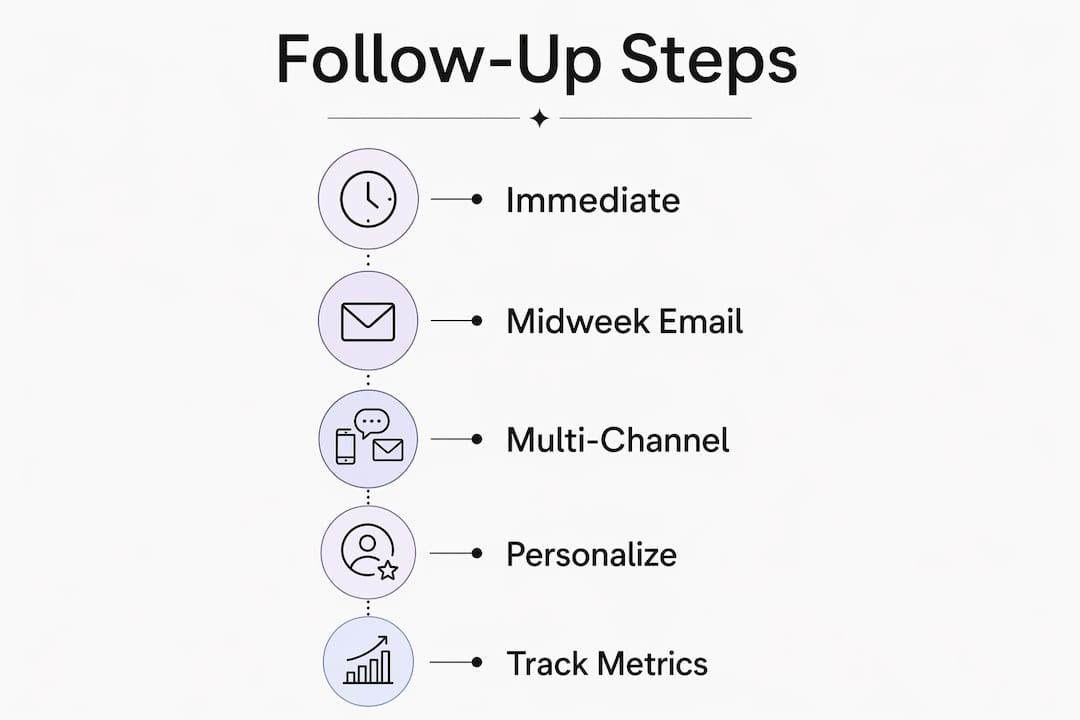
- Day 1: Call or text within 30 minutes of inquiry, then send a brief email recap
- Day 2–3: Follow up with a value-add email (a market report, a relevant listing, or a case study)
- Day 5: Phone call with a specific question tied to their stated needs
- Day 8–10: Switch channels. Try a video message or a LinkedIn connection
- Day 14: Send a “break-up” message that gives them a graceful exit
Pro Tip: Send your first follow-up email on a Tuesday, Wednesday, or Thursday morning. Open rates peak mid-week during business hours, and that timing alone can lift your reply rate noticeably.
What makes a follow-up message actually work?
The phrase “just checking in” is the fastest way to get ignored. It puts the burden on the prospect to remember why they should care. A message that earns a reply does the opposite: it reminds them of the context, adds something new, and makes the next step obvious.

Effective follow-up emails follow a clear structure: a subject line tied to your last conversation, a one-sentence context opener, a brief recap of their situation, one new piece of value, and a single low-friction call to action. That structure keeps you focused and keeps the prospect oriented.
Keep your emails under 150 words. Brevity signals confidence. Confident, brief messages consistently outperform long, apologetic ones because they respect the reader’s time without hedging.
Here is what a strong follow-up message includes:
- Context anchor: Reference your last interaction specifically (“When we spoke Tuesday about the Brickell listing…”)
- New value: Add something they did not have before. A comparable sale, a neighborhood insight, or an answer to a question they raised
- Single CTA: Ask for one thing only. “Does Thursday at 2 PM work for a 15-minute call?” is better than three options and an open-ended question
- Confident tone: Write as a trusted advisor, not as someone apologizing for reaching out
Pro Tip: Avoid subject lines like “Following up again.” Instead, use the prospect’s name or a specific detail: “The Coral Gables property you asked about” gets opened. Generic subjects get archived.
What channels and sequences drive the best results?
Email alone is not enough. Switching channels during a follow-up sequence increases meetings booked by 2.5 times compared to email-only outreach. That number reflects a simple truth: people live in different inboxes, and variety breaks through the monotony of a crowded email feed.
A well-built multi-channel sequence for real estate and luxury brokerage looks like this:
- Touch 1 (Day 1): Phone call, followed immediately by a text or email summary
- Touch 2 (Day 2): Email with a value-add resource (market data, listing comparison)
- Touch 3 (Day 5): Phone call with a specific, prepared question
- Touch 4 (Day 8): Video message via a tool like Loom, personalized to their property interest
- Touch 5 (Day 11): LinkedIn message or direct message on the platform where they are active
- Touch 6 (Day 14): Break-up message with an easy opt-out
Automation makes this manageable, but only when you build it correctly. Clear suppression logic stops your sequence the moment a lead replies or books a meeting. Without that rule, your CRM keeps firing messages to someone who already said yes, and that destroys trust fast.
Track open rates, click rates, and reply rates for each touch. When a specific message type consistently underperforms, cut it and test something new. Your sequence is a living document, not a set-and-forget system.
Pro Tip: Use lead segmentation to tailor your channel mix. A first-time buyer responds differently than a luxury investor. One sequence does not fit all.
| Channel | Best use case | Typical response window |
|---|---|---|
| Value-add content, recaps, CTAs | 24–48 hours | |
| Phone call | Urgent follow-up, relationship building | Immediate |
| Video message | Personalized outreach, property tours | 24–72 hours |
| LinkedIn DM | Professional leads, B2B referral contacts | 48–96 hours |
| Text message | Time-sensitive updates, quick confirmations | Under 2 hours |
How to nurture leads and build trust over time
60% of prospects say “no” four times before eventually saying “yes.” That statistic reframes every unanswered message. Silence is not rejection. It is usually timing.
The agents who convert those slow-burn leads treat every follow-up as a value delivery moment, not a reminder. Each message should leave the prospect better informed than before you reached out. A market update, a recently sold comparable, a candid answer to a concern they raised weeks ago: these are the touches that build authority.
“Being honest, even when that means acknowledging a property is not the right fit, builds the kind of credibility that turns a lead into a client and a client into a referral source. Transparency is not a weakness in sales. It is the foundation of every durable relationship.”
Honesty in follow-up includes acknowledging when the timing is not right for the prospect. Offering an easy opt-out, and meaning it, signals that you respect their decision. Paradoxically, that respect often prompts a reply when nothing else has.
Personalization is the other lever most agents underuse. Referencing a detail from a prior conversation, a neighborhood they mentioned, or a concern they raised, signals that you were listening. That signal is rare. It makes you memorable in a field where most follow-ups feel copy-pasted.
To nurture leads effectively over a longer cycle, build a content calendar of value-add touches: monthly market reports, neighborhood spotlights, and client success stories. These keep you top of mind without asking for anything. When the prospect is ready to move, you are the first call they make.
Key Takeaways
Consistent, value-driven follow-up across multiple channels, timed within the critical first 30 minutes and sustained over 4–6 structured touches, is the most reliable path from initial contact to closed deal.
| Point | Details |
|---|---|
| Speed wins the first contact | Follow up within 5–30 minutes of a new inquiry to catch peak interest. |
| Value beats volume | Every message must add something new: data, insight, or a direct answer. |
| Multi-channel outreach works | Mixing email, phone, video, and social increases meetings booked by 2.5 times. |
| Automation needs exit rules | Suppress sequences the moment a lead replies or books to avoid over-contacting. |
| Persistence pays off | 60% of prospects decline four times before agreeing, so a structured cadence matters. |
What I’ve learned about follow-up after years in the field
The biggest mistake I see agents make is treating follow-up like a chore they owe the lead. That mindset produces apologetic, vague messages that get ignored. The shift that changes everything is treating each touch as an opportunity to be genuinely useful.
I have watched agents send 10 identical “just checking in” emails and wonder why no one responds. I have also watched a single well-timed video message, referencing a specific property detail, book a meeting that had been cold for six weeks. The difference is not persistence. It is relevance.
The break-up message is one of the most underrated tools in the sequence. A simple, honest note that says “I do not want to keep reaching out if the timing is not right. If you would like to pause, just say the word” does two things. It removes pressure, and it often prompts a reply from leads who felt guilty about going quiet. I have closed deals from break-up messages more times than I can count.
On automation: use it, but own it. Know exactly what your CRM is sending and when. Build suppression rules before you launch any sequence. A lead who books a call and then receives three more automated emails the next day will not show up to that call with confidence in you.
The agents who master real estate follow-up strategies are not the ones who reach out the most. They are the ones who make every touch feel like it was written specifically for that person, on that day, about that deal.
— Jason
Plo gives your follow-up process real teeth
Running a disciplined follow-up sequence across email, phone, and social is hard to do manually at scale. Plo is built for exactly this: giving real estate agents, yacht brokers, and luxury brokers the tools to run structured, personalized outreach without dropping a single lead.
Plo’s platform tracks engagement at every touchpoint, fires suppression logic the moment a lead responds, and surfaces the contacts most ready to move. You get the top prospecting tools built for high-value sales cycles, not generic CRM workflows. If you are ready to run a follow-up process that actually converts, Plo is where that work gets done. See what sales automation for brokers looks like when it is built for your market.
FAQ
How soon should I follow up with a new lead?
Follow up within 5–30 minutes of a form submission and within 2 hours after a sales call. That window captures peak interest before the prospect moves on.
How many times should I follow up before stopping?
A standard cadence runs 4–6 touches over 7–14 days for stalled leads. Research shows 60% of prospects say “no” four times before agreeing, so stopping after one or two attempts costs you real revenue.
What should I say in a follow-up email?
Open with a specific reference to your last interaction, add one new piece of value, and close with a single clear call to action. Keep the message under 150 words and avoid vague phrases like “just checking in.”
Does multi-channel outreach really make a difference?
Switching between email, phone, video, and social during a sequence increases meetings booked by 2.5 times compared to email alone. Channel variety breaks through inbox fatigue and reaches prospects where they are most active.
When is the best time to send a follow-up email?
Send follow-up emails on Tuesday, Wednesday, or Thursday mornings. Mid-week morning sends consistently produce the highest open rates across sales outreach.