

Sales prospecting is the repeatable process of identifying, researching, and engaging potential clients to build a qualified pipeline that converts. Most agents and brokers treat it as a numbers game. It is not. A step by step prospecting guide forces you to think in systems, not sprints. The difference between a packed pipeline and a dry one almost always comes down to structure: a defined ideal customer profile (ICP), a multi-channel outreach sequence, and a qualification framework like BANT or MEDDIC applied consistently. This guide gives you that structure, built around 2026 best practices for real estate agents, luxury brokers, and sales professionals who want predictable results.
What is a step by step prospecting guide?
Sales prospecting is defined as a consistent pipeline-building process that combines account research, personalized outreach, qualification, and handoff to the next stage of the sales cycle. The industry term is “sales prospecting,” and the phrase “step by step” simply means you follow a fixed sequence every time, rather than improvising. That repeatability is what separates top producers from everyone else.
The core insight is this: prospecting is the art of relevance, not volume. Initiating a conversation only works when you demonstrate that you understand the prospect’s real problem before you ever send a message. Agents who open with “I’d love to connect” get ignored. Agents who open with a specific observation about a prospect’s recent listing activity get replies.
Three concepts anchor every effective prospecting system. First, the ICP defines exactly who you are targeting. Second, a multi-channel sequence coordinates email, phone, and social touches into one coherent campaign. Third, a qualification framework filters out poor fits early so you spend time only on winnable deals.
What do you need before you start prospecting?
Skipping the setup phase is the most common reason prospecting fails. You need three things in place before you contact a single prospect.
Define your ICP with real data. Your ideal customer profile is not a guess. Pull your last 20 closed deals and identify the patterns: property type, price range, neighborhood, transaction timeline, and how the client found you. Those patterns define your ICP. Qualitative signals matter too. Note which clients referred others, which ones were easiest to work with, and which deals closed fastest.
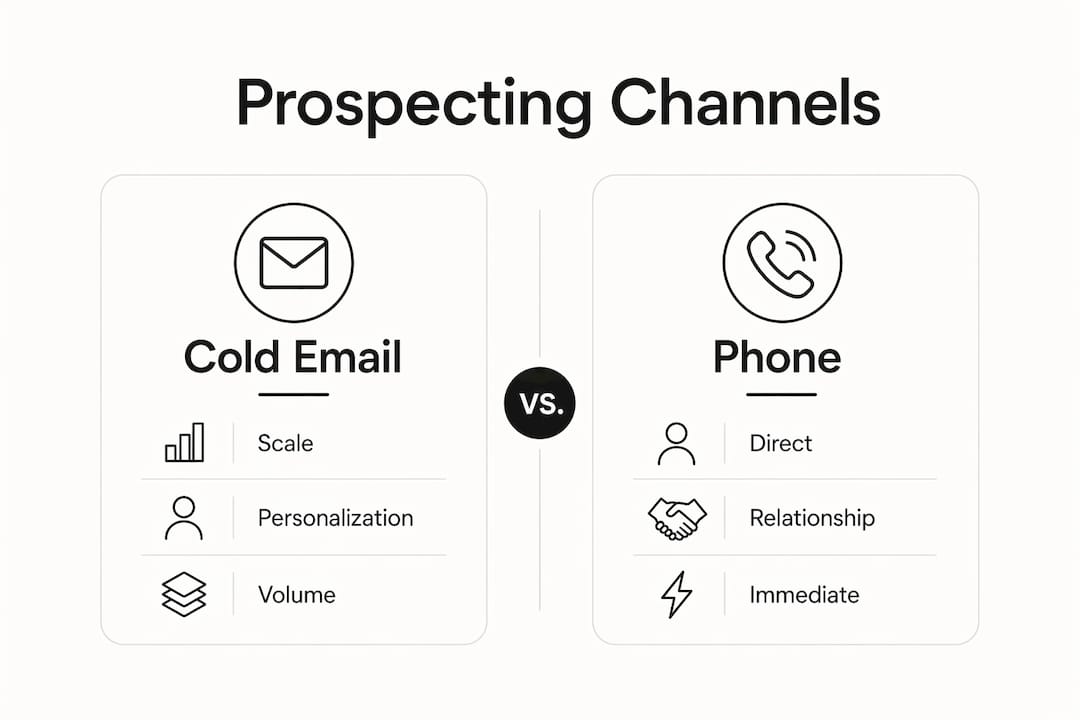
Select two or three prospecting channels. Combining email, phone, and LinkedIn into a coordinated sequence produces more predictable revenue than relying on any single method. That does not mean you need to be everywhere. Pick the channels your target audience actually uses and commit to them.
Set up your CRM before outreach begins. Logging activity in real time is non-negotiable. A CRM that is updated after the fact is a CRM full of errors. Choose a platform that lets you log calls, emails, and notes immediately after each interaction.
| Channel | Best for | Key limitation |
|---|---|---|
| Cold email | Scale and personalization at volume | Inbox competition is high |
| Phone outreach | High-value, time-sensitive prospects | Requires strong opening scripts |
| LinkedIn / social selling | Relationship-based, warm introductions | Slower to convert |
| Referral networks | High trust, high conversion | Limited volume |
How do you build a prospecting workflow that actually works?
A proven prospecting workflow runs in six steps. Each step feeds the next, and skipping one breaks the chain.

Step 1: Build a focused prospect list
Quality beats volume every time. A focused list of 100 well-matched prospects consistently outperforms mass outreach to 1,000 random contacts. That ratio matters because every personalized message takes time, and time spent on poor-fit prospects is time stolen from winnable ones. Use your ICP to filter your list before you write a single word of outreach. For real estate agents, this means targeting by neighborhood, property type, and transaction history, not just zip code.
Step 2: Research each prospect efficiently
Spend no more than 3–7 minutes researching each prospect. Focus on one specific trigger and one proof point per contact. A trigger is a recent event: a new listing, a price reduction, a neighborhood sale. A proof point is something you have done that is directly relevant to their situation. That combination gives you a personalized opener without sending you into a research spiral.
Step 3: Design a multi-touch sequence
The 2026 benchmark for outreach cadences is eight touches over 14 days. That sequence should span at least two channels. A sample structure looks like this:
- Day 1: Personalized email referencing the trigger
- Day 2: LinkedIn connection request with a brief note
- Day 4: Follow-up email with a relevant insight or market stat
- Day 6: Phone call
- Day 8: LinkedIn message
- Day 10: Email with a case study or social proof
- Day 12: Phone call with a voicemail
- Day 14: Final email with a clear close or opt-out offer
Pro Tip: Space your touches further apart as the sequence progresses. Early touches can be 1–2 days apart. Later touches should be 3–4 days apart. This respects the prospect’s attention without disappearing from their radar.
Step 4: Execute outreach at the right time
Timing is not a minor detail. Tuesday through Thursday produce the highest response rates, while Monday mornings and Friday afternoons consistently underperform. Within those days, the 10–11 AM and 2–3 PM windows tend to catch prospects between tasks rather than in the middle of them.
Step 5: Log activity immediately
Logging prospecting activity immediately after contact maintains CRM accuracy and prevents missed follow-ups. The rule is simple: if it is not in the CRM, it did not happen. Set a personal standard of logging within five minutes of every call or email sent.
Step 6: Qualify with a framework
BANT (Budget, Authority, Need, Timeline) and MEDDIC (Metrics, Economic Buyer, Decision Criteria, Decision Process, Identify Pain, Champion) are the two most widely used qualification frameworks in sales. BANT works well for shorter sales cycles. MEDDIC fits complex, high-value transactions like luxury real estate or yacht brokerage. Apply your chosen framework at the first substantive conversation to decide whether a prospect belongs in your active pipeline or a nurture list.
| Step | Objective | Key output |
|---|---|---|
| List building | Identify high-fit prospects | Filtered prospect list |
| Research | Find trigger and proof point | Personalized opener |
| Sequence design | Plan multi-touch cadence | 8-touch, 14-day plan |
| Execution | Contact at optimal times | Sent messages and calls |
| Logging | Maintain CRM accuracy | Real-time activity records |
| Qualification | Prioritize pipeline | BANT or MEDDIC score |
What are the most common prospecting mistakes?
Most prospecting failures trace back to four repeatable errors. Recognizing them is the first step to fixing them.
-
Generic outreach. AI-generated templates that could apply to anyone convert at near-zero rates. Every message needs a specific trigger reference. “I saw your Maple Street listing dropped in price last week” outperforms “I help agents like you grow their business” every single time. Consistency and relevance beat volume in every prospecting study conducted in the last five years.
-
Abandoning after one or two touches. Most prospects need multiple contacts before they respond. Stopping after one email is not being respectful. It is leaving pipeline on the table.
-
Research paralysis. Spending 30 minutes researching a single prospect before sending one email is a productivity trap. Cap your research at 7 minutes and move on. The goal is a relevant opener, not a biography.
-
Treating “not interested” as a dead end. “Not interested” is a conversation starter, not a stop sign. A scripted pivot like “Completely understand. Can I ask what your current situation looks like so I know if there’s ever a better time to reach out?” keeps the door open without being pushy.
Pro Tip: Block 90 minutes each morning exclusively for prospecting before you check email or take calls. Prospecting done first gets done. Prospecting saved for later gets skipped.
How do you measure and improve prospecting performance?
Tracking prospecting metrics like response rates, meetings booked, and conversion ratios is what separates agents who grow from agents who plateau. Without data, you are guessing at what works.
The three metrics that matter most are:
- Response rate: The percentage of prospects who reply to any touch in your sequence. A healthy benchmark for personalized outreach is above 10%.
- Meeting rate: The percentage of responses that convert to a booked call or showing. This measures the quality of your qualification conversation.
- Pipeline conversion ratio: The percentage of meetings that advance to an active deal. This is your ultimate measure of ICP accuracy.
Review these numbers weekly, not monthly. A weekly review catches problems in your sequence before they compound. If your response rate drops, test a new subject line or opening trigger. If your meeting rate drops, revisit your qualification questions. If your conversion ratio drops, your ICP may need tightening.
Most CRM platforms offer automated reporting dashboards that surface these numbers without manual calculation. Use them. The goal is to spend your analysis time on decisions, not on pulling data. For agents using prospecting tools built for real estate, automated dashboards are standard, not a premium add-on.
Prospecting in 2026: what I’ve actually learned
Prospecting is the one part of sales that never gets easier, no matter how long you have been doing it. I have watched agents with years of experience still dread their prospecting blocks. The reason is almost always the same: they are treating it as a volume exercise instead of a relevance exercise.
The agents who build real pipelines are not the ones sending the most messages. They are the ones who spend five minutes understanding a prospect’s specific situation before they reach out. That specificity is what gets replies. It is also what builds the kind of trust that converts a cold contact into a long-term client.
The technology available in 2026 is genuinely useful. Automated sequences, CRM integrations, and AI-assisted research tools can handle the mechanical parts of prospecting. But automation must be paired with authentic openers that reference real research. A sequence that fires off generic messages at scale is not prospecting. It is spam with a schedule.
My honest advice: commit to 100 well-researched prospects before you ever think about scaling to 1,000. Master the sequence. Master the qualification conversation. Then let technology amplify what already works. Trying to automate a broken process just produces broken results faster. The real estate prospecting guide Plo publishes takes this same approach, and it is worth reading alongside this framework.
— Jason
Plo’s tools for agents who are serious about their pipeline
Real estate agents and luxury brokers who follow a structured prospecting process need tools that keep pace with their workflow, not slow it down.
Plo builds prospecting and sales cycle tools specifically for agents, yacht brokers, and luxury brokers who want to amplify the work they are already doing. From automated multi-touch cadences to real-time CRM dashboards, Plo’s platform handles the mechanics so you can focus on the conversations that close deals. If you are ready to see what a purpose-built prospecting system looks like in practice, explore Plo’s prospecting tools or book a demo call with the team to see it in action.
Key takeaways
Effective prospecting is a repeatable, multi-channel system built on ICP clarity, timed outreach, and consistent qualification, not volume alone.
| Point | Details |
|---|---|
| Quality over volume | A focused list of 100 well-matched prospects outperforms 1,000 random contacts every time. |
| Multi-touch sequences | Eight touches over 14 days is the 2026 benchmark for balanced, effective outreach cadences. |
| Timing drives response rates | Tuesday through Thursday outreach produces the highest response rates; avoid Monday mornings and Friday afternoons. |
| Log activity immediately | Real-time CRM logging prevents missed follow-ups and keeps your pipeline data accurate. |
| Measure three core metrics | Track response rate, meeting rate, and pipeline conversion ratio weekly to catch and fix problems fast. |
FAQ
What is prospecting in sales?
Sales prospecting is the process of identifying and engaging potential clients to build a qualified pipeline. It combines account research, personalized outreach, and qualification to move prospects toward a sales conversation.
How many touches does an effective prospecting sequence need?
The 2026 benchmark is eight touches over a 14-day period, spread across at least two channels such as email and phone. Spacing touches further apart as the sequence progresses respects the prospect’s attention without losing momentum.
What is the best time to reach out to prospects?
Tuesday through Thursday produce the highest response rates for prospecting outreach. Within those days, the 10–11 AM and 2–3 PM windows consistently outperform other time slots.
What qualification frameworks work best for real estate prospecting?
BANT works well for shorter sales cycles, while MEDDIC fits complex, high-value transactions like luxury real estate or yacht brokerage. Apply your chosen framework at the first substantive conversation to prioritize your pipeline accurately.
How do you avoid research paralysis when prospecting?
Cap your research at 3–7 minutes per prospect and focus on one specific trigger and one proof point. That combination gives you a personalized opener without pulling you into an unproductive deep dive.