

Sales velocity is defined as the rate at which your sales pipeline generates revenue, calculated by combining four inputs: number of opportunities, win rate, average deal size, and sales cycle length. The formula produces a daily or monthly revenue figure that tells you exactly how fast your pipeline converts effort into dollars. For real estate agents, yacht brokers, and luxury sales professionals, this number is not just a reporting metric. It is the clearest signal of whether your sales engine is actually working.
What is sales velocity and how do you calculate it?
Sales velocity measures how quickly revenue flows through your pipeline. The formula is straightforward: (Number of Opportunities × Win Rate × Average Deal Size) ÷ Sales Cycle Length. The result is revenue generated per day, which functions as the true output of your entire sales system.

Each component carries real weight. Number of opportunities is the count of active deals in your pipeline right now. Win rate is the percentage of those deals you actually close. Average deal size is the typical contract value. Sales cycle length is the number of days from first contact to signed agreement.
Here is a simple example to make the math concrete:
| Input | Example Value |
|---|---|
| Number of opportunities | 50 |
| Win rate | 25% |
| Average deal size | $250,000 |
| Sales cycle length (days) | 60 |
| Sales velocity (per day) | $52,083 |
A mid-market sales team running these numbers produces roughly $3.76M per quarter. That figure is not a forecast. It is the actual engine output of the sales system at its current settings.
Pro Tip: Track your sales velocity monthly, not quarterly. Monthly tracking catches pipeline slowdowns six to eight weeks before they show up in closed revenue, giving you time to act.
Why is sales velocity important and how does it differ from other metrics?
Sales velocity reveals pipeline quality and pace together. Volume-based metrics like total pipeline value or lead count can mask slow-moving deals that inflate your numbers without ever closing. Sales velocity cuts through that noise by weighting speed alongside size and probability.
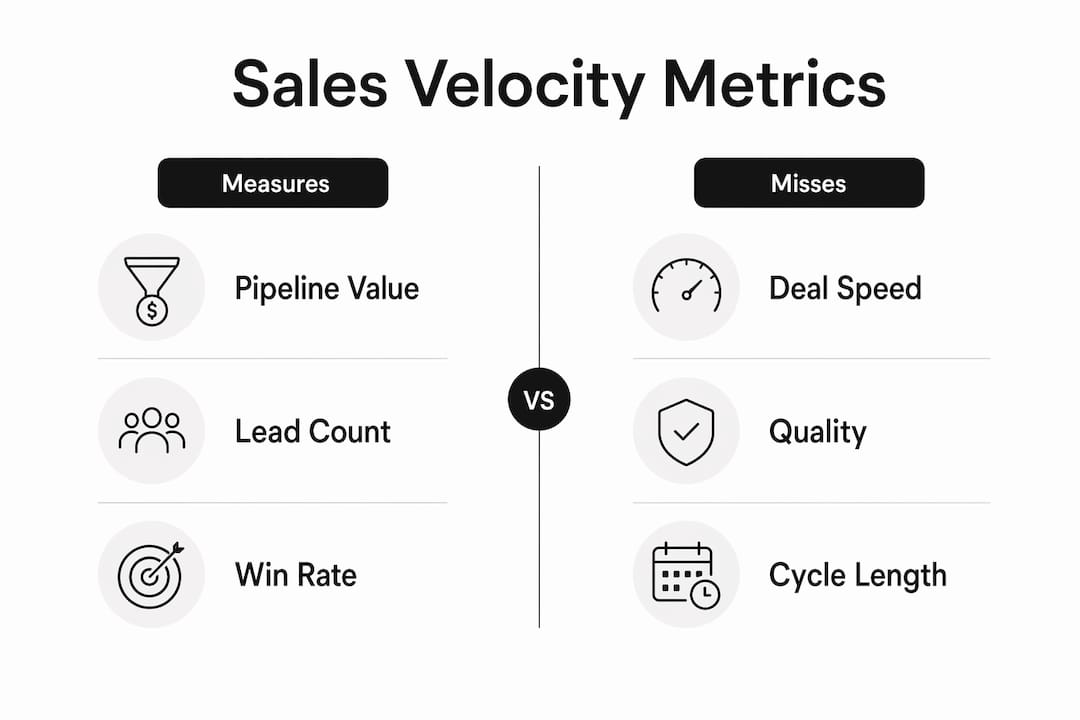
Here is how it compares to related metrics:
| Metric | What it measures | What it misses |
|---|---|---|
| Pipeline coverage | Total value vs. quota | Deal speed and quality |
| Lead velocity rate | Growth rate of new leads | Whether leads actually close |
| Deal velocity | Speed of individual deals | Overall pipeline health |
| Sales velocity | Revenue per day across all deals | Individual deal nuance |
Sales velocity also plays a direct role in forecasting. Because it reflects current pipeline conditions rather than historical averages, it gives leadership a real-time read on whether the team will hit its number. That is why many RevOps teams use “pipeline velocity” as their internal term for the same formula, while sales leadership calls it sales velocity. The math is identical. The audience changes the label.
Pro Tip: Use sales velocity as your weekly pipeline review anchor. If velocity drops two weeks in a row, you have a structural problem, not a bad month.
What factors most influence sales velocity and how can you improve it?
The four levers of sales velocity are opportunity volume, win rate, deal size, and cycle length. Each one moves the needle. The mistake most teams make is pulling all four at once, which makes it impossible to know what actually worked.
The right way to run a velocity diagnostic
Follow these steps to identify and fix your weakest lever:
- Calculate your current velocity. Run the formula with your last 90 days of data. Get a baseline number before changing anything.
- Identify your lowest-performing input. If your win rate is below 20%, that is your problem. If your cycle length exceeds 90 days, start there.
- Isolate one lever and change it. Adjust only that variable for 30 days. Measure the impact on your daily revenue rate.
- Document the result. Did velocity increase? By how much? Only after confirming the improvement should you move to the next lever.
- Repeat the cycle. Velocity improvement is incremental. Compounding small gains across all four levers produces dramatic results over two to three quarters.
Cycle compression is the most underrated lever
Reordering procurement and legal reviews to the first week of the sales process can cut 30 or more days from your cycle length. That single change can roughly double your revenue per day without adding a single new opportunity to the pipeline. Most brokers never touch this because it requires coordinating with buyers early, which feels uncomfortable. Do it anyway.
Deals closed within 50 days win at twice the rate of deals that drag past that mark, with a 47% win rate for sub-50-day cycles versus 20% for longer ones. Shorter cycles do not just feel better. They statistically produce more revenue.
The funnel-stuffing trap
Sub-$10M revenue teams frequently increase lead volume to solve a win rate problem. This is the wrong fix. Adding unqualified opportunities to a leaky pipeline dilutes your team’s focus and drives conversion rates lower. The correct response is to tighten qualification criteria and compress the cycle, not flood the top of the funnel.
“The fastest path to higher sales velocity is not more leads. It is fewer, better leads moving through a shorter, cleaner process.” — Plo editorial team
For real estate agents and luxury brokers, this means qualifying harder at the first showing or initial consultation. A prospect who needs four months of hand-holding before making an offer is not a good opportunity. They are a velocity killer.
Pro Tip: Score your pipeline by behavioral signals, not just CRM stage. Multi-threading and meeting cadence predict deal velocity more accurately than the date a deal was created in your CRM.
You can also review pipeline optimization steps built specifically for real estate professionals to apply these frameworks to your market.
How do 2026 buyer behavior changes affect sales velocity?
The modern buying process has shifted decisively toward committee-driven decisions and pre-contact research. B2B purchasing now involves consensus-driven buying committees of 6–10 stakeholders. In luxury real estate and high-value brokerage, that dynamic shows up as family members, financial advisors, and legal counsel all weighing in before a deal moves forward.
The more significant shift is this: 95% of vendor shortlists are shaped by pre-contact positioning before formal sales engagement begins. That means your reputation, your listings presentation, and your digital presence determine whether you are even in the conversation before you make your first call.
Here is what that means for velocity in practice:
- Get visible before the buyer reaches out. Content, referrals, and local market authority all shorten the time from first contact to serious conversation.
- Reduce friction in the early stages. Every unnecessary step between inquiry and first meeting adds days to your cycle. Automate scheduling, pre-qualify with a short intake form, and have your pitch ready before the first call.
- Multi-thread from day one. In committee-driven deals, connecting with only one stakeholder is a velocity risk. Identify all decision-makers early and engage them in parallel.
- Address objections before they surface. Buyers who have done their research arrive with specific concerns. Sales teams that anticipate and address those concerns in the first meeting compress the middle of the cycle dramatically.
- Use nurture sequences to maintain momentum. Deals stall when buyers go quiet. A structured lead nurturing approach keeps your pipeline moving without requiring constant manual follow-up.
The brokers who win in 2026 are not the ones with the most leads. They are the ones who show up at the right moment, already trusted, with a process that moves fast.
Key Takeaways
Sales velocity is the single most complete measure of sales performance because it captures speed, quality, and volume in one number.
| Point | Details |
|---|---|
| Core formula | Multiply opportunities, win rate, and deal size, then divide by cycle length to get daily revenue. |
| Cycle length matters most | Deals closed within 50 days win at twice the rate of longer cycles. |
| Fix one lever at a time | Isolating one variable lets you measure real impact before changing anything else. |
| Pre-contact positioning | 95% of shortlists form before a buyer contacts a seller, so visibility drives velocity. |
| Avoid funnel stuffing | Adding unqualified leads lowers win rate and reduces overall velocity. |
The uncomfortable truth about sales velocity most teams ignore
I have watched sales teams obsess over pipeline size while their velocity quietly collapsed. They had 200 active deals and were closing fewer than they did with 80. The problem was never volume. It was that nobody was asking the hard question: why is our win rate dropping?
Sales velocity forces that conversation. When you put a single number on the health of your pipeline, you cannot hide behind “we have a lot in the works.” Either your revenue per day is growing or it is not.
The insight that changed how I think about this metric is cycle compression. Most brokers treat the sales cycle as a fixed variable, something that just takes as long as it takes. That is wrong. The cycle length is the most controllable input in the formula, and it is the one that gets the least attention. Moving procurement conversations and legal reviews to week one of the process feels aggressive. But it is the difference between a 45-day close and a 90-day close, and that difference roughly doubles your revenue per day without a single new lead.
The other thing I would tell any broker or sales leader: resist the urge to change everything at once. Pick your weakest lever, fix it, measure the result, and move on. That discipline is rare. It is also what separates teams that grow predictably from teams that are always chasing their number.
— Jason
How Plo helps you build a faster, cleaner pipeline
Real estate agents and luxury brokers who understand their sales velocity still need the right tools to act on it. Knowing your number is step one. Having a system that improves it is step two.
Plo gives brokers the prospecting and pipeline tools to move faster at every stage. From identifying qualified local leads to tracking deal progress and automating follow-up, Plo amplifies the work you are already doing. The platform is built for agents who want to close more deals in less time, without adding headcount or complexity. See the top prospecting tools Plo recommends for building a high-velocity pipeline, or book a demo to see how it fits your market.
FAQ
What is the sales velocity formula?
Sales velocity equals (Number of Opportunities × Win Rate × Average Deal Size) ÷ Sales Cycle Length. The result is the revenue your pipeline generates per day.
What is a good sales velocity benchmark?
Benchmarks vary by market and deal size. A useful internal benchmark is whether your velocity is growing month over month. Deals closed within 50 days win at twice the rate of longer cycles, making cycle length the most impactful variable to watch.
How does sales velocity differ from pipeline velocity?
The formulas are identical. Many sales organizations use “sales velocity” in leadership discussions and “pipeline velocity” in RevOps contexts for pipeline health analysis. The terminology reflects audience preference, not a different calculation.
What is the fastest way to improve sales velocity?
Compress your sales cycle by moving procurement and legal conversations to the first week of the process. This single change can cut 30 or more days from your cycle and roughly double your daily revenue rate without adding new opportunities.
Why does win rate matter more than lead volume?
A higher lead volume with a low win rate dilutes team focus and reduces conversion. Improving qualification criteria and shortening the cycle produces more revenue than adding unqualified leads to the top of the funnel.