

Most real estate agents are sitting on a goldmine they never touch. The average agent follows up with only 11% of their database in a given month, which means nearly 9 out of 10 potential clients are going silent while another agent earns their trust. The gap between a struggling agent and a top producer often isn’t talent, market access, or listings. It’s follow-up. This article breaks down exactly why follow-up is the most leveraged activity in your business, what the data says about effective touchpoints, and how you can build a system that converts more prospects into loyal, referring clients.
Table of Contents
- Why follow-up is the key to real estate success
- Essential elements of a winning follow-up strategy
- Benchmarks and data: What the numbers say about follow-up
- Personalization: The secret ingredient of follow-up success
- What most agents miss about follow-up strategy
- Upgrade your follow-up: Tools and next steps
- Frequently asked questions
Key Takeaways
| Point | Details |
|---|---|
| Follow-up is essential | Consistent, structured follow-up is the backbone of higher real estate conversions. |
| Multi-touch wins | Agents reaching out 7+ times via multiple channels dramatically outperform single-touch approaches. |
| Use data and automation | CRMs help track follow-ups and ensure your prospects never fall through the cracks. |
| Personalization adds value | Being relevant and value-driven turns follow-up from annoying to engaging, boosting response rates. |
| Mindset matters most | Technologies are tools; curiosity, discipline, and process make the biggest difference in results. |
Why follow-up is the key to real estate success
A follow-up strategy in real estate is a structured, repeatable process for staying in contact with leads, past clients, and prospects at the right time, through the right channel, with the right message. It’s not a one-time check-in call. It’s a deliberate system designed to move people from interest to action.
Here’s the uncomfortable truth: the follow-up impact for brokers is enormous, yet most agents treat it like an afterthought. Top producers prioritize follow-up as aggressively as they prioritize lead generation. Meanwhile, average agents spend thousands on marketing and then let warm leads go cold because they never made a second call.
The opportunity gap is staggering. When you understand that nurturing real estate leads is directly tied to faster sales cycles and higher conversion rates, the ROI of a consistent follow-up system becomes impossible to ignore.
“Generating leads without a follow-up system is like filling a bucket with a hole in the bottom. The work is wasted if you don’t have the infrastructure to capture and convert.”
Here’s what gets lost when follow-up is neglected:
- Deals that should have closed go to competitors who stayed in contact longer
- Warm leads turn cold within days of first contact, making reactivation twice as hard
- Referrals dry up because clients don’t feel remembered or valued
- Client churn increases when past clients don’t hear from you between transactions
- Your database depreciates in value because unmaintained contacts drift away over time
- Trust erodes when prospects interpret silence as disinterest or lack of professionalism
Consistency and personalization work together here. Consistent follow-up without personalization feels like spam. Personalization without consistency means you show up once and disappear. The winning formula requires both, and the agents who master that combination dominate their markets. Understanding lead generation for investors further illustrates how follow-up discipline separates sustained producers from one-hit wonders.
Having established the cost of missed follow-ups, the next step is understanding what makes an effective follow-up framework.
Essential elements of a winning follow-up strategy
Top-performing agents don’t wing it. They operate a follow-up workflow that runs like a well-oiled engine. According to real estate coaching professionals, a structured multi-channel sequence using calls, texts, and emails coordinated through a CRM that tracks touch history, sets reminders, and ensures consistency over time is the gold standard methodology.
The comparison between single-touch and multi-touch approaches tells a powerful story:
| Approach | Channels Used | Avg. Response Rate | Conversion Potential |
|---|---|---|---|
| Single-touch | 1 (email or call) | 5–10% | Low |
| Multi-touch | 3+ (call, text, email) | 28–40% | High |
| Automated multi-touch | 3+ with CRM triggers | 35–55% | Very High |
| Personalized multi-touch | 3+ with tailored content | 45–65% | Highest |
The numbers make it clear. A single email or one phone call is not a strategy. It’s a gamble. Agents who use multi-channel follow-up sequences see dramatically better results because they meet prospects where they are, rather than assuming every client prefers the same communication channel.
Here are the 5 critical components of a winning follow-up strategy:
- Timing — Contact new leads within the first 5 minutes of inquiry whenever possible. Speed-to-lead is one of the strongest predictors of conversion in real estate.
- Frequency — Stay consistent without overwhelming. A structured sequence over 14 to 30 days hits multiple touchpoints without becoming noise.
- Channel mix — Combine calls, texts, emails, and even video messages to reach leads across their preferred platforms.
- Content relevance — Every message should offer something useful: a market update, a new listing, answers to their specific questions. Generic messages get ignored.
- CRM usage — Track every interaction, set automated reminders, and never rely on memory alone to manage follow-up timing.
Pro Tip: Instead of asking “Did you have any questions?” try opening with a value statement: “I just saw two homes come to market in the area you mentioned, and I think one fits your criteria well. Can we connect this week?” This reframes your outreach as helpful rather than pushy, and it gives the prospect a concrete reason to respond.
Following up after property viewings is one of the highest-leverage opportunities in your pipeline. Learning how to improve follow-ups after client walkthroughs can turn uncertain buyers into motivated, moving ones.

CRM-based automation increases reliability. But automation alone won’t do the heavy lifting if the messages lack substance. The best agents use automation to schedule and trigger outreach, then layer in genuine personalization to make each message feel human.
Benchmarks and data: What the numbers say about follow-up
The data on follow-up effectiveness is clear and compelling. Conversion rates increase sharply when agents execute 7 or more touchpoints within 14 days, with Tom Ferry coaching benchmarks showing 8.4% conversion for those agents compared to just 2.7% for single-touch follow-up. That’s more than three times the conversion rate from simply staying in contact longer.
Here’s how the numbers break down across outreach frequency:
| Outreach attempts | Avg. response rate | Avg. conversion rate | Closed transactions (per 100 leads) |
|---|---|---|---|
| 1 touch | 10–15% | 2.7% | 2–3 |
| 3–4 touches | 20–28% | 4.5% | 4–5 |
| 5–6 touches | 30–38% | 6.2% | 6–7 |
| 7+ touches in 14 days | 40–55% | 8.4% | 8–9 |
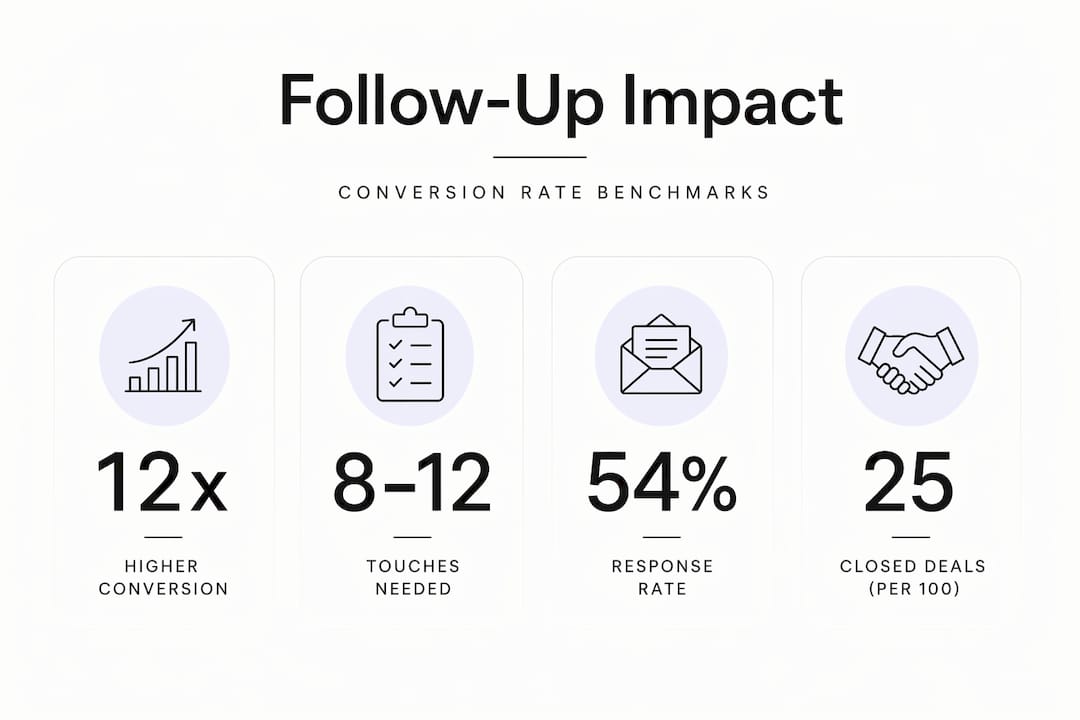
The table reveals a direct relationship: more structured, consistent outreach equals more closed business. But here’s the real issue. Most agents stop after the first or second attempt. They interpret silence as rejection. In reality, silence often just means the lead isn’t ready yet.
An average lead requires 8 to 12 follow-up attempts before converting. Think about that. If the average agent only follows up with 11% of their database in a given month, and it takes 8 to 12 attempts to convert a single lead, the math on missed revenue is staggering.
One concrete way to maximize this opportunity is to use your top lead generation strategies alongside a tight follow-up system, so every new lead enters a pipeline that actively moves them toward a decision instead of letting them stall. The agents who study lead generation platforms understand that filling the top of the funnel means nothing without a reliable follow-up mechanism at every stage below it.
The ROI of better follow-up coverage is one of the most underappreciated levers in real estate. You don’t necessarily need more leads. You need to convert more of the leads you already have.
Personalization: The secret ingredient of follow-up success
Persistence without personalization is noise. Every agent knows they should follow up. Far fewer know how to follow up in a way that builds trust instead of breaking it.
According to expert coaches who specialize in real estate conversion, follow-up should be personalized and value-driven, with high-performing agents balancing persistence with relevance and always providing a clear next step to avoid alienating prospects.
Robotic or templated outreach destroys engagement fast. When a prospect receives a message that could have been sent to 500 other people, they feel like a number, not a client. That perception kills trust before the relationship has a chance to develop. The best way to break that pattern is to make every message feel like it was written for one person.
Here are proven personalization tactics that top agents use to keep follow-up relevant:
- Reference prior conversations specifically: “You mentioned your priority was being within 10 minutes of the school district. I found two listings that fit that exactly.”
- Ask context-specific questions: “Has anything changed on your timeline since we last spoke?” shows you remember and care.
- Offer targeted resources: Send a hyperlocal market update, a neighborhood guide, or a mortgage calculator tailored to their price range.
- Summarize what you’ve already discussed: Starting with a brief recap signals that you’ve been paying attention and builds rapport.
- Acknowledge where they are in the process: A buyer who just started looking needs different content than one who has already made two offers.
“The agents who convert more aren’t necessarily making more calls. They’re making calls that matter because each one is grounded in the prospect’s specific situation, timeline, and goals.”
Aligning your outreach with proven real estate marketing strategies helps you build a communication cadence that feels personal at scale. And data-driven client communication reinforces that buyers respond better when agents present relevant, localized information rather than generic talking points.
Pro Tip: Instead of “just checking in,” try restarting stalled conversations with a compelling hook. Something like: “The market just shifted in [neighborhood name]. Here’s what that means for buyers in your budget.” This positions you as an expert, not a salesperson chasing a commission.
Understanding the personalization layer sets you up to apply these strategies in your own business. Here’s a fresh perspective on what actually moves the needle.
What most agents miss about follow-up strategy
Here’s the contrarian view: the problem with follow-up in real estate isn’t a technology problem. It’s a mindset problem.
Agents invest in CRMs, automation tools, drip campaigns, and AI-powered sequences. They set up beautifully designed email flows. They schedule reminders. And then they still wonder why conversion rates remain flat. The reason is that automation and tools are amplifiers. They amplify what’s already there. If what’s there is generic, automated, and self-serving, the technology just delivers that message faster and to more people.
The crucial variable in effective follow-up isn’t the software. It’s authentic, curiosity-driven engagement. The agents who dominate their pipeline reviews aren’t the ones with the most sophisticated CRM setup. They’re the ones who genuinely want to understand what their clients need, and who ask better questions because of that genuine interest. That authenticity is nearly impossible to fake and extraordinarily difficult to automate.
Take a hard look at your own follow-up routine. Ask yourself: are you reaching out because you want to help this person find the right property, or are you reaching out because you want to close a deal? Prospects can feel the difference. It shows up in how questions are framed, how carefully responses are heard, and whether conversations close the loop or just open new pitches.
Rehumanizing the process creates exponential impact. When you replace “just checking in” with genuine curiosity, when you follow up on something specific the client mentioned in the last conversation, and when you commit to closing every loop you open, the results compound over time. Clients refer people to agents they trust. Trust is built through consistent, caring, and specific engagement. Reviewing your follow-up workflow insights through that lens changes how you design every sequence and script in your business.
The best follow-up strategy is the one that makes your client feel seen. Technology helps you execute it at scale. But the mindset has to come first.
Upgrade your follow-up: Tools and next steps
Follow-up excellence requires both the right strategy and the right infrastructure to execute it consistently. That’s exactly where ex.plo.re comes in.
We built our platform for real estate agents, luxury brokers, and yacht brokers who are serious about turning their pipeline into a predictable revenue engine. Our tools automate the heavy lifting while keeping your outreach personal, timely, and effective. Explore the best top prospecting tools designed specifically for brokers who want to work smarter and close more deals. Whether you’re building your first structured follow-up system or optimizing an existing one, our prospecting strategies give you the frameworks and tools to amplify everything you’re already doing.
Frequently asked questions
How many follow-ups do real estate leads typically require to convert?
Industry data confirms that most real estate leads require 8 to 12 follow-up touches before converting, which means most agents stop reaching out far too early in the process.
What is the difference between single-touch and multi-touch follow-up?
Multi-touch follow-up uses several channels across multiple contacts, which greatly increases conversion compared to a one-time outreach because it meets prospects where they are and keeps your name top of mind over time.
How can agents personalize their follow-up without sounding robotic?
Agents can build authentic outreach by referencing prior conversations, asking client-specific questions, and always offering value-driven follow-up that addresses the prospect’s actual situation rather than sending generic messages.
Why do most real estate agents struggle with consistent follow-up?
The root cause is the absence of structured systems and automation. Without them, the average agent contacts only 11% of their database monthly, leaving the majority of leads and potential revenue completely unaddressed.