

Every hour you spend driving an unqualified buyer to showings is an hour you didn’t spend closing a real deal. Top agents know that lead quality beats lead volume every time, and the difference between a packed pipeline and a productive one comes down to one thing: a disciplined qualification process. This guide breaks down the exact frameworks, questions, and intake systems that separate serious buyers from curiosity seekers, so you can invest your energy where it actually pays off.
Table of Contents
- Why qualifying buyer leads is essential for real estate success
- Key frameworks: Ready–Willing–Able and decision-tree models
- Essential qualifying questions to ask every buyer lead
- Building and using a buyer intake questionnaire
- Common mistakes to avoid when qualifying buyer leads
- A fresh perspective: High-trust qualification beats shortcuts every time
- Take lead qualification further with the right tools
- Frequently asked questions
Key Takeaways
| Point | Details |
|---|---|
| Start with structured frameworks | Frameworks like Ready–Willing–Able dramatically improve lead filtering efficiency. |
| Ask high-impact questions | Prioritize questions about motivation, financing, timeline, and authority every time. |
| Systematize intake | A buyer questionnaire makes qualification fast, precise, and repeatable. |
| Avoid common mistakes | Never skip key steps or rely only on intuition—document and verify for best results. |
| Trust-building trumps shortcuts | Deep qualification and rapport yield quality relationships and higher closings. |
Why qualifying buyer leads is essential for real estate success
Unqualified leads don’t just waste your afternoon. They erode your momentum, drain your marketing budget, and quietly kill your conversion rate. Think about it: running three showings for a buyer who hasn’t spoken to a lender is the equivalent of a surgeon booking an operating room without confirming the patient is ready. The cost is real, and it compounds fast.
The competitive edge that comes from a systematic approach is massive. When you generate real estate leads with a clear qualification filter baked in from the start, your pipeline gets leaner and sharper. You stop chasing and start attracting. For luxury brokers especially, where a single transaction can represent months of relationship work, the stakes of misallocating your time are even higher.
“A structured buyer qualification process is not gatekeeping; it’s professionalism. The agents who master it close more deals and build better client relationships.”
Four criteria define a genuinely qualified buyer:
- Timeline: When do they need to move? Is there a real deadline driving urgency?
- Motivation: Why are they buying now, and what happens if they don’t act?
- Financial ability: Do they have a pre-approval letter, not just a general sense of their budget?
- Authority: Are all decision-makers in the conversation, or are there unseen influencers who could derail the deal?
The Ready–Willing–Able buyer qualification model addresses all four criteria by sorting serious buyers from tire-kickers based on timeline, motivation, and financial ability including pre-approval status. Combine that with the decision-framework approach HousingWire recommends, where qualifying questions are focused on motivation, timeline, and decision-making authority, and you have a system that prioritizes leads objectively rather than by gut feel.
Understanding the types of real estate leads you’re working with also shapes how aggressively you qualify. A referral from a past client carries different weight than a cold web inquiry. Calibrate accordingly.
With the stakes clear, it’s crucial to understand what criteria separate a serious buyer from those not ready or motivated to act.
Key frameworks: Ready–Willing–Able and decision-tree models
Now that you know why qualification matters, let’s unpack the leading methods top agents use so you can confidently identify the best-fit buyers.
The Ready–Willing–Able model breaks down like this:
- Ready means the buyer has a defined timeline and genuine urgency. They’re not browsing; they have a reason to move.
- Willing means they’re emotionally motivated. They want this, not just theoretically, but enough to act when the right property appears.
- Able means they have the financial resources to complete the transaction. Pre-approval is the gold standard here. Anything less is an assumption you can’t afford to make.
The decision-tree model works differently. It’s a branching series of qualifying questions where each answer either advances the lead or redirects it. Smart lead sources can feed into a pre-built decision tree so your team handles triage automatically. The key advantage of the decision-tree approach is speed. It can screen a lead in under five minutes and tell you exactly where to invest follow-up effort.
Here’s a side-by-side comparison of both frameworks:
| Feature | Ready–Willing–Able | Decision-tree model |
|---|---|---|
| Primary focus | Buyer readiness and resources | Lead prioritization and routing |
| Best for | Initial intake and consultations | High-volume inbound lead screening |
| Speed | Moderate (requires conversation) | Fast (can be automated) |
| Depth | High (covers motivation and ability) | Moderate (depends on question quality) |
| Ideal scenario | Luxury and complex transactions | Scalable brokerage operations |
| Automation potential | Low to moderate | High |
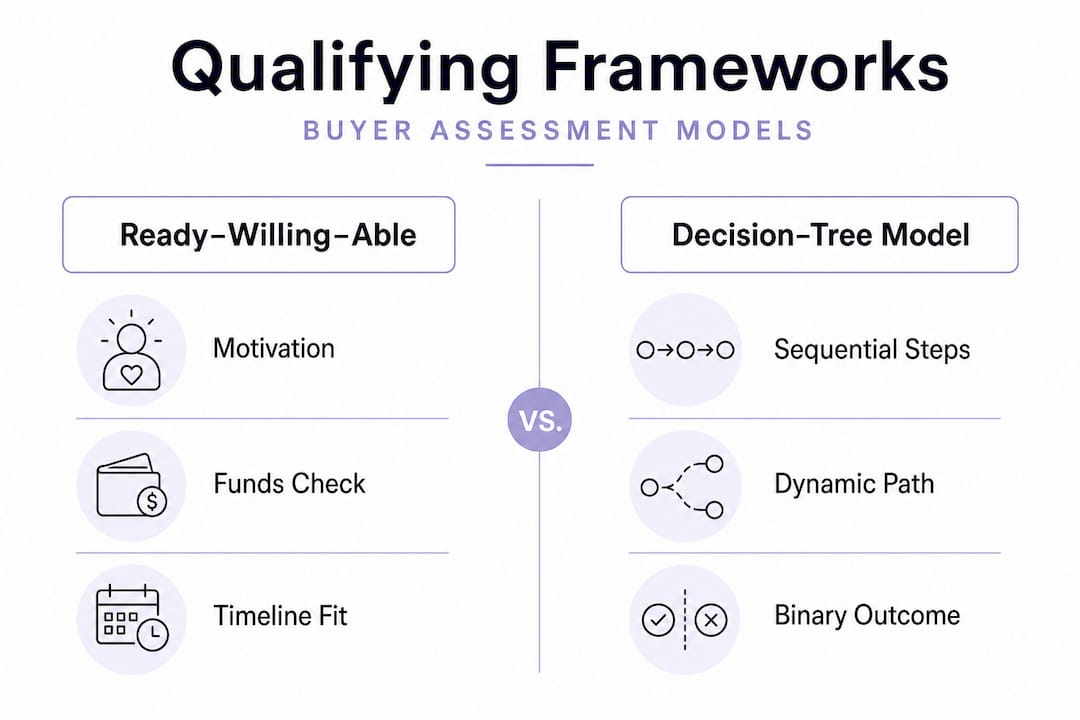
Pro Tip: Combine both frameworks for maximum efficiency. Use the decision-tree model as your first-pass filter through digital intake or an initial call. Then apply the Ready–Willing–Able framework in depth during your buyer consultation to uncover motivation and verify financial readiness. Together, they give you speed and depth.
Essential qualifying questions to ask every buyer lead
Armed with your framework, the next step is to engage with buyers using targeted qualification questions.
Research published by seven key buyer questions from Close With Quality outlines a screening approach that covers the critical areas you need to explore before committing to an in-person meeting. Those areas include exclusivity, motivation, timeline, lender conversations, monthly affordability, decision-making, and readiness to move quickly.
Here are the seven questions you should be asking every buyer lead:
- Are you currently working with another agent? This screens for exclusivity and tells you immediately whether you’re competing for their attention or starting fresh.
- What is motivating you to buy right now? Dig into the “why.” A job relocation is very different from passive curiosity. Motivation determines urgency.
- What is your target move-in timeline? 30 days versus 12 months changes your entire strategy. Pin this down early.
- Have you spoken with a lender, and do you have a pre-approval letter? This is non-negotiable. Pre-approval verifies ability; without it, everything else is hypothetical.
- What monthly payment or price range are you comfortable with? This reveals true financial comfort versus stated budget and can surface misaligned expectations before they become a problem.
- Who else will be involved in the final decision? Spouses, partners, parents, business partners; know them now. Surprises at the closing table are expensive.
- If we find the right property, are you prepared to make an offer quickly? This tests resolve. Serious buyers say yes. Browsers hedge.
“The goal of qualifying questions isn’t to interrogate; it’s to serve. The more you know about a buyer’s true situation, the better you can match them to the right property at the right time.”
When buyers are evasive or unclear, don’t back off. Rephrase and reframe. Instead of “Do you have a pre-approval?” try “Most sellers in this market require proof of financing before accepting offers. Have you taken that step yet?” This positions the question as protecting them, not screening them out. That approach builds trust while still getting you the information you need.
Once you’ve identified serious leads, the work of nurturing real estate leads begins. Qualification isn’t a one-time event; it’s an ongoing process that deepens your understanding of the buyer as the relationship matures.

Building and using a buyer intake questionnaire
With the right questions in your toolkit, systematizing intake ensures you never miss a key detail. Let’s create your repeatable process.
A buyer intake questionnaire turns your qualifying questions into a structured, scalable workflow. Instead of relying on memory or improvised conversation, you capture every critical data point the same way, every time. This consistency is what separates reactive agents from operational powerhouses.
Here are the recommended fields and categories for your questionnaire:
| Category | Fields to capture |
|---|---|
| Contact info | Full name, phone, email, preferred contact method |
| Household details | Number of people moving, pets, accessibility needs |
| Financial status | Pre-approval status, lender name, approved amount, down payment source |
| Timeline | Target move-in date, lease expiration, driving urgency |
| Decision-making | All parties involved in final decision, relationship to buyer |
| Property needs | Location, size, bedrooms, must-haves vs. nice-to-haves |
| Intent signals | How long they’ve been searching, properties already viewed |
The buyer questionnaire process advocated by HousingWire captures key fields upfront including financing status, timeline needs, and household and decision-making information. This front-loaded approach means every follow-up conversation is already grounded in solid data.
How you introduce the questionnaire matters. Frame it as a service tool, not a screening filter. Something like: “To make sure I find you exactly what you’re looking for without wasting your time on the wrong properties, I’d love to get a few details upfront.” Buyers who are serious will complete it. Those who refuse are telling you something important.
A few implementation tips:
- Send it digitally. Google Forms, Typeform, or your CRM’s native intake feature all work. Avoid paper unless you’re in a setting where it makes sense.
- Keep it under ten minutes. If it feels like a mortgage application, you’ll lose them. Stick to the fields that directly influence your strategy.
- Integrate it with your CRM. Responses should populate contact records automatically, triggering follow-up sequences based on urgency and readiness tier.
Pro Tip: Set up automated follow-up reminders tied to the questionnaire completion status. If a lead doesn’t complete it within 48 hours, an automated nudge can recover a meaningful percentage of those prospects without any manual effort on your part.
Common mistakes to avoid when qualifying buyer leads
Even seasoned agents occasionally fall into old patterns. Avoid these traps to maximize your qualifying efforts.
The biggest qualification pitfalls center on failing to ask high-signal discovery questions about timeline, financing, pre-approval status, motivation triggers, and the full decision-making process. When agents skip these, they misallocate their time across inbound leads and wonder why their close rate is underwhelming.
Watch out for these specific mistakes:
- Skipping the financial verification step. Assuming a buyer is financially ready because they “seem serious” is one of the most expensive habits in real estate. Always confirm pre-approval.
- Accepting vague timelines. “Soon” and “when the right place comes along” are not timelines. Push for specifics.
- Relying on gut feel over documented criteria. Your instincts matter, but they aren’t a system. Undocumented qualification is invisible to your team and unscalable.
- Not identifying all decision-makers. Showing up to a negotiation and discovering an unseen partner vetoes the deal is entirely avoidable.
- Failing to document and follow up. A qualified lead that goes undocumented is a lost opportunity. If it’s not in your CRM, it doesn’t exist.
Pro Tip: Leverage technology to automate reminder workflows tied to follow-up stages. Lead generation strategies that integrate CRM automation into the qualification process consistently outperform those that rely on manual tracking. Technology doesn’t replace your judgment; it amplifies it.
A fresh perspective: High-trust qualification beats shortcuts every time
Here’s a view from years in the field, and why high trust matters more than ever.
There’s a temptation in this industry to prioritize speed over depth. Get the appointment on the calendar, show the property, and figure out the details later. It feels productive. It rarely is. The agents chasing their tails with six unqualified showings a week are working harder than the agent running two deep, pre-qualified consultations with motivated buyers. Volume without quality is just noise.
The agents who rise to the top, especially in luxury markets, have an almost uncomfortable willingness to ask hard questions early. They’re not apologetic about it. They understand that rigorous qualification is actually a form of respect. It says: I value your time enough to make sure we’re aligned before we go any further. Buyers who are serious respond to that energy. They recognize professionalism.
Luxury brokers in particular benefit from high-touch, high-trust processes because their buyers are sophisticated. They’ve been through transactions before. They know when an agent is winging it versus when an agent has a system. A structured prospecting workflow communicates that you are the professional they need in their corner.
The uncomfortable truth is that shortcuts cost more than they save. Skipping a qualifying question to avoid awkwardness might get you to the second showing, but it won’t get you to the closing table. Build the trust early, qualify deeply, and let the process do the heavy lifting.
Take lead qualification further with the right tools
Ready to go further? Advanced digital tools make executing these qualification processes both easier and faster.
The frameworks and questions in this guide are powerful on their own, but they scale exponentially when supported by the right technology. CRM systems built for real estate agents don’t just store contacts; they track qualification status, automate follow-up sequences, and surface the leads most likely to convert based on behavioral signals.

If you’re serious about boosting client acquisition, the combination of structured qualification and smart automation is your fastest path to consistent deal flow. At ex.plo.re, we give real estate agents, luxury brokers, and yacht brokers the tools to build that system without starting from scratch. From intake automation to pipeline tracking, our platform is designed to amplify the work you’re already doing. Explore how our tools stack up against other options when you compare lead generation tools and see exactly where the right technology can close the gap between effort and results.
Frequently asked questions
What’s the difference between pre-approval and pre-qualification in real estate?
Pre-approval is the gold standard because a lender has actually verified a buyer’s income, assets, and credit, whereas pre-qualification is a less rigorous, self-reported estimate that carries far less weight with sellers.
How quickly should you qualify a new buyer lead?
Qualify every new lead within 24 to 48 hours. Urgency tiering based on timeline (90 days, 3 to 6 months, or 6 months or more) can only be established quickly, and delay reduces both contact rates and lead quality.
What are the minimum questions to ask when qualifying a buyer?
At minimum, ask about timeline, financing status, motivation to buy now, and who else is involved in the decision. These four key areas cut to the heart of readiness, ability, and authority in the fewest possible exchanges.
Should luxury brokers screen buyer leads differently?
Luxury brokers should use the same Ready–Willing–Able and decision-tree frameworks, but add additional layers around financial verification, privacy preferences, and discretion protocols. The higher the transaction value, the more important it is to confirm both ability and intent before investing significant time and resources.