

Seller motivation is defined as the specific, verifiable circumstances that create urgency for a property owner to sell quickly, often overriding their preference for maximum price. This is the industry’s core concept behind “motivated seller” qualification, and understanding it separates investors who close deals from those who chase leads indefinitely. According to NAR 2026 generational trends, personal reasons like family proximity drive 26% of home sales, yet motivation goes far deeper than sentiment. Data from iSpeedToLead’s analysis of 20,000 closed deals confirms that genuine motivation is always circumstance-driven, not emotional. When you can explain seller motivation accurately, you negotiate from a position of real knowledge.
What does it mean to explain seller motivation?
Seller motivation refers to the external constraints that make selling necessary rather than optional for a property owner. The critical distinction here is between a seller who wants to sell and one who needs to sell. A seller who wants to sell will hold firm on price and timeline. A seller who needs to sell has a cost attached to waiting, and that cost is your negotiating leverage.
True motivation is measurable and tied to concrete costs of delay, not just emotion. Think of a landlord three months behind on mortgage payments versus a homeowner who simply thinks the market looks good. Both are sellers. Only one is motivated. The difference shows up immediately in pricing flexibility, timeline urgency, and willingness to accept non-standard terms.

Understanding this distinction is the foundation of every effective negotiation strategy in residential real estate. Investors who treat all sellers as equally motivated waste time, money, and credibility. Those who qualify motivation first close faster and at better terms.
What key factors influence seller motivation?
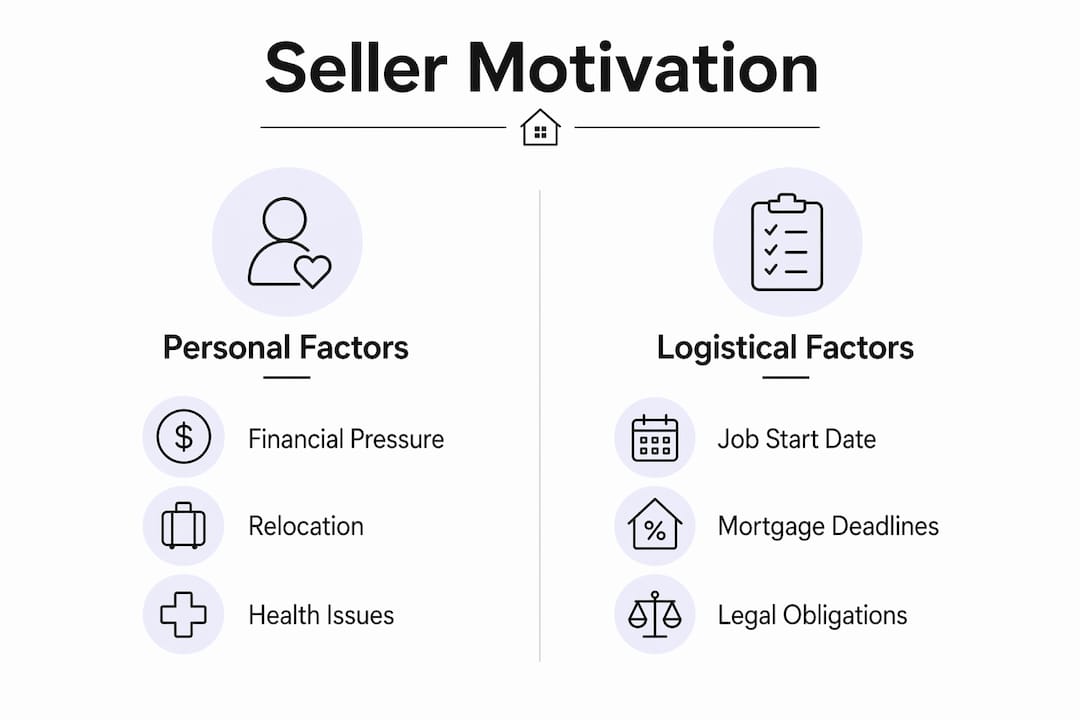
Seller motivation is never one-size-fits-all. The factors that create urgency fall into three broad categories: personal, financial, and logistical.
Personal triggers are the most common entry point. Family proximity is the leading personal reason sellers cite for moving, at 26% according to NAR 2026 data. Retirement relocation, divorce, and changes in household size also create genuine urgency, particularly when a specific move-in date at the destination is already set.
Financial pressures create the highest urgency levels. These include:
- Pre-foreclosure and missed mortgage payments
- Tax delinquencies and IRS liens
- Probate deadlines requiring asset liquidation
- Inherited properties with carrying costs the heir cannot sustain
- Landlord burnout from chronic tenant issues or deferred maintenance
Logistical constraints are often underestimated. A seller who accepted a job offer in another city starting in six weeks has a hard deadline. A property in probate has court-imposed timelines. A listing that expired after 90 days on the MLS carries frustration and urgency that a fresh listing does not. Post-failed MLS listing sellers convert at roughly four times the rate of fresh sellers, making expired listings one of the highest-value prospecting categories available.
Here is a quick reference for motivation triggers and their typical urgency levels:
| Motivation trigger | Urgency level | Pricing flexibility |
|---|---|---|
| Job relocation with set start date | High | Moderate to high |
| Pre-foreclosure or missed payments | Critical | High |
| Probate with legal deadline | Critical | High |
| Divorce settlement required | High | Moderate to high |
| Landlord burnout | Moderate | Moderate |
| Family proximity preference | Low to moderate | Low |
| Expired MLS listing | Moderate to high | Moderate to high |
How does seller motivation affect negotiation outcomes?
Motivation changes the entire structure of a negotiation. A seller with a hard deadline or a financial cost attached to delay will accept terms that a comfortable seller would reject outright. Over 50% of sellers reduce their listing price four or more times before closing, which tells you that initial asking price is rarely the real number. The seller’s motivation level determines how quickly that number moves and how far it will go.
Speed matters more than most buyers realize. Contact rates peak within five minutes of receiving a motivated seller lead, and delays reduce closing probability dramatically. This is not a minor operational detail. It is the difference between being the buyer who solves the seller’s problem and being the third call they take after the problem is already solved.
The most effective offers are not simply low offers. Offers aligned with the seller’s actual problem close at higher rates than price-only negotiations. A seller facing probate needs certainty and speed, not a bidding war. A landlord burned out by tenant turnover needs relief from operational headaches. Understanding why sellers accept lower cash offers comes down to this: the offer that removes the seller’s specific pain closes the deal.
Pro Tip: Before you negotiate price, negotiate the problem. Ask the seller what a successful sale looks like for them. The answer will tell you whether to lead with speed, certainty, a leaseback option, or a specific closing date. Price is often the last variable that matters.
How to identify and verify true seller motivation
Identifying motivation is a skill built on direct questions and external verification. Here is a practical sequence used by experienced property sourcers and agents:
- Ask the reason for moving. “Why are you selling?” is the single most valuable question in real estate. The answer reveals whether the motivation is personal preference or structural necessity.
- Probe for a specific timeline. “When do you need to be out?” separates a vague desire to sell from a real deadline. A seller who says “sometime this year” is different from one who says “before the 15th of next month.”
- Ask about the cost of not selling. “What happens if you don’t sell by that date?” This question surfaces the financial or legal consequences that define true motivation. A seller who answers with a shrug is not motivated. A seller who mentions foreclosure, a court date, or a job start date is.
- Verify externally. Check public records for foreclosure notices, probate filings, tax delinquencies, and listing history. A seller’s stated timeline should align with what the records show.
- Assess listing history. A property that has been listed and delisted multiple times signals frustration and growing urgency. Sellers with verifiable timeline constraints where delay is costlier than selling now are your highest-probability prospects.
- Listen for price flexibility signals. Phrases like “I just need to get out from under it” or “I’m not looking to get rich, I just need this done” are direct signals of motivation depth.
Pro Tip: Cross-reference what a seller tells you with county records before your second conversation. Sellers do not always disclose the full picture upfront, not out of dishonesty, but because they are embarrassed or uncertain. Public records give you the facts without the filter.
You can also sharpen your approach by reviewing how pressing timelines affect selling decisions in practice, which adds useful context for structuring your qualification conversations.
Comparing motivation levels and tailoring your offers
Property sourcers categorize sellers on a motivation spectrum from low to critical, and your offer strategy should shift accordingly. Treating a moderately motivated seller the same way you treat someone facing imminent repossession is both ineffective and unnecessary.
Here is how the spectrum breaks down and what each level calls for:
| Motivation level | Typical triggers | Offer strategy |
|---|---|---|
| Low | Lifestyle preference, market curiosity | Build rapport, stay in contact, no aggressive pricing |
| Moderate | Landlord fatigue, expired listing, divorce in early stages | Offer certainty and speed alongside fair pricing |
| High | Job relocation, probate with deadline, divorce finalized | Lead with timeline certainty, flexible closing date |
| Critical | Pre-foreclosure, tax lien, imminent repossession | Fast close, cash offer, relief framing over price |
The ethical dimension here matters. Mapping motivation to a measurable cost of delay gives you negotiating confidence without exploitation. You are not creating the seller’s problem. You are offering a solution to a problem that already exists. Sellers in critical situations often describe a well-structured cash offer as a relief, not a loss.
One more data point worth internalizing: most motivated seller deals close in the 31 to 90 day window, with a median around 73 days. Patience combined with structured follow-up beats volume chasing every time. The investor who stays in contact with a moderately motivated seller through a 60-day follow-up sequence often closes the deal that the impatient buyer walked away from.
For a broader view of how seller motivation connects to 2026 real estate market trends, Plo has additional resources that put these dynamics in full market context.
Key takeaways
Seller motivation is defined by verifiable external constraints, and matching your offer to the seller’s specific urgency level is the single most reliable path to closing deals at favorable terms.
| Point | Details |
|---|---|
| Motivation is circumstance-driven | True motivation comes from external constraints like foreclosure or relocation, not preference. |
| Urgency level shapes pricing flexibility | Critical motivation yields the highest discounts; low motivation rarely produces price movement. |
| Speed of response matters | Contact rates peak within five minutes of lead receipt, making fast follow-up a competitive advantage. |
| Offers should solve problems, not just cut price | Aligning your offer with the seller’s actual constraint closes more deals than price alone. |
| Most deals close in the 31 to 90 day window | Structured follow-up over weeks beats chasing volume with no system. |
Why most investors misread seller motivation
I have watched investors walk away from genuinely motivated sellers because the conversation felt too comfortable. The seller was polite, the home was clean, and nothing screamed urgency. But the probate filing was sitting in the county records, and the estate had a court date in 45 days. The investor who did the 10-minute records check closed that deal. The one who relied on gut feel moved on.
The most common mistake I see is confusing emotional interest with structural motivation. A seller who says “I’ve been thinking about selling for a while” is not motivated. A seller who says “I need to close before the 30th or I lose the house” is. The words sound different. The records look different. The outcome is completely different.
What I have found actually works is a two-track qualification process. You ask the direct questions in the conversation, and you verify independently through public records. When both tracks align, you have a real deal. When they do not, you have a lead to nurture, not a deal to chase.
The other thing worth saying plainly: empathy is not a soft skill in this context. It is a deal skill. Sellers in distress are not looking for someone to exploit their situation. They are looking for someone who understands it and can move quickly. The investors who communicate that clearly, and back it up with a fast, clean offer, win the deals that everyone else is still trying to figure out.
— Jason
Find motivated sellers faster with the right tools
Knowing how to read seller motivation is only half the equation. The other half is finding motivated sellers before your competition does, and qualifying them fast enough to act.

Plo gives real estate agents and investors the prospecting infrastructure to do exactly that. From AI-scored lead prioritization to automated follow-up sequences, the tools in Plo’s platform are built for the 31 to 90 day deal cycle where most motivated seller transactions actually close. If you are ready to stop chasing cold leads and start working a qualified pipeline, explore the best prospecting tools for 2026 and see how top agents are building deal flow with data, not guesswork.
FAQ
What does seller motivation mean in real estate?
Seller motivation refers to the specific, verifiable circumstances that create urgency for a property owner to sell, such as foreclosure, probate deadlines, or job relocation. It is distinct from general interest in selling because it involves a measurable cost attached to delay.
What are the most common factors influencing seller motivation?
The leading factors include financial pressures like pre-foreclosure and tax liens, logistical constraints like job relocation or probate deadlines, and personal reasons like family proximity. According to NAR 2026 data, family proximity alone accounts for 26% of home sales.
How do you verify that a seller is truly motivated?
Ask directly about their timeline and the consequences of not selling, then cross-reference their answers with public records including foreclosure notices, probate filings, and listing history. Sellers with verifiable external constraints are the most reliable indicators of genuine motivation.
Why do motivated sellers accept below-market offers?
Motivated sellers accept lower offers because the cost of waiting exceeds the value of holding out for a higher price. Speed, certainty, and relief from a specific problem often matter more to them than squeezing out an extra few percentage points on the sale price.
How long does it take to close a motivated seller deal?
Most motivated seller deals close in the 31 to 90 day window, with a median around 73 days according to iSpeedToLead’s analysis of 20,000 closed transactions. Structured follow-up over that period is the key variable separating closed deals from lost opportunities.