

Securing exclusive deals has become a priority for many top-producing agents in markets like the United States, Canada, and across Europe. For those eager to attract high-net-worth clients, mastering off-market listings offers a powerful edge. These discreet transactions allow you to move beyond the limitations of public platforms and cultivate genuine relationships that result in unique opportunities. Discover how off-market strategies can transform your approach and position you as a trusted advisor among affluent buyers and sellers.
Table of Contents
- What Is an Off-Market Listing? Key Concepts
- Types of Off-Market Listings Explained
- How Off-Market Transactions Work in Practice
- Legal and Ethical Requirements for Agents
- Comparing Off-Market vs. MLS Listings
- Risks, Rewards, and Common Pitfalls
Key Takeaways
| Point | Details |
|---|---|
| Understanding Off-Market Listings | Off-market listings offer unique real estate opportunities outside traditional marketing channels, allowing for greater privacy and flexible negotiations. |
| Types of Off-Market Listings | Various transaction types, such as foreclosure auctions and tax deed sales, present specialized opportunities that require targeted negotiation strategies. |
| Best Practices for Agents | Successful off-market transactions depend on building strong networks and employing advanced market intelligence to identify and communicate with potential sellers. |
| Legal and Ethical Standards | Agents must adhere to strict legal and ethical requirements to ensure transparency and integrity throughout off-market transactions. |
What Is an Off-Market Listing? Key Concepts
Off-market listings represent a unique and strategic approach to real estate transactions where properties are sold outside traditional public marketing channels. Unlike standard real estate sales that rely on Multiple Listing Service (MLS) platforms, these properties remain intentionally unlisted, creating exclusive opportunities for agents and buyers willing to explore alternative acquisition strategies.
The core characteristics of off-market listings include:
- Properties not publicly advertised on standard real estate platforms
- Direct communication between sellers and potential buyers
- Greater privacy and discretion for property owners
- Potential for more flexible negotiation terms
- Reduced competition from other potential buyers
In commercial real estate, off-market property acquisition involves sophisticated data-driven targeting, where agents proactively identify potential sellers through strategic research. This approach often focuses on properties with upcoming financial triggers like loan maturities or ownership transitions, allowing for more personalized and strategic outreach.
Real estate professionals leverage off-market listings by building robust professional networks, maintaining strong relationships with property owners, and utilizing advanced market intelligence. Relationship-based selling becomes paramount, as agents must demonstrate expertise and trustworthiness to access these exclusive opportunities.
Pro tip: Develop a comprehensive database of potential off-market property owners by tracking local market trends, networking consistently, and maintaining detailed contact records.
Types of Off-Market Listings Explained
Off-market listings encompass a diverse range of property transaction types that extend far beyond traditional real estate sales channels. These specialized categories provide unique opportunities for agents and investors to access properties through alternative acquisition strategies, each with distinct characteristics and market dynamics.
Key types of off-market listings include:
- Foreclosure Auctions: Properties seized by lenders due to mortgage defaults
- Tax Deed Sales: Real estate acquired through unpaid property tax proceedings
- Wholesale Deals: Properties sold quickly by investors before formal listing
- Pre-foreclosure Negotiations: Transactions initiated before official foreclosure processes
- Direct-to-Seller Purchases: Transactions bypassing traditional brokerage channels
Alternative commercial real estate listings represent emerging opportunities beyond conventional property categories. These specialized sectors include data centers, cell towers, senior housing, and self-storage facilities, which are gaining significant investor attention due to evolving technological and societal trends.
Each off-market listing type requires unique negotiation strategies and deep market understanding. Real estate professionals must develop specialized knowledge to navigate these complex transaction landscapes, understanding the motivational factors and legal considerations specific to each listing category.
Pro tip: Develop specialized expertise in multiple off-market listing types by attending targeted workshops, networking with industry specialists, and continuously expanding your market research capabilities.
How Off-Market Transactions Work in Practice
Off-market transactions represent a sophisticated approach to real estate deals that transcend traditional listing methods. Unlike conventional public listings, these transactions require strategic relationship building, advanced research techniques, and nuanced negotiation skills that transform how properties change hands outside standard market channels.
Key stages of off-market transaction processes include:
- Market Research: Identifying potential sellers through comprehensive data analysis
- Network Development: Cultivating relationships with property owners and industry contacts
- Direct Outreach: Initiating personalized communication with potential sellers
- Confidential Negotiations: Conducting private discussions outside public platforms
- Tailored Deal Structuring: Creating flexible transaction terms
Commercial real estate transactions rely heavily on data-driven strategies that analyze complex factors like loan maturities, property debt positions, and portfolio management events. Successful agents leverage sophisticated research techniques to identify potential sellers before properties reach traditional marketing channels.

The process mirrors over-the-counter financial trades, emphasizing bilateral negotiations and private interactions. Real estate professionals must develop robust communication skills, understand intricate market dynamics, and build trust with potential sellers to successfully navigate these specialized transaction environments.
Below is a summary of how off-market transaction stages influence agent strategies:
| Stage | Agent Role | Unique Benefit |
|---|---|---|
| Market Research | Data analysis expert | Early identification |
| Network Development | Relationship builder | Access to exclusive deals |
| Direct Outreach | Negotiator | Personalized conversations |
| Confidential Negotiations | Trusted advisor | Enhanced privacy |
| Tailored Deal Structuring | Flexible strategist | Custom transaction terms |
Pro tip: Create a systematic tracking system for potential off-market opportunities, documenting property details, owner contact information, and potential motivational factors for selling.
Legal and Ethical Requirements for Agents
Off-market transactions demand rigorous legal and ethical standards that go beyond traditional real estate practices. Real estate agents must navigate complex regulatory landscapes while maintaining strict professional integrity, ensuring transparency and protecting all parties involved in these specialized property transactions.
Key legal and ethical considerations include:
- Disclosure Requirements: Fully revealing all material information about the property
- Conflict of Interest Management: Avoiding situations that could compromise professional judgment
- Client Confidentiality: Protecting sensitive transaction and personal information
- Fair Representation: Ensuring equitable treatment for all parties
- Compliance with Local Regulations: Adhering to specific state and federal real estate laws
Ethical transaction principles emphasize preventing private gain and maintaining public trust through transparent, accountable practices. Real estate professionals must balance the discretionary nature of off-market deals with stringent legal and ethical standards that protect client interests.
Navigating these complex requirements demands continuous professional education and a commitment to maintaining the highest standards of professional conduct. Agents must develop sophisticated understanding of legal frameworks, ethical guidelines, and industry best practices to successfully execute off-market transactions while preserving their professional reputation.
Pro tip: Develop a comprehensive compliance checklist for off-market transactions, including mandatory disclosure requirements, potential conflict of interest assessments, and documentation protocols.
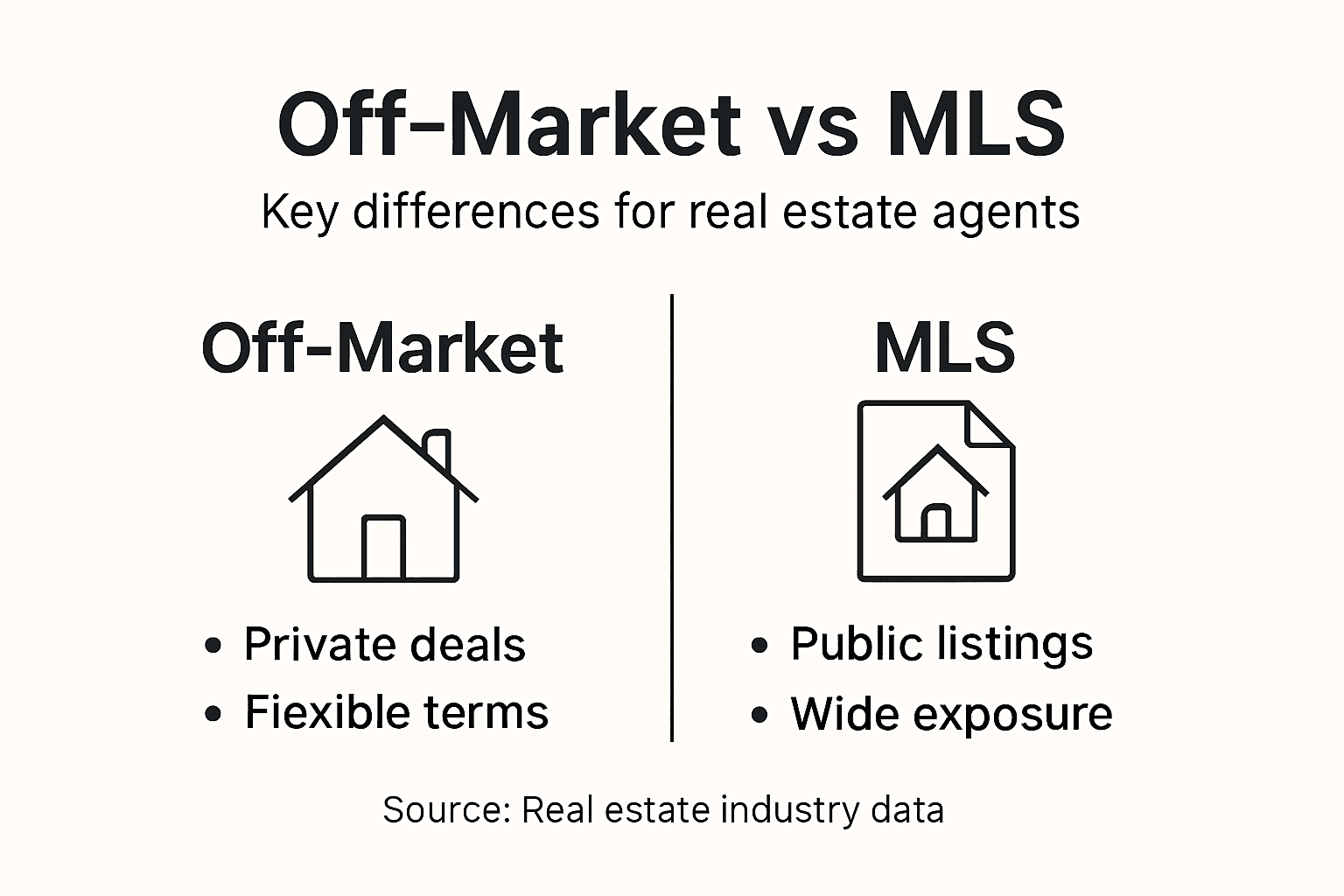
Comparing Off-Market vs. MLS Listings
Real estate professionals must understand the critical distinctions between off-market and Multiple Listing Service (MLS) listings to develop effective transaction strategies. These two approaches represent fundamentally different pathways for property sales, each with unique advantages and challenges that can significantly impact successful real estate deals.
Key differences between off-market and MLS listings include:
- Visibility: MLS offers broad public exposure; off-market provides selective privacy
- Competition: MLS attracts multiple potential buyers; off-market minimizes competitive bidding
- Pricing Dynamics: MLS often drives prices up through competitive offers; off-market enables more negotiable pricing
- Transaction Speed: Off-market deals typically close faster with fewer contingencies
- Target Audience: MLS serves traditional homebuyers; off-market attracts specialized investors
Residential real estate market trends demonstrate that approximately 30% of home sales now occur through off-market channels, reflecting a significant shift in transaction methodologies. Investors and sophisticated buyers increasingly prefer these alternative approaches that offer more strategic and flexible purchasing opportunities.
The strategic selection between MLS and off-market listings depends on specific client goals, property characteristics, and market conditions. Real estate agents must develop nuanced understanding of both approaches to provide tailored advice that maximizes client outcomes and navigates complex market dynamics effectively.
Here’s a concise overview contrasting off-market and MLS listing advantages for sellers and buyers:
| Aspect | Off-Market Listings | MLS Listings |
|---|---|---|
| Seller Control | Greater flexibility, private terms | Standardized process, less control |
| Buyer Access | Limited, often through referrals | Wide public access |
| Negotiation Process | Personalized, direct with seller | Often through agent mediation |
| Closing Timeline | Potentially faster, fewer delays | Typically longer, more contingencies |
Pro tip: Develop a comprehensive market analysis framework that evaluates potential listing strategies based on property type, seller motivations, and current market conditions.
Risks, Rewards, and Common Pitfalls
Off-market transactions represent a complex landscape of strategic opportunities and potential challenges that demand sophisticated understanding from real estate professionals. Navigating these specialized deals requires a nuanced approach that balances potential rewards against inherent risks and operational complexities.
Key risks and rewards in off-market transactions include:
-
Rewards:
- Access to exclusive, non-public property opportunities
- Reduced competitive bidding environments
- Potential for more flexible negotiation terms
- Faster transaction processing
- Direct seller communication
-
Risks:
- Limited market exposure
- Potential information asymmetry
- Reduced regulatory oversight
- Higher due diligence requirements
- Increased complexity in valuation
Off-market transaction strategies demonstrate that successful execution hinges on careful evaluation of deal specifics, understanding market dynamics, and maintaining rigorous professional standards. The most effective agents develop robust frameworks for assessing opportunities while mitigating potential downside risks.
Professional risk management in off-market transactions requires continuous learning, strong network relationships, and meticulous attention to legal and ethical considerations. Real estate agents must cultivate deep market intelligence, develop comprehensive due diligence processes, and maintain transparent communication with all transaction stakeholders.
Pro tip: Create a structured risk assessment matrix that systematically evaluates potential off-market opportunities across multiple dimensions including financial, legal, and market performance indicators.
Unlock Off-Market Listing Success with Advanced Tools and Expert Support
Navigating the complex world of off-market listings demands more than just knowledge It requires powerful tools to manage your network build relationships and track opportunities efficiently At ex.plo.re CRM we understand how crucial it is to have streamlined prospecting and sales cycles when working with unseen, exclusive properties Our platform empowers real estate agents to overcome challenges like limited market exposure, confidential negotiations, and personalized outreach by providing cutting-edge technology and expert talent to amplify your impact
Benefit from:
- A centralized system to organize off-market prospects and property details
- Tools designed to refine your sales pitch and negotiation strategies
- Support that enhances your ability to access and close exclusive deals faster
Ready to turn hidden opportunities into powerful listings? Discover how ex.plo.re CRM helps you become the trusted advisor every off-market seller wants in their corner

Take the first step to become a market leader by leveraging dedicated tools and expert support. Visit ex.plo.re CRM now and unlock your full potential in off-market transactions.
Frequently Asked Questions
What is an off-market listing in real estate?
An off-market listing refers to a property that is sold outside traditional public sales channels, such as the Multiple Listing Service (MLS). These properties are not publicly advertised, allowing for more exclusive access for agents and buyers.
What are the benefits of off-market transactions for buyers?
Off-market transactions provide reduced competition from other buyers, potential for more flexible negotiation terms, and greater privacy for sellers. This often leads to unique opportunities that are not available in the public market.
How do real estate agents find off-market listings?
Agents typically utilize advanced market research techniques and build strong networks with property owners. They identify potential sellers through data-driven targeting and personal outreach strategies to discover hidden opportunities.
What legal and ethical considerations should agents keep in mind with off-market transactions?
Agents must adhere to strict legal and ethical standards, including full disclosure of property information, managing conflicts of interest, maintaining client confidentiality, and complying with local regulations to ensure transparency and protect involved parties.