

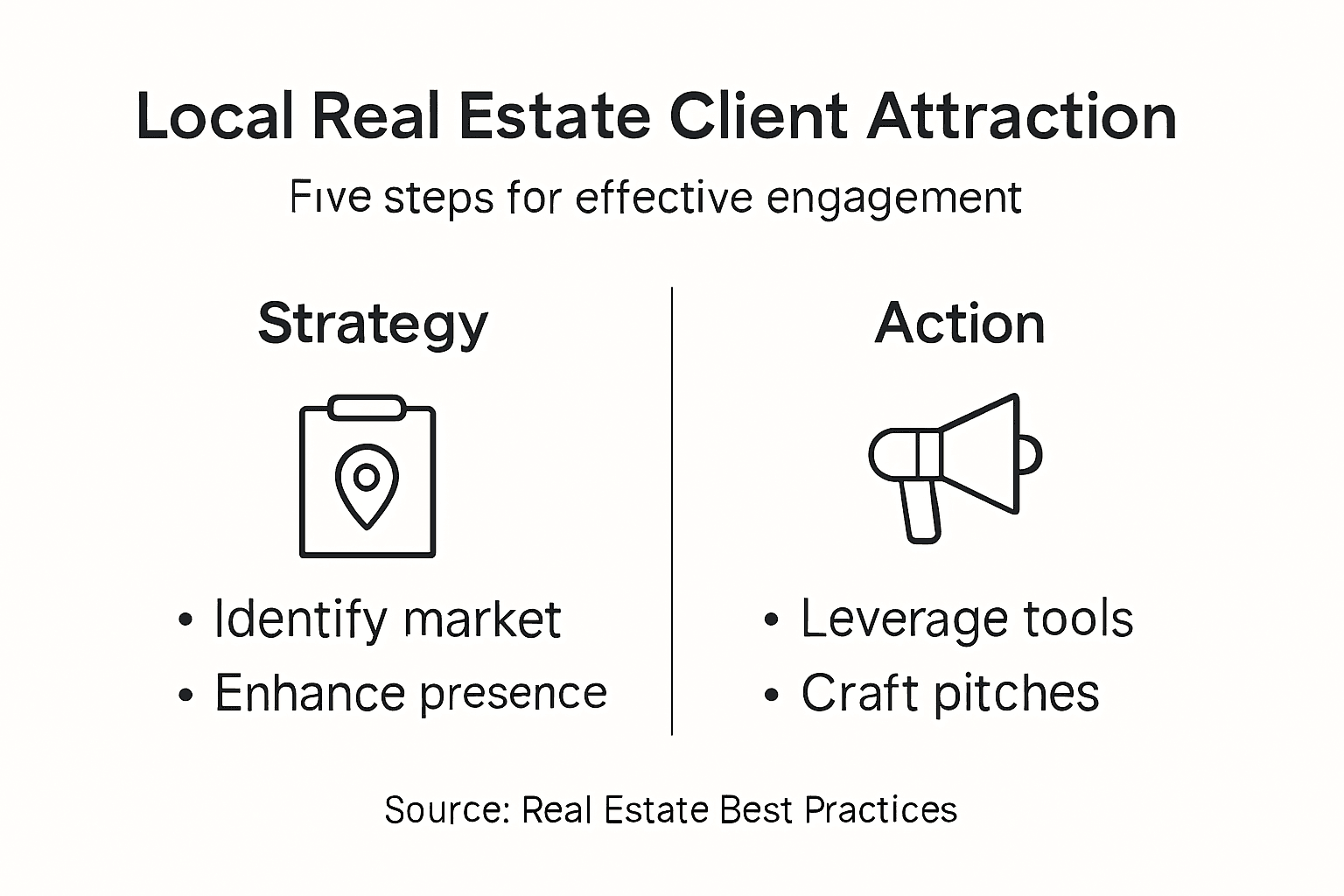
Every real estate agent in North America knows that attracting the right clients takes more than a strong handshake and a yard sign. The market is crowded, and generic tactics rarely reach motivated buyers or sellers in your community. By focusing on precise market segmentation, customizing your sales pitch, and adopting smart digital tools, you can position yourself as the go-to expert in your chosen neighborhood. This approach helps you stand out and forge lasting connections with ideal clients.
Table of Contents
- Step 1: Identify Target Local Markets And Niches
- Step 2: Enhance Your Online Presence Strategically
- Step 3: Leverage Digital Tools For Smart Prospecting
- Step 4: Craft Compelling Sales Pitches And Offerings
- Step 5: Engage And Nurture Local Prospects Continuously
- Step 6: Evaluate And Optimize Your Client Attraction Efforts
Quick Summary
| Main Insight | Detailed Explanation |
|---|---|
| 1. Identify Your Local Market Segments | Understand specific demographics and preferences to tailor your strategies for targeted marketing. |
| 2. Optimize Your Online Presence | Strengthen your digital footprint by using SEO and engaging content to establish local market authority. |
| 3. Utilize Digital Tools for Prospecting | Implement CRM and analytics tools to efficiently track leads and personalize outreach efforts. |
| 4. Develop Compelling Sales Pitches | Craft personalized pitches that connect emotionally and rationally with your clients’ unique needs. |
| 5. Engage Clients Continuously | Maintain ongoing relationships through consistent communication and value-driven engagement strategies. |
Step 1: Identify target local markets and niches
Understanding your local real estate market starts with strategic segmentation. Successful real estate agents recognize that not all clients are created equal – some neighborhoods, demographics, and property types demand specialized approaches. Analyzing specific market segments allows you to craft laser-focused marketing strategies that resonate with precise client groups.
To pinpoint your ideal local markets, begin by conducting comprehensive research across multiple dimensions:
- Demographics: Age ranges, income levels, family structures
- Geographic zones: Specific neighborhoods, suburban vs urban areas
- Property preferences: Luxury homes, starter properties, investment opportunities
- Client lifecycle stages: First-time buyers, downsizing seniors, real estate investors
Your goal is to develop a nuanced understanding of unique client needs within your local ecosystem. By identifying precise consumer characteristics, you can differentiate yourself from generic real estate approaches and become the go-to expert for specific market segments.
Specialization transforms generalists into recognized local market authorities.
Pro tip: Create a detailed client persona document that maps out your ideal target market’s specific characteristics, preferences, and pain points.

Step 2: Enhance your online presence strategically
Transforming your digital footprint requires a deliberate and sophisticated approach to online marketing. Real estate professionals must strategically position themselves across digital platforms, creating a compelling narrative that attracts potential clients and showcases professional expertise. Optimizing local digital marketing strategies enables you to stand out in a competitive marketplace.
Key strategies for amplifying your online presence include:
- Create a professional website highlighting your local market expertise
- Develop consistent social media profiles across platforms like LinkedIn, Instagram, and Facebook
- Generate high-quality local content that demonstrates neighborhood knowledge
- Implement targeted local SEO techniques to improve search visibility
- Build a robust Google Business Profile with accurate contact information and client reviews
Real estate agents must recognize that local online marketing is about building trust and establishing yourself as a neighborhood expert. Your digital presence should reflect your deep understanding of local market dynamics, property trends, and community insights.
Your online brand is your 24/7 professional ambassador – make it count.
Pro tip: Invest in professional photography and videography that captures your unique local market perspective and personal brand.
Step 3: Leverage digital tools for smart prospecting
Successful real estate professionals understand that modern prospecting requires sophisticated digital strategies. Utilizing data analytics for targeted outreach transforms how agents identify and engage potential clients, turning random connections into strategic opportunities.
Key digital prospecting tools and techniques include:
- Customer Relationship Management (CRM) systems to track and nurture leads
- Social media listening platforms to understand client interests and behaviors
- AI-powered analytics tools that predict potential buyer movements
- Local online networking forums to connect with community members
- Automated email marketing for personalized client communication
Real estate agents can dramatically improve their prospecting efficiency by leveraging local digital resources that provide deep insights into community dynamics and individual client needs. The goal is to transform raw data into meaningful connections that drive real conversations and potential sales.
Here’s a summary comparing key digital tools for smart real estate prospecting:
| Tool Type | Main Purpose | Benefit for Agents |
|---|---|---|
| CRM Systems | Organize and manage client relationships | Track leads efficiently |
| Social Listening Tools | Monitor client discussions and trends | Identify new opportunities |
| AI Analytics Platforms | Predict likely buyer or seller behavior | Enable data-driven targeting |
| Email Automation | Personalize and schedule outreach | Boost engagement rates |
Digital tools are not just technology – they are your competitive advantage.
Pro tip: Invest in training to master the advanced features of your digital prospecting tools, turning data into actionable client insights.
Step 4: Craft compelling sales pitches and offerings
Transforming your real estate approach requires developing sales pitches that resonate deeply with potential clients. Communicating a clear value proposition means creating narratives that speak directly to the unique needs and aspirations of your target market.
Key elements of a powerful sales pitch include:
- Understand your specific client demographic
- Highlight unique property features that solve client problems
- Demonstrate local market expertise
- Create emotional and rational connection points
- Use storytelling to illustrate potential lifestyle transformations
Successful real estate professionals recognize that targeted messaging builds trust by showing genuine understanding of client challenges. Your pitch should feel like a personalized solution, not a generic sales approach.
A great sales pitch is a bridge between a client’s current situation and their dream future.
Pro tip: Practice your pitch by recording yourself and analyzing how authentically you communicate value and empathy.
Step 5: Engage and nurture local prospects continuously
Successful real estate professionals understand that building lasting relationships goes far beyond initial contact. Developing consistent local engagement strategies transforms casual interactions into long-term client connections that generate ongoing referrals and opportunities.
Key continuous engagement tactics include:
- Create personalized communication workflows
- Host regular community networking events
- Share hyper-local market insights
- Develop targeted email newsletter campaigns
- Maintain active social media interactions
Real estate agents who invest in sustained local relationship building understand that trust develops through persistent, value-driven communication. Your goal is to become the go-to local expert who provides genuine insights and support, not just another sales pitch.
Consistent engagement transforms contacts into lifelong clients.
Pro tip: Develop a systematic follow-up process that touches base with prospects every 45-60 days, providing meaningful local market updates and personalized insights.
Step 6: Evaluate and optimize your client attraction efforts
Successful real estate professionals transform their marketing approach through strategic performance analysis. Measuring client attraction metrics enables you to understand precisely what strategies generate the most promising leads and which tactics need refinement.
Key optimization strategies include:
- Track lead conversion rates across different marketing channels
- Analyze engagement metrics from social media and website interactions
- Collect and review client feedback systematically
- Compare performance of different marketing approaches
- Run targeted A/B testing on marketing messages and visuals
Real estate agents who continuously test marketing strategies can quickly pivot their approaches, ensuring maximum effectiveness in attracting local clients. Your goal is to create a dynamic, data-driven marketing ecosystem that evolves with your target market.
To help you maximize your marketing strategy, here is a comparison of common performance metrics:
| Performance Metric | Measures | What It Reveals |
|---|---|---|
| Lead Conversion Rate | Percentage of inquiries turned clients | Marketing channel effectiveness |
| Social Engagement | Likes, shares, comments | Content relevance and reach |
| Website Traffic | Number of unique site visitors | Digital visibility |
| Client Satisfaction Score | Survey or feedback ratings | Service quality and reputation |
Performance metrics are the compass that guides your marketing strategy.
Pro tip: Implement a quarterly review process where you critically assess your marketing performance, identifying top-performing strategies and opportunities for improvement.
Unlock Your Local Real Estate Potential with Proven Tools and Expertise
Attracting the right local real estate clients means overcoming the challenge of standing out in a competitive market. This article highlights how mastering client segmentation, crafting compelling sales pitches, and leveraging digital prospecting tools are essential to becoming a trusted neighborhood expert. If you struggle with consistently engaging local prospects or tailoring your message to specific client needs, you are not alone. Many agents find that transforming fragmented efforts into a streamlined, strategic workflow makes all the difference.
That is why ex.plo.re is designed to empower you with cutting-edge technology and expert talent that amplifies your daily sales cycle. From improving how you attract and nurture leads to refining your sales offerings, our platform offers everything you need to convert insights into action. Imagine turning local market data into targeted outreach and building deeper, lasting client relationships effortlessly.
Take control of your local real estate strategy today and join the many agents who have elevated their business by partnering with ex.plo.re. Let us help you become the power broker your market trusts with solutions tailored to your unique challenges. Visit ex.plo.re now to start transforming how you connect, sell, and grow.
Looking for smarter ways to sharpen your sales pitch and optimize your prospecting? Explore our full range of services at ex.plo.re and empower your local market impact.
Start now to dominate your local market with confidence.

Frequently Asked Questions
How can I identify my target local markets in real estate?
To identify your target local markets, conduct research on demographics, geographic zones, property preferences, and client lifecycle stages. Begin by compiling data on the age, income, and family structures within specific neighborhoods to better tailor your marketing efforts.
What strategies can I use to enhance my online presence as a real estate agent?
To enhance your online presence, create a professional website that showcases your expertise, profile on social media platforms, and publish high-quality local content. Aim to implement targeted local SEO techniques to improve your visibility in search results, increasing inquiries by quantifiable percentages over time.
How do I leverage digital tools for effective prospecting in real estate?
Leverage digital tools such as Customer Relationship Management (CRM) systems, social media listening platforms, and AI analytics tools to improve your prospecting efforts. Start by investing time in mastering these tools to generate more meaningful connections and boost your lead generation efforts.
What key elements should I include in compelling sales pitches to attract local clients?
Include elements that demonstrate your understanding of the target client’s demographics, highlight unique property features, and showcase your local market expertise. Use storytelling techniques to connect emotionally with potential clients and make your pitch relatable and personalized.
How can I maintain ongoing engagement with local prospects in real estate?
To maintain ongoing engagement, create personalized communication workflows, host community networking events, and produce targeted email campaigns. Schedule regular touchpoints, such as monthly local market updates, to build trust and transform initial connections into long-term relationships.
What metrics should I track to evaluate and optimize my client attraction strategies?
Track metrics such as lead conversion rates, social media engagement levels, and overall website traffic to evaluate your client attraction strategies. Use analytic tools to compare the effectiveness of different marketing channels, allowing you to refine your approach and boost success rates over time.
Recommended
- Local SEO for Real Estate – Attracting Luxury Clients
- 7 Essential Real Estate Networking Tips for More Clients
- Benefits of Local Networking for Luxury Brokers
- Cold Calling in Real Estate: Why It Matters
- Immobilienmakler Vorderer Odenwald | Haus verkaufen mit Lauria Immobilien
- Why Use Professional Mortgage Brokers Abroad