

Nearly every american real estate agent now faces a high-tech shift, with the industry’s AI market projected to soar from $164.96 billion in 2023 to $731.59 billion by 2028. As these smart systems quickly become part of everyday property deals, understanding their role is crucial for anyone hoping to stay competitive. This guide explains what real estate AI agents are, why they matter, and how they are reshaping the landscape for buyers, sellers, and professionals alike.
Table of Contents
- What Real Estate AI Agents Are
- Types Of AI Agents In Real Estate
- How AI Agents Drive Growth
- Adoption Trends And Market Forecasts
- Legal Risks And Ethical Considerations
- Best Tools And Agent Strategies
Key Takeaways
| Point | Details |
|---|---|
| Transformation in Real Estate | Real estate AI agents are enhancing operational efficiency by automating tasks traditionally performed by human agents. |
| Emergence of Diverse AI Agent Types | Different AI agents, such as screening and conversational agents, are tailored to address specific real estate challenges. |
| Substantial AI Adoption Growth | The expected rise in AI tool usage from 40% in 2023 to 65% by 2025 illustrates a critical shift in industry practices. |
| Legal and Ethical Frameworks | Professionals must prioritize algorithmic fairness, data privacy, and accountability in AI deployments to mitigate risks. |
What Real Estate AI Agents Are
Real estate AI agents represent a groundbreaking technological evolution in property sales and client interactions, transforming how real estate professionals leverage advanced technologies to streamline their operations. These intelligent systems combine machine learning, natural language processing, and data analytics to create autonomous digital entities capable of performing complex tasks traditionally handled by human agents.
At their core, AI agents in real estate function as sophisticated digital assistants that can analyze market trends, predict property values, engage potential clients, and even manage initial stages of property transactions. Researchers exploring AI agent architectures have demonstrated their capacity to process vast amounts of data rapidly, identifying patterns and insights that might escape human perception. These agents can simultaneously monitor multiple market segments, track pricing trends, and generate personalized recommendations for buyers and sellers.
The practical applications of real estate AI agents extend far beyond simple data processing. Advanced systems can now engage in open-ended conversations with investors, providing nuanced insights and influencing decision-making processes. By integrating technologies like LangChain and vector databases, these AI agents can understand context, interpret complex queries, and deliver targeted information that feels remarkably human-like. Real estate professionals who embrace these technologies can dramatically enhance their efficiency, reduce administrative workload, and provide more personalized service to their clients.
Key capabilities of real estate AI agents include:
- Automated market analysis and trend prediction
- Personalized client communication
- 24/7 lead qualification and initial screening
- Intelligent property recommendation systems
- Predictive pricing models
- Comprehensive market research capabilities
Types Of AI Agents In Real Estate
In the rapidly evolving landscape of real estate technology, multiple distinct types of AI agents have emerged, each designed to address specific challenges and opportunities within the industry. Real estate marketing strategies increasingly leverage these sophisticated digital tools to enhance operational efficiency and client engagement.
Rule-based AI agents represent the foundational approach in real estate technology. Researchers exploring AI agent architectures have identified these systems as programmed with predefined logic and decision trees, enabling them to handle structured tasks like initial property screening, basic client matching, and standard communication protocols. These agents operate through explicit programming, executing tasks with precision but limited adaptability.
Advanced AI agents, particularly those integrating large language models, represent a more dynamic technological paradigm. These intelligent conversational agents can engage in nuanced interactions, understanding context and generating human-like responses. Based on research detailing AI agent implementation strategies, these sophisticated systems utilize technologies like LangChain to process complex queries, provide personalized property recommendations, and even simulate empathetic client interactions.
The primary categories of AI agents in real estate include:
- Screening Agents: Automated systems that pre-qualify leads and filter potential clients
- Recommendation Agents: AI tools that match property preferences with available inventory
- Predictive Analysis Agents: Systems that forecast market trends and property valuations
- Conversational Agents: Advanced AI that handles client communication and initial consultations
- Transaction Management Agents: Automated platforms managing documentation and transaction workflows
- Market Research Agents: AI systems continuously gathering and synthesizing real estate market intelligence
How AI Agents Drive Growth
AI agents are revolutionizing real estate growth by fundamentally transforming operational efficiency and strategic decision-making processes. Amplify your impact through intelligent technologies that systematically optimize every aspect of professional real estate performance, from lead generation to transaction management.

Operational automation represents a critical mechanism of growth for real estate professionals. Emerging market research demonstrates how AI tools dramatically reduce administrative burdens by automating routine tasks like scheduling, data entry, and initial client communications. This automation enables agents to redirect their energy toward high-value activities such as relationship building, strategic negotiations, and personalized client experiences.
The adoption trajectory of AI in real estate presents a compelling growth narrative. Recent industry data reveals a remarkable projected increase in AI tool utilization, with professionals expecting a significant jump from 40% adoption in 2023 to 65% by 2025. These intelligent systems are not merely technological accessories but fundamental growth drivers that provide competitive advantages through enhanced predictive analytics, personalized client interactions, and data-driven market insights.
Key growth mechanisms powered by AI agents include:
- Predictive Lead Scoring: Identifying high-potential client prospects
- Automated Communication: Delivering personalized, timely client interactions
- Market Trend Analysis: Generating real-time insights for strategic decision-making
- Efficiency Optimization: Reducing administrative overhead
- Performance Tracking: Monitoring and improving individual and team productivity
- Risk Management: Providing advanced risk assessment and mitigation strategies
Adoption Trends And Market Forecasts
The real estate technology landscape is experiencing a transformative surge in AI adoption, with unprecedented growth projections that signal a fundamental shift in industry dynamics. Real estate brokers are rapidly recognizing the strategic imperative of integrating intelligent technologies to maintain competitive advantage.
Market valuation trends reveal an extraordinary trajectory of AI integration in real estate. Recent comprehensive market research demonstrates a remarkable projected growth from $164.96 billion in 2023 to an anticipated $731.59 billion by 2028. This exponential expansion reflects not just technological advancement, but a fundamental reimagining of real estate professional capabilities through AI-driven solutions.
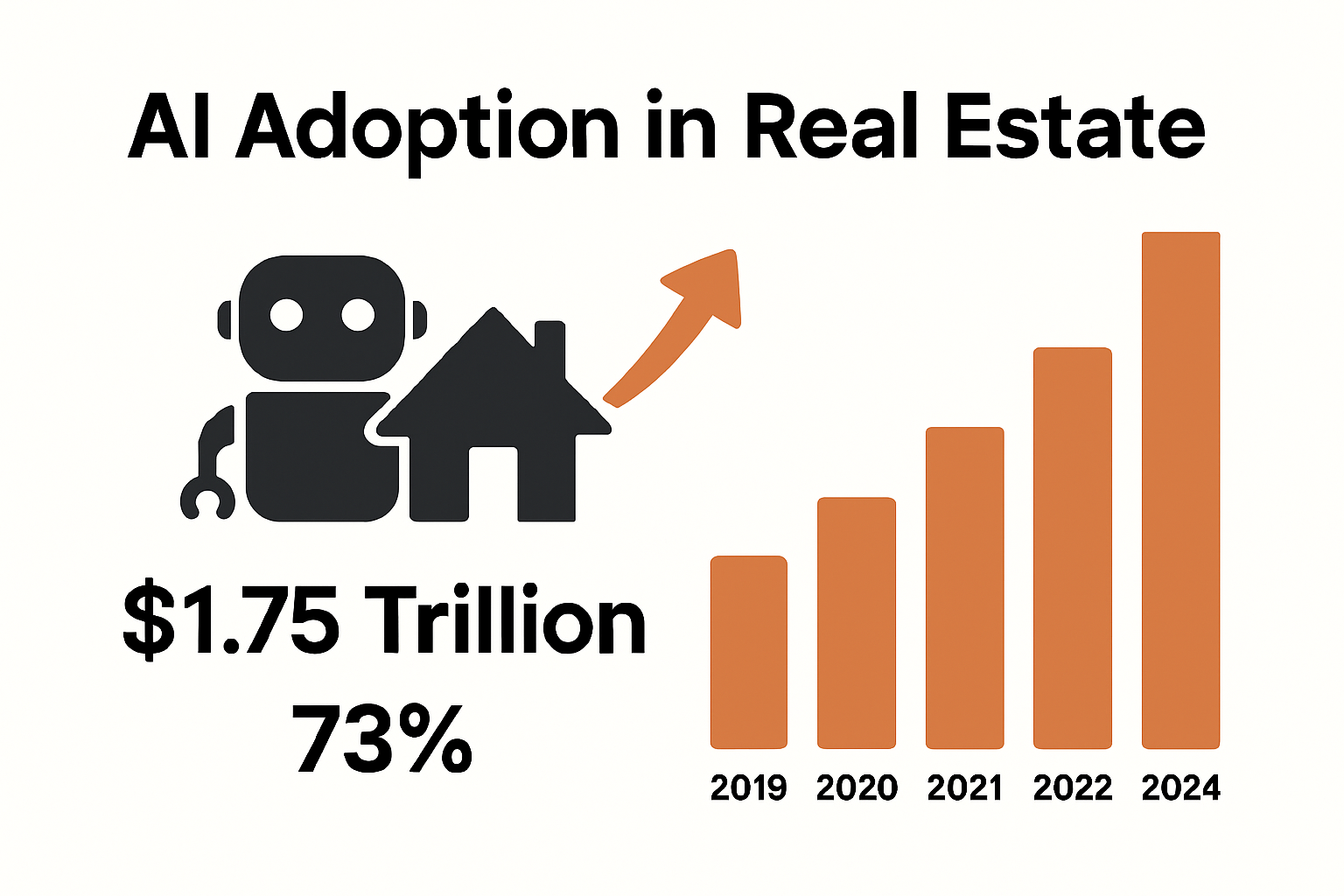
The adoption curve for AI technologies presents a compelling narrative of rapid technological integration. Industry data indicates a substantial increase in AI tool utilization among real estate professionals, with projections showing a dramatic jump from 40% adoption in 2023 to 65% by 2025. These technological adoption patterns suggest a critical inflection point where AI transitions from an innovative option to an essential operational tool for competitive real estate practices.
Key market forecast highlights include:
- Exponential Market Growth: 345% increase in AI market valuation by 2028
- Professional Adoption Rate: 65% of real estate agents expected to use AI tools by 2025
- Technological Investment: Significant capital flowing into AI real estate solutions
- Competitive Differentiation: AI becoming a critical factor in market positioning
- Operational Transformation: Fundamental shifts in service delivery models
- Global Market Expansion: Increasing international interest in AI real estate technologies
Legal Risks And Ethical Considerations
As AI technologies become increasingly embedded in real estate operations, professionals must navigate a complex landscape of legal and ethical challenges that demand rigorous scrutiny and proactive management. Amplify your impact by understanding the critical framework of responsible AI deployment in the real estate sector.
Algorithmic fairness emerges as a paramount concern in AI-driven real estate technologies. Cutting-edge research on AI governance highlights the critical need for transparent decision-making processes that eliminate potential biases in property valuation, client matching, and investment recommendations. The potential for unintentional discrimination through algorithmic processes represents a significant legal and ethical risk that requires comprehensive monitoring and continuous algorithmic auditing.
Advanced AI systems in real estate now possess sophisticated capabilities to detect regulatory inconsistencies and ensure compliance with complex legal frameworks. These intelligent compliance mechanisms can systematically review property listings, verify documentation accuracy, and flag potential regulatory violations, thereby serving as a proactive risk mitigation strategy for real estate professionals.
Key legal and ethical considerations include:
- Bias Detection: Implementing algorithmic fairness protocols
- Data Privacy: Protecting client information and maintaining confidentiality
- Transparency: Ensuring clear explanations of AI-driven decisions
- Consent Management: Obtaining explicit user permissions for data usage
- Accountability: Establishing clear responsibility frameworks for AI actions
- Continuous Auditing: Regular assessment of AI system performance and ethical standards
Best Tools And Agent Strategies
Successful real estate professionals are increasingly leveraging advanced AI technologies to gain a competitive edge in a rapidly evolving market. Lead generation strategies have been dramatically transformed by intelligent tools that streamline client acquisition and engagement processes.
Cutting-edge AI development frameworks are revolutionizing real estate technology implementation. Innovative research demonstrates how platforms like LangChain and Pinecone enable sophisticated AI agents capable of complex interactions, from automated client communications to advanced market analysis. These technological ecosystems provide real estate agents with powerful tools that can process vast amounts of data, generate personalized insights, and automate routine operational tasks with unprecedented precision.
Advanced AI agents offer comprehensive strategies for real estate professionals seeking to optimize their workflows. Emerging AI applications showcase remarkable capabilities in transforming administrative processes, enhancing customer experiences, and providing data-driven decision support. The most effective agents integrate multiple intelligent functionalities, creating a holistic approach to real estate technology implementation.
Key strategies and tools for real estate AI adoption include:
- Predictive Analytics Tools: Advanced market trend forecasting systems
- Conversational AI Platforms: Intelligent client interaction and communication solutions
- Automated Lead Scoring Systems: AI-powered prospect qualification technologies
- Personalized Recommendation Engines: Dynamic property matching algorithms
- Workflow Automation Frameworks: Intelligent task management and scheduling tools
- Comprehensive Data Integration Platforms: Unified intelligence gathering and analysis systems
Unlock Growth with Real Estate AI Agents and Amplify Your Impact Today
The challenge highlighted in the article revolves around real estate professionals striving to integrate AI agents that automate routine tasks, predict market trends, and personalize client interactions while overcoming the complex landscape of adoption and ethical considerations. Real estate agents want to reduce administrative burdens, boost lead qualification efficiency, and deliver highly tailored service to become power brokers in their market. Key pain points include the need for predictive analytics, automated workflows, and seamless communication that drives growth while maintaining trust and compliance.
At ex.plo.re CRM, we understand these challenges and have built a platform that empowers you to harness cutting-edge AI-driven tools without disrupting the workflows you already know. Whether you want to improve your lead generation strategies, streamline your sales cycle, or enhance your client engagement through smart automated communication, our solutions are designed to amplify your impact and grow your business sustainably.
Elevate your game now by integrating advanced AI capabilities like predictive lead scoring and personalized recommendations with our easy-to-use platform.
Discover how to transform your prospecting and sales process into an unstoppable growth engine today.
Drive results with the power of AI agents at your fingertips.
Start your journey with ex.plo.re CRM and become the power broker you aspire to be.
Ready to lead the future of real estate?
Explore real estate AI solutions that work with your strengths and accelerate your growth now.

Frequently Asked Questions
What are real estate AI agents?
Real estate AI agents are advanced digital systems that utilize machine learning, natural language processing, and data analytics to automate tasks traditionally performed by human agents, such as market analysis, client engagement, and initial property transactions.
How do AI agents enhance operational efficiency in real estate?
AI agents automate routine tasks like scheduling, data entry, and client communications, allowing real estate professionals to focus on higher-value activities such as relationship building and strategic negotiations.
What types of AI agents are used in the real estate sector?
The main types of AI agents in real estate include screening agents, recommendation agents, predictive analysis agents, conversational agents, transaction management agents, and market research agents, each serving specific functions within the industry.
What are the key benefits of adopting AI technologies in real estate?
Key benefits include improved predictive analytics, enhanced personalized client interactions, streamlined administrative tasks, real-time market insights, and the ability to make data-driven decisions that can lead to increased growth and competitive advantage.